Showing posts with label iron man. Show all posts

Thursday, June 30, 2011

5 Avengers Who Could Be Great Justice Leaguers

I don’t have to essentially repeat my intro from the other day in reverse, do I? If you haven’t already, go back and read my post on Justice Leaguers who would make great Avengers—or at least the first couple paragraphs—and then come back here.

Done? Ok, let’s rock…

IRON MAN
Yep, right out the gate with a big one, I think Tony Stark and his armored alter ego would be a tremendous asset to the Justice League of America. Iron Man is definitely your classic “feet of clay” Marvel hero rather than your idealized DC type, but if you look at his history, he’s all about rising to both the occasion and the people around him. Tony started out as military contractor, but upon experiencing the horror of war vowed to be better regardless of the personal and financial hits he would take. He may have fought a Civil War against Captain America, but he also has incredible respect for Steve Rogers and has been working overtime to be a hero worthy of standing alongside Cap since he thawed him out of the ice. Being an Avenger has always brought out the best in Iron Man and I believe being part of the Justice League would do the same. Tony Stark is both ultra-competitive and extremely—figuratively—goodhearted. He’d not only want to be on the same level as Superman, he’d want to prove he can be even better; he’d not only need to earn Batman’s respect, he’d have to beat him at being the best billionaire altruist and hero—I bet they’d actually go from a grudging respect to being good friends! He may almost irritatingly competitive, but it comes from a good place, and I believe Iron Man would utilize all his considerable resources to take both himself and the Justice League to untold levels of greatness.

HELLCAT
Nobody ever thought teen model Patsy Walker could make it as a super hero, but she did—she became an Avenger! Ever since, Hellcat has been bucking the odds, whether that means earning her place on a team where Namor was arguably the weakest member, making a marriage with the son of the devil work—temporarily—or coming back from the freaking dead. Bottom line: If you tell Patsy Walker she can’t do something, she will do it. If Patsy lived in the DC Universe, she would march right up to the Hall of Justice or build her own spaceship to fly to the moon and you better believe she would join the Justice League. Hellcat’s just the right amount of sugar and spice to make things interesting for DC’s pantheon of champions. She’s a sweetheart who would probably be a great gal pal to Wonder Woman and Zatanna, make Superman smile and get Batman to loosen up; she’s also as fierce as her namesake and would tell Green Arrow where to stick it, let Plastic Man know to shut it and get Batman to loosen up. Hellcat would be a neat variation on Black Canary—who she’d make a great foil for/confidante to—as an underestimated little lady with the spunk and skills to hang with the big guns.

MONICA RAMBEAU
If there’s one Avenger who doesn’t understand intimidation, it’s Monica Rambeau. She named herself Captain Marvel despite the moniker previously belonging to a legendary universal champion who died surrounded by the great heroes ever and didn’t flinch in trying to live up to it. She joined an Avengers team that included Captain America and Thor and did not just earn her spot but was chosen to be their leader before she’d even really completed her rookie season. Whether as Photon or just herself, she’ll fly into any situation with poise, confidence and skill to ensure the resolution that guarantees the safety of those around her. She has incredible powers that allow her to travel across galaxies in an eye blink or put down the toughest bad guys. There is no quality Monica Rambeau possessed that does not make her an ideal candidate for the Justice League. Picture her and The Flash as two light-fast streaks racing into battle. Imagine what she could do matching energy abilities with Green Lantern. Just think what a master strategist like Batman could do if he knew he had this kind of resource at his disposal. They’d be lucky to have her.

QUASAR
Wendell Vaughn is tagged as a guy with tremendous potential to be a great Avenger, but his sticking point has always been that with his other duties as Protector of the Universe and need to mainly stay in outer space for cosmic adventures, he hasn’t really been able to commit as much time to the team as they’d like. The nice thing about the Justice League is they don’t really mind if you miss a meeting or ten, just so long as you deliver when it counts. Any Green Lantern who has ever been in the League can’t be there all the time because they’ve got a whole sector to patrol, but they make it work. Batman comes and goes as he pleases, but the void gets filled. The Justice League has enough powerhouses that they can afford to be without Quasar one mission and then appreciate his presence the next. Speaking of power, as a member of the recently former Annihilators, Wendell has demonstrated that just as how I described Tony Stark earlier he’s a guy who plays up to the people he’s surrounded by, so being around other super-charged heroes would only raise his game. Quasar’s also just such a nice, even-keeled guy that he’d probably fit in better with the generally harmonious League than the oft-bickering Avengers.

JACK OF HEARTS
Jonathan Hart never really got much of a chance to find his true potential as an Avenger or a hero because his powers were so unstable he had to spend most of his time locked in an isolated room and then when he got out he exploded a lot—right up until his death. The combined brainpower of Hank Pym and Tony Stark couldn’t find a solution to Jack of Hearts’ condition, but for some reason I feel like the DC Universe could. The Justice League is a melting pot of such varied cultures as Kryptonian, Thanagarian and Martian, not to mention the New Gods of New Genesis, all of which have technology even further beyond our imagination than Iron Man’s armor. A city like Metropolis where the future is now doesn’t really exist in the Marvel Universe; the Guardians of the Galaxy don’t visit the present nearly as often as the Legion of Super-Heroes. Bottom line, while the Avengers certainly live in a world where anything is possible, I think the one that surrounds the Justice League is even a bit more far out, and my gut tells me they’d find a way to “cure” Jack of Hearts, who would be so grateful he’d be one of the most committed members their team had ever known.

Sunday, April 24, 2011

Five Comics Worth Reading - April 2011

DETECTIVE COMICS
Following Grant Morrison’s initial foray, I thought perhaps some writers might find it a bit challenging to distinguish the Dick Grayson version of Batman from the Bruce Wayne incarnation beyond the slightly tweaked costume, but for the most part I’ve been pleasantly surprised with how it’s gone down. Dick has been played as the extremely competent hero he was as Nightwing, yet with a higher level of confidence to match his new position and distinctive whimsy to perhaps combat it; few places has this new Batman shined as nicely as in the retooled Detective Comics written by Scott Snyder, which has hit on quite a few cylinders for me. Besides nailing a great protagonist in the Grayson Batman, Snyder has also embraced the book’s title with genuinely compelling—and frankly creepy—mysteries that he layers nicely with a mix of forensics and super hero stuff. Snyder’s secret weapon has also been his nuanced use of Commissioner Gordon, either as the back-up or lately star of the story, giving this stalwart a nice stage to play on and enough moral murkiness to remind you he’s no angel, just the best cop in a bad city. Having the distinctive and striking art of Jock and Francesco Francavilla certainly doesn’t hurt this title’s case either.

INCORRUPTIBLE
Since its inception, Incorruptible has been a fun companion piece to Irredeemable, telling a more lighthearted morality tale off to the side of the rampant tragedy and destruction of the parent book—and seriously, I’m not joking when I say the story about the former super criminal with the underage female sidekick named Jailbait is the “softer” side of the Irredeemable Universe. As Irredeemable has moved towards a broader story and resultantly brought some its characters over into Incorruptible, it has only made the latter title stronger. It’s quite interesting to watch what Mark Waid is doing in contrasting the heroes of Paradigm with their egos and neuroses against the simple single-mindedness of Max Damage, reformed villain; Max may have been a jerk and worse in the past, but he operates on a very simple field of “this is how we fix things” with no room for grandstanding or political posturing, whereas the “good guys” overanalyze their every move because they’re so much more concerned about keeping their images intact. The side stuff where Max is falling for his old archenemy’s girl even as she moves to portray him or putting off dealing with the trauma-fueled psychoses of his new sidekick is good stuff as well, but as ever, I just enjoy reading Mark Waid pick apart the mechanics and dynamics of what’s behind super heroes and villains.

IRON MAN 2.0
Nick Spencer writes comics that I feel like should be too smart for me, but makes sure I get them. With Iron Man 2.0, he’s covering all sorts of political, social and economic issues as he sends War Machine into the government and around the world dealing with conspiracies and WMDs, but even though I’m more or less useless when it comes to any news items not posted on the AOL homepage when I sign in at work every morning, I’m not only getting it, but getting into it, as he’s using these building blocks not to talk down, but to create a world that resonates with stuff really going on and at the same time carves out an interesting corner of the Marvel Universe for his cast to explore. I dig his characterization of James Rhodes—a tougher character to nail down than most people think in my opinion—as a guy committed to his country, more committed to doing the right thing, driven by a sense of duty, but not a total starched shirt as you would imagine years of hanging around Tony Stark would loosen up even the staunchest military man. I like the mix of big explosions with whole issues that are just supporting characters introduced only months ago talking about other characters we’ve never met—and that issue had me riveted! I think Spencer and my buddy editor Alejandro Arbona are dead on with their assessment of War Machine needing to be not just lots of guns, but whatever the next cutting edge way of waging war is; again, it’s a smart book, but not too smart for a dummy like me. And intelligence aside, scenes of Tony and Rhodey talking like kids about their armors as toys are just plain fun.

R.E.B.E.L.S.
I suppose this can be filed under “too little too late” with the book coming to an end next month, but I’ve been meaning for awhile to mention how much I enjoy Tony Bedard and Claude St. Aubin’s take on the cosmic DC Universe. They way Bedard manages a large and eclectic cast, shifting the focus every page or two and keeping things fresh, reminds me of how Paul Levitz and Keith Giffen nailed a somewhat similar premise on Legion of Super-Heroes back in the 80’s, and there are few higher compliments I can give. Bedard has once again made Vril Dox the kind of guy whose arrogance and cleverness I look forward to following—if for no other reason than to see how he’ll cheat his way out of the latest situation his mouth got him into—while on the total other end of the spectrum he writes a great smart ass and crazy Lobo while also finding nice spots for Adam Strange, Starfire, Captain Comet and the rest of DC’s displaced space stars. To St. Aubin’s credit, his clean art does a great job of making the many overlapping plots easy to follow and the action pop off the page. I should also note that their take on Starro creeps me out to no end. Pick this one up in trade!

UNCANNY X-FORCE
It takes talent to mix nostalgia and continuity service with genuinely intelligent stories as well as character-driven development plus throw in a decent amount of shooting and stabbing in one book; fortunately Rick Remender is talented as well as smart with a knack for enjoying his work, so he is more than adept at serving up delicious comics stew with Uncanny X-Force. I can’t say enough good things about this book, one of my top favorites as I tear through my comics. I love Remender’s long game as he’s both playing off existing mythology when it comes to Apocalypse and also building something entirely new. I’m invested in Psylocke’s quest to save Archangel’s soul—and her own. I’m intrigued by what Fantomex is up to and how he interacts with the rest of the team. The different take Remender has on Deadpool from just about anybody else I’ve ever read is fascinating. All that aside, you’ve got Deathlok versions of the Avengers—not to mention Deathlok himself as a supporting cast member—great old school X-Men villains like the Reavers and The Shadow King coming back, and a return trip to the friggin’ Age of Apocalypse; it truly is a perfect storm and I also really appreciate Remender’s commitment to acknowledging that every single this that has happened in past stories did in fact happen and will be addressed. Did I mention the murderer’s row of artistic talent that includes Jerome Opena, Esad Ribic, Mark Brooks, Rafael Albuquerque and Billy Tan not to mention Dean White? There are few comics out there right now I am a bigger fan of—if there are any.

Tuesday, March 22, 2011

Mix & Match Super Villains

It’s no secret that the Eisner Award-winning Invincible Iron Man is a pretty consistently solid comic book (or so the scoreboard would indicate). Matt Fraction’s writing is sharp, Salvador Larroca’s art is slick, my main man Alejandro Arbona edits the heck out of the whole shebang and Tony Stark has become a wonderfully complex and charismatic lead.

So it’s no surprise I dig the book as I do, but even I was a bit taken aback at how much I’m digging the current “Fix Me” arc in which Spider-Man archfoe—revealed to also be a former Stark peer in his younger years—Doctor Octopus is squaring off with Iron Man as he attempts to get Tony to cure his life-threatening physical ailments or at least admit his failure. It’s well-written, well-drawn, all that jazz, but honestly one of the biggest draws for me is simply seeing Doc Ock, generally an Amazing Spider-Man fixture, mixing it up with somebody new (and he brings Sandman and Electro along for the ride to boot).

Heroes trading their villains around is, of course, nothing new and has been going on since at least the Silver Age if not longer (I truthfully do not know if, say, The Red Skull ever appeared in Sub-Mariner during the 40’s or if Golden Age Lex Luthor fought that era’s Batman) and has been a fixture ever since. Particularly in the 90’s, if a villain was popular—Venom is the number one example that jumps to mind—you’d see them everywhere whether it made sense or not (A-listers like The Joker or Doctor Doom aren’t in the discussion here as part of what makes them great is that they can face off with anybody and it works).

In recent years, as restraint has returned to the medium, super villains have tended more or less to find a home title/hero and stick to it, so when something like “Fix Me” occurs it feels a little more special, as I’m sure it did the first time Magneto fought the Avengers back in the 60’s. More than that, though, if you find just that right “I can’t believe I didn’t think of that” pairing, it’s so sweet to see a bad guy out of the element you associate them with, but making such a perfect adversary for their unfamiliar dance partner. No matter how good “Fix Me” ultimately is, I’m sure Doc Ock will remain primarily a Spider-Man baddie simply because there’s such a rich history there, but developing a side feud with Iron Man can only up his profile and make for more great stories. I’m hoping for similar goodness in the just-announced “Storm Hunter” story this summer where Kraven goes after The Black Panther in another matchup that just makes total sense.

Following that train of thought, I wracked my brain for some shuffled hero vs villain showdowns I think have a lot of potential—and by the way, I fully recognize that as much as I know about comics I’ve got decades of continuity working against, thus I’m sure at least one of these has happened already and I look forward to hearing about it in the comments, but that doesn’t mean it can’t be done again and even better.

(Also, I don’t have Photoshop at home, so I’ll assume you all know what the good guys look like and instead display pictures of the baddies)

SUPERMAN VS BANE
First and foremost, Superman always needs more villains he can just get into punching matches with, because the rotation between Metallo, Bizarro and Parasite in between cerebral wars with Lex Luthor and Brainiac gets played pretty quickly. Realistically, maybe Bane isn’t in Superman’s weight class, but then again, neither are a lot of the guys he fights. Besides that, Bane is a lot smarter than your average musclehead (when he’s being written right), as he’s the guy who not only physically dominated Batman, but weaved the psychological web of destruction that allowed that to occur. The optimum time for this to happen would have been right smack dab in the 90’s when Bane could taunt Superman with the “I broke your best friend” card, but done right today, this could bump Bane up a level and give Superman a fresh sparring partner for when you just need an issue of Action Comics full of double page spreads.

THE X-MEN VS THE DEVIANTS
It’s tough coming up with opponents for the X-Men particularly in the here and now as they are literally an army living on their own private sanctuary. However, the Deviants’ numbers dwarf even Cyclops and company, plus they’re an entire race bred more or less to go to war. Really there could be no more perfect threat for the X-Men to play against, as the Deviants are mutants gone down the worst possible scenario and any last remnant of Xavier’s dream torn to shreds: they’re an offshoot of humanity feared for their power, shunned for their differentness and driven to isolate themselves and lash out against the Eternals, Celestials and every either “normal” or “gifted” group that has been able to ascend into the light they’re denied, so of course they would really hate the X-Men. I’d love to see Cyclops’ strategic skills pitted against the likes of Warlord Kro and the X-Men forced to look into the dark mirror of what they could become—and are actually moving closer to if they really take a minute to think about Utopia—in the Deviants.

GREEN ARROW VS CAPTAIN BOOMERANG
Ok, maybe pairing off the two specialized weapons guys is a bit cliché, but just because it’s sensible doesn’t mean it wouldn’t be fun. Awesome arrow vs boomerang dual aside—and once they get to the gimmicks it would be seriously amazing—the personalities would be an interesting mesh as well. Going after Green Arrow would be a sensible move for Boomer, as he’s one of those villains constantly trying to prove he’s better than his reputation and targeting the perceived “weakest” member of the Justice League falls right in line with his character. For Ollie, looking at Boomerang would be—as with a the X-Men/Deviants pairing I just discussed—a glimpse at the road not travelled but that could still be. Digger is a guy who has let arrogance and his vices consume him and lost his family because of it; Ollie isn’t that far off from that. Both guys are arrogant and snarky and would have I suspect a spirited battle of wits, words, fists and projectiles.

SPIDER-MAN VS BATROC
This may be my personal favorite. I have already read the amazing Captain America & Batroc one-shot by Kieron Gillen and Renato Arlem headed to stores this Wednesday, and it only renewed and strengthened my affinity for “Ze Leapair,” a truly fantastic pseudo-villain and just fun character. I’d love to see Batroc gain a higher profile in the Marvel Universe, and Spider-Man is the perfect opponent for him. Captain America and Batroc always have cool dustups, but at his core, my favorite Frenchman is an acrobat, not a scrapper, so Spidey would be a great opponent for him just from a physical and fighting style angle. Batroc is also a guy who leads with his pride, preferring to prove himself against Cap rather than beat him or even pull off the big score and he’s all about the honorable opponent, so you know he and Spider-Man would start off trading barbs, but the Wallcrawler’s ceaseless banter and deprecating sense of humor would ultimately drive him—no pun intended—up the wall. And yet, underneath the surface, Batroc and Spidey actually have more than a little in common: both are underdogs, both seek and generally don’t get respect, and both stand by their morals at the end of the day (seriously, read any good Batroc story and he’s not really a bad guy, more of a thrill junkie and swashbuckler). Put the right artist on this and it would be an instant classic fight sequence, but the correct writer could also forge a cool rivalry/friendship in the end—paging Mr. Gillen and Mr. Arlem!

THE LEGION OF SUPER-HEROES VS BLACK ADAM
Probably the best Legion of Super-Heroes story ever is The Great Darkness Saga, with Darkseid emerging in the future, and a modern highlight of Dan Abnett and Andy Lanning’s run came when Ra’s al Ghul showed up as the out-of-nowhere mastermind trying to take over the United Planets. Long story short: Present day villains are gold in the 30th/31st century. Black Adam is immortal and this could certainly still be around somewhere in a thousand years or so, plus he’s one of the few figures who simply on his own could present a viable physical challenge to a fighting force as vast and diverse as the Legion. I’d love to see Captain Marvel’s toughest opponent lock horns with Mon-El and Ultra Boy, trade sparks with Lightning Lad and Lightning Lass or match magic with The White Witch. Black Adam is an unstoppable force and some of the Legion’s greatest battles have come when they go up against that type of threat; I’d love to see Cosmic Boy or Brainiac 5’s battle strategy, but I’d also like to see what happens when BA shrugs it off and ignites the tempers of Legion hotheads like Wildfire and Timber Wolf, leading to the inevitable dog pile. Throw in Isis and Osiris as well and this is a slobberknocker for the ages for sure.

IRON MAN VS THE LEADER
I’m biting a little on the Iron Man-Doc Ock feud I started the post talking about, but if anything, that story has shown me that Tony Stark up against other smart guys makes for quality stories. For years and years The Leader has been banging his giant head against the wall trying and failing to put mind over muscle against The Hulk, so it would be interesting to see him step up to somebody of his own intellect. Conversely, I don’t think Iron Man has ever gone against anybody with the brain capacity of The Leader, so it would be a different kind of challenge for him than battling The Mandarin or one of his numerous armored rivals. I don’t hate The Leader’s chances here, as a guy who has come within inches of putting The Hulk down despite no physical abilities can surely give Iron Man a run, while Tony would be in the uncomfortable position of not being able to necessarily fall back on his knowledge, having to opt for finesse and firepower instead.

Sunday, October 31, 2010

Ben's Halloween as Tony Stark

I've already seen some pics of Rickey and Kevin's Halloween costumes for this year, both of which were excellent, and if the past is any indication Kiel will top us all, so hopefully all of them will post what they got up to, but I'll start and discuss my adventures as none other than Marvel's own...


...Tony Stark, aka Iron Man!

I fully admit that I stole this idea from roughly two dozen cosplayers I've seen at various conventions over the past two-three years; I figured it would be do-able, but also enough of a challenge that if I did it right, it would look appropriately cool.

The main advantage those dudes had over me was generally natural black hair, so dying that was the first order of business.


Also, as you can see, I snagged some neat accesories, namely the Repulsor Blaster and the Arc Chest Light. I always intended to hit Wal-Mart the night before I needed the costume done and grab whatever was neat and affordable, and I lucked out with these. The Chest Light in particular was a steal as you can clip it on any shirt and I know myself and the gang at Marvel will have fun for months with both gadgets, as they're definitely headed to work with me.

The other thing I didn't have was a goatee, so I grew my stubble out a weak, shaved it like Mr. Downey Jr., then my lovely wife used some black face paint to make sure it didn't look like a 13-year-old boy trying to grow facial hair like usual. I knew from the start that a suit was clutch (tank top wasn't gonna do), so we threw all that together and voila:

Last night I hit my buddy Jordan's Halloween party and had a blast with some friends from college and new folks we've been meeting via him and his wife, Chloe. A very fun group that included another Tony Stark! His costume had a few less bells and whistles than mine, but he did come up with a homemade Arc Reactor glowing from under his shirt by using a glowstick, which I was a bit jealous of. The coolest take away for me me, though, was that there were two guys at one Halloween party dressed as Iron Man in his civilian identity, when only a few years ago most of the general public didn't even know the costumed version--that rocks.


Pictured here from left to right are my friends and I: Taylor as Hunter S. Thompson, Jordan as a Jersey Devil (a devil from the Jersey Shore; pretty clever), Dan as a character from The Town (and he was quite frustrated that I was about the only person who realized who he was) and me.

And then here's me as well as Megan as a Pisces.


Interestingly aside from "Cool costume!" the comments I got the most were "You look great with a goatee--have you thought of growing one for real?" and "You look like David Arquette." On the first, yeah, I've been trying for about a decade; on the second, great, what perfect timing.

Happy Halloween!

Wednesday, September 15, 2010

'Force Works' Was Ahead Of Its Time

Admission: I can't stop reading Force Works comics.


Super serial.

For anyone who doesn't know, Force Works was a Marvel team book published between 1994 and 1996 that was ostensibly a continuation of the publisher's slowly dying Avengers West Coast title with a '90s coat of paint. I'm sure even the most ardent fans don't consider the series much beyond a a footnote in Iron Man history, but the book is kind of notable for being one of the first major American efforts by reigning superhero sci-fi scribes Dan Abnett and Andy Lanning (AKA "DnA").

I don't have a tremendous amount of fanboy nostalgia for the book, though I did initially come to the series as a seventh grader. That Halloween, I went trick or treating at a buddy's neighborhood, and one of the houses there was owned by someone who must've had a comic shop because instead of Snickers or candy corn, they were passing out comics. Once the night ended, a bunch of the kids there passed their comics to me because...well, because I was that kid. So I ended up walking home with a few random things like Malibu's Deep Space Nine series and the first issues of Marvels "Marvel Action Hour" tie-ins, which were 22-page adaptations of the Iron Man and Fantastic Four cartoons in syndication – the former of which inexplicably featured Force Works prominently.

Over the rest of middle school, I watched that TV series (even though it ran at 8:00 AM on Saturday in front of a Canadian "Saved By The Bell" ripoff called "Boogie's Diner") start to finish because...well, because I was that kid too. In the meantime, I picked up a few more issues of the Iron Man Marvel Action Hour comic series – attractive to me as someone who'd never found a jumping on point to Iron Man, plus I liked the art by Anthony Williams – as well as a few scattered issues of Force Works (most memorably the series finale which I got mostly because Andrew Wildman drew it). After that, the team remained largely forgotten.

Earlier this summer, that DisneyXD cable channel started re-airing episodes of the '90s Iron Man 'toon in a little bit of inter-company cross-promotion for "Iron Man 2's" imminent arrival in theaters. When I'm up late transcribing (or writing CKT posts, even!) I end up flipping to DisneyXD's late night superhero marathons whenever MSNBC becomes too depressing, and this was no exception. Combine that confluence of events with a string of conventions this summer where the majority of my brief shopping time was spent diving in dollar bins, and I ended up nabbing a handful of the 22-issue Force Works run on a lark.

I caught up reading those books over the past week, and I'll be damned if DnA didn't turn out a story that while not an awe-inspiring game changer for the superhero genre was strangely prescient considering the trends I see in today's superhero team books. Let me show you what I mean.


1. Force Works Was A High-Concept IP Reinvention

Like I said above, when you get down to brass tacks, the Force Works monthly was a simple rebranding of the failing Avengers West Coast series. The big A franchise was hardly in the shape it is now back in '94 (I'm pretty sure the main title was in the throws of Ben's favorite "bomber jacket" era then), and so it's no surprise that the West Coast title was on its way out after a nice run of 102 issues. What is a bit different for the time was that said team would get a high-concept facelift so soon after its demise, and Force Works was the West Coast Avengers team in everything but its name. It featured most of the same characters (Iron Man, Scarlet Witch, U.S. Agent and, to start, Wonder Man) except that they got a new name, a few costume redesigns and a kitschy new tech-powered HQ.

More importantly, the big hook for the Force Works monthly was that this team wasn't just going to sit there on their laurels and wait for supervillains to attack. They were going to be proactive heroes! Or, as the tagline stated, Force Works was "The Best Defense In An Offensive World." If that hook sounds at all familiar to you, it's because the same essential idea is at the heart of a ton of current or recent hero books including Cry For Justice, JSA All-Stars, Uncanny X-Force, Outsiders and probably a half dozen other books I'm forgetting.

These days, almost every new title launched at either Marvel or DC is a tweak or twist on series or concepts from years past, generally pulled out of the back issue bin either to play on nostalgia for a former success or to polish up a good core idea with a modern allegorical twist. Force Works was both as it spent its first year showcasing how much more bad ass the West Coast cast could be in action by telling stories that allowed its heroes to get fake comic book political by taking on everything from rogue super general in former Soviet block countries to corporate raider revisions of old villains. In that respect, the book feels a lot less '90s than it probably should.


2. The Series Launched With The Death Of A Fan-Favorite Character

If you bought the first issue of that best-selling Busiek/Perez Avengers reboot and thought, "Oh hey, Wonder Man is back as an Ionic energy hero...wait! Wonder Man was dead?!?!?" (and I know some of you thought that), know that Force Works was the final resting place of former Hollywood hero hunk Simon Williams. In fact, our boy bought it straight out in the very first issue after the proactive superteam was (ironically?) caught off-guard by a rogue Kree battle ship that appeared in the skies above earth. To keep said ship from crashing into our planet and taking possibly dozens of people with it, Wonder Man flew it into the stratosphere and E-X-P-L-O-D-E-D.

Do I even need to point out how common this is these days? From ongoing series reboots like the recent killing of Ryan Choi in Titans to the death of Banshee in X-Men: Deadly Genesis and from the big events that kick off with shocking murders including Blue Beetle in Countdown To Infinite Crisis and Bullseye in Shadowland, killing an expendable but known character at the start of a story is now the go-to way to ramp up fan reactions to the book. And just as it went with Wonder Man in Force Works, the message being sent by C-list slaughter is clear: "This shit is fucking SERIOUS, you guys. You HAVE to buy our new book because EVERYTHING YOU THOUGHT YOU KNEW HAS CHANGED."

And in honesty, I'm going to give an edge to DnA and Force Works on this one too. While I know death has never been permanent in superhero comics, it still feels (to me at least) that death had a bit more gravitas attached to it back in the '90s than it did for most of the '00s. Back in the halcyon days of shoulder pads and ammo pouches, when a character like Wonder Man got killed, you had to accept that the creators who pulled the trigger weren't going to go back on that – unlike today when death and resurrection for a hero are planned from page one. In other words, back then you had to wait and see IF Marvel would bring back your fav character fro the grave. Today, you just wait to see WHEN it'll happen.


3. The Support Heroes Mattered Way More Than The Marquee Guys

All right, I know that it's been common knowledge that team books have been able to get more done with B-listers pretty much since Stan Lee introduced "Cap's Kooky Quartet" into Avengers. But even though the best team books hold the honor of kind of making the Hawkeyes and Martian Manhunters of the world feel like they might one day carry a long-running solo series, both Force Works and a number of modern team comics place extra importance on the lives of their marginal cast. And the real reason for this is that writers can fuck up the lives of said cast members.

Over their 22 issues, DnA bolstered the status of perpetual also rans like U.S. Agent and the Julia Carpenter Spider-Woman (who besides juggling an in-headquarters stalker and being a single mom ended up dating a mysterious boyfriend no one remembered appearing late in the series...though that last part was on purpose). But the most important thread in the series revolved around the alien warrior made up of 100 alien warriors' minds Century. The cosmic axe-wielding hero created by the writers specifically to work in the team got a TON of love for a complete unknown including several guest spots in Marvel Comics Presents and his own one-shot, and if I'm reading between the lines right, DnA had plans for Century to not just romance team leader the Scarlet Witch but to have a crazy space battler with her darker half on down the line.

Backstory building like this became more and more relevant as the book went along in a way that reminds me a lot of how Brian Michael Bendis essentially used New Avengers as a backdoor Luke Cage solo series here and there or how Dwayne McDuffie's entire Justice League run where seldom seen minority characters like Vixen, Bronze Tiger and Doctor Light earned more page time and development than anyone even when Superman and Batman were still on the team. In fact, the only time Iron Man – the supposed draw of the book – had a major impact on Force Works was when he was threatening to pull funding like a dad killing your garage band's practice or in one of two crossovers he anchored at the time whose plot threads were resolved in other, more important titles. Which brings me to my final comparison...


4. Ultimately, The Book's Big Plan Got Scuttled Thanks To An Event

Probably the biggest reason why Force Works left so little an impact on the Marvel Universe even for die-hard fans is because the series end dovetailed into an event called "The Crossing." If you've never heard of this story, the basic premise is that Tony Stark is driven insane by Kang (or Immortus? I honestly can't tell the fucking difference) and forced to kill a nanny who lives at Avengers mansion or some shit. In an effort to save the day, the other Avengers pull an alternate reality teen Tony from out of the past to kill the original Iron Man, and that was that. The story was so poorly received it helped convince Marvel to hire two of their biggest competitors to take over the entire Avengers franchise from scratch. So yeah...not good.

"The Crossing" pulled Iron Man out of his own team book for the better part of its second year, meaning that the "proactive heroes" high concept was largely scuttled AND that there was no big name character to help keep fan interest in the title much longer. DnA wrapped the run in the middle of a number of subplots with a story that both tied up threads from "The Crossing" probably no one wanted to have wrapped up and pulled a pretty solid "resurrection of Wonder Man" fakeout (I have no proof, but I'd like to think they did that last one just to stick it to the crybabies).

Once again, it may just be me, but this is a pattern I see repeated a lot in this era of Mobius Strip event comics which leap frog one off the back of the other again and again. From the reality TV reboot of New Warriors made cannon fodder for Civil War to half a dozen (surprisingly successful) attempts to tie Agents of Atlas to Marvel U shakeups via new #1 issues to that other New Warriors book that went from some kind of street-level teen rebellion thing to a mashup of leftover Generation X characters to a part of the Initiative and ultimately to a quiet death, the modern event era is littered with high-concept relaunches of old properties whose shelf life is somewhere between 12 months and whenever the next red sky shows up.

Ultimately, I don't think all these trends hold a lot of baring on whether or not any individual comic series is any good or not. The best creators can find ways to make cool core concepts sing no matter what the circumstances surrounding them. But I do wonder some days how many people are starting to see the reboots, redesigns and retcons of books like Force Works more as clichés rather than as creative realignment. Hell, I'm wondering if I myself can really tell the difference anymore.

Sunday, May 9, 2010

The Appeal of Iron Man

In my view, it’s generally a worthwhile and interesting endeavor to try and figure out what makes any popular comic book (or fictional) character that way, but since he’s currently got a number one movie out and ain’t doing too shabby in the periodicals either, let’s take a look at Iron Man for a bit.

Way back when I was in elementary school, I have a pretty distinct memory of going up to a girl in my class during recess and telling her I was related to Iron Man; now though I do feel I developed the flirting gene earlier than most dudes I grew up with (or at least overcame my “girls are icky” phase far sooner than most), I didn’t do this out of any desire to impress a member of the fairer sex, it was just what seemed to my young mind a cool thing to do. Surprisingly though, the lady in question responded to my revelation with, “Yeah, so am I.”

Was either of us actually related to the fictional Armored Avenger? I can say definitely that I at least am not, but the more interesting thing here is that not just a burgeoning comic geek like myself but also a girl who had little to no interest in super heroes both knew who Iron Man was while still in grade school and thought he was impressive enough to feign familial ties with.

I think Iron Man is a character that appeals very quickly and on a very surface level to children and inner children alike. He’s basically a walking action figure, the type of concept that is like candy coated in crack to a kid, as you can go wild over his accessories and the fact that he’s got different suits for different occasions. I also think the idea of “suit of armor” is just easier for people to wrap their head around than something like telepathy, a healing factor, freeze breath or even super speed (to say nothing of the really complex super powers). And the other nice thing about the abilities Iron Man’s suit afford him are that they’re really only limited by the imagination of the writer and/or fan; you can pretty much take any super power from any other hero—flight, super strength, energy projection, invulnerability, sonic blasts, heat blasts, roller skates, etc.—and graft them all onto Iron Man at once with pretty simple if pseudo-science-packed explanations (but that’s part of the fun).

For whatever reason, I also maintain and will stand by as expertly as a color blind person can that the combination of red and yellow (or “gold”) as a character’s costume is inherently pleasing to the eye, particularly for people just getting into comics. It’s the shading scheme for Iron Man and The Flash, but also figures prominently into the looks of Superman, Robin, Captain Marvel (both of them), Deathlok and so on; red’s a good medium between flashy and subdued and yellow just accentuates it well.

But digging deeper beyond the stuff that make a 10-year-old—or 28-year-old in arrested development—smile, the main under the helmet, Tony Stark, is obviously the biggest component of Iron Man’s continued relevance and success, particularly in cinematic form. I give all the credit in the world to Robert Downey Jr. for making Tony Stark simply magnetic and a star around which a cinematic universe can be anchored, but with respect to RDJ, his major accomplishment has been realizing and “getting” a protagonist who came to him with a boatload of upside and potential, not spinning him out of thin air.

Tony Stark is in his own way as unique and groundbreaking a character in the medium of comics as Peter Parker was in his. Where Peter was among the first (and certainly the most prominent) teenage heroes to actually behave like a real teenager, Tony was perhaps the first flawed hero who didn’t necessarily learn from his mistakes, and he’s been alternately succeeding in and failing to do so ever since.

I know a lot of people—particularly non-comic fans exposed via the movie—dig Tony Stark because he’s both cool and far from perfect, while I know many folks, including some of my closest comic-reading buddies, who can’t stand Tony because he is—for lack of a better way to say it—kind of a douche. Indeed what some people really like about the guy is a part of what other people find off-putting, but this is the risk you run with a character as boldly imperfect as Tony Stark.

Superman is more or less infallible in his drive to do the right thing. Spider-Man was born out of a selfish act but has sought to make up for it ever since. Batman is singularly driven to pursue justice due to personal tragedy and adhered to a strict moral code. These are perhaps the three biggest archetypes in comics—though there are countless exceptions to that rule—and while Iron Man takes pieces from each, he does not fully owe his characterization to any.

Tony Stark experienced personal tragedy when he was abducted and had damage done to his heart. He has spent years trying to replace his legacy as a glorified war profiteer and make up for his past by striving for peace. At his heart, he is a guy who wants to do the right thing.

However, despite being a decent man beneath his layers, Tony Stark remains more often than not selfish, arrogant, cavalier and prone to treating people very poorly. He doesn’t do any of these things out of real malice; he’s just a person with a litany of character defects. Comics in general and the Marvel Universe in particular are littered with these types of heroes, but Tony is something of a rarity in that despite being a genius, he doesn’t always learn from his mistakes.

To put it in another way: if Uncle Ben died on Tony’s watch because of something he did, he’d feel terrible about it and do everything in his considerable power to make right the wrong he was responsible for, but there’s no guarantee he’d be so vigilant as to make sure he didn’t commit the same faux pas again the way Peter Parker always is.

Tony Stark always feels he’s the smartest guy in the room and that his way is the right way, regardless of what people tell him. He showed this decades ago during Armor Wars and that didn’t necessarily work out terribly well for him, and yet despite all that event—and its aftermath—cost him, he still took it upon himself to be the be-all, end-all authority during Civil War and beyond. His reward for that was having to induce his own brain-death and watch Norman Osborn run the country.

Despite that, the next time a similar crisis erupts and a judgment call needs to be made, Tony Stark will most likely once again put it on himself to make that call, not necessarily heeding the judgment of those around him. This is partly out of ego and partly out of impatience, but there’s also a part of Tony Stark that just feels taking on the burden of responsibility is the heroic thing to do.

Like I said, some people I know process all of the last few paragraphs and combined with Tony’s general smarminess do not like the character; I get that and he’s certainly not a character you’d expect to be universally-beloved. On the flip side, I do think most of us can see a lot of ourselves in Tony’s basic behaviors, though it might be tough to recognize at first because we don’t possess the resources or abilities to succeed or fail on the epic level he does. Ultimately though, most of us do tend to believe we are right in most instances, most of us will impose our way if we have a chance rather than take the gamble that somebody else’s will fail, and most of us will make the same mistake more than once before learning not to (if indeed we ever do).

Tony Stark is something of a wish fulfillment character in that he’s wealthy, suave and charming, but he’s not a paragon of virtue in the sense that the aforementioned Superman, Spider-Man, et al. are. He’s a hero to be sure, but he’s far from perfect at it. For some people, that makes him among our favorite characters because he’s relatable to the way we are; for others, that makes him a guy they don’t want to read about because that’s not an aspect of themselves they particularly want to explore in escapist fiction.

Iron Man and Tony Stark each have a great many surface-level qualities that make them appealing that I covered early on and there’s a great deal going on a bit deeper that either adds to or subtracts from that appeal depending on where you fall. That Iron Man is not so much a character that creators, actors, directors, etc. feel needs to appeal to all people at all times both contributes to his unique standing in the pantheon of super heroes and perhaps explains the appeal he does possess best of all.

Tuesday, May 4, 2010

Five Marvel Legends I Want to Own

Last week I rattled off my personal favorites from my current collection of Marvel Legends, but since there are a great many I don’t own—and because it’s never to early to start shopping for my January 24 birthday—here are the five figures I covet most from this line…

HONORABLE MENTION: IRON MAN
The catch here is that for all the success Iron Man has seen over the past couple years, I’ve still yet to find an action figure that captures my idealized version of the character. Some of the more modern armors like the Extremis and movie versions have been captured pretty well, but my Shellhead of choice is the classic 70’s/80’s look with the striped iron underwear and big ass power discs on his hips—that incarnation was actually in the very first series of Legends, and it looks ok, but there’s always been something off about it to me. I kinda want the figure, but I’ve just never been able to take the plunge; woe is me.

HONORABLE MENTION: WEREWOLF BY NIGHT
He only comes in the “Monsters Gift Pack”; already have Dracula (as a Flash), don’t want Frankenstein or Zombie, must have Werewolf.

5. WONDER MAN
I do not know why, but I am captivated by the Marvel Legends Wonder Man figure in a way the character himself has never come close to capturing my attention. So many times I have found him at a convention going for a reasonable price, yet I’ve stopped myself with the rationale of “Surely there’s somebody I’d rather buy than Wonder Man.” Your grip over me is a mystery, Simon Williams, in your wacky wannabe pro wrestler costume with your creepy red eyes and klunky-looking vehicle, but goodness I wish to put you on my shelf. Oh, he also comes with a tiny little Yellowjacket—neat!

4. BLACK BOLT
Putting sentimental favorites like Nova and The Flash aside, Black Bolt probably has my favorite costume in all of super hero comics, for real. I think Jack Kirby was at his zenith in creating the look for the Inhumans and their visual appeal has probably sustained them for years longer than creators have had truly revolutionary ideas for them and inspired those same folks to work harder at keeping them a vital part of the Marvel Universe just so we don’t lose those wonderful designs to limbo. I don’t think it’s possible for Black Bolt not to look awesome with his neat blue/black palette, sharply energetic lines and of course those batwings; the folks who created this figure got everything right when it came to carrying those elements over to a toy.

3. NICK FURY
As TJ noted in the comments of my last Marvel Legends post, Nick Fury is one helluva figure. I think toy designers just like artists probably strive a little harder when rendering Fury so that a guy with no powers and greying temples can hold his own among an army of costumed demigods, but ol’ Nick is also a super spy, meaning he can out-cool most mutants or aliens his own damn self, and the boost just puts him over the top. The bright white belts and pouches stand out in nice contraste to that navy blue S.H.I.E.L.D. jumpsuit, and the jet pack accessory is tough to top, especially with the big ol’ smoke trail that doubles as a stand and provides a great pose. Factor in the perfect eye patch/scowl/cigar combo to polish things off and this guy’s a must-have.

2. CABLE
A glorious by-product of 90’s excess, Cable was more or less born to be an action figure, with his many guns, belts, pouches and other accessories made to order, plus a metal arm and glowing eye that make my inner child want to squeal with delight (which happens…pretty often). I dig that Marvel Legends embraces Cable the way he was meant to be, not going for any of the stripped-down, more streamlined looks he adopted while trying to break out of his comfort zone towards the end of the 20th century, but full bore slapping his gigantic shoulder pads and copious amounts of spare ammo on the figure for maximum awesomeness. There is no figure I have pursued more doggedly than Cable as I would love to have him and Deadpool standing shoulder to shoulder in my collection, but he’s really tough to find and expensive when you do (or was last time I checked), so the search continues.

1. DEATHLOK
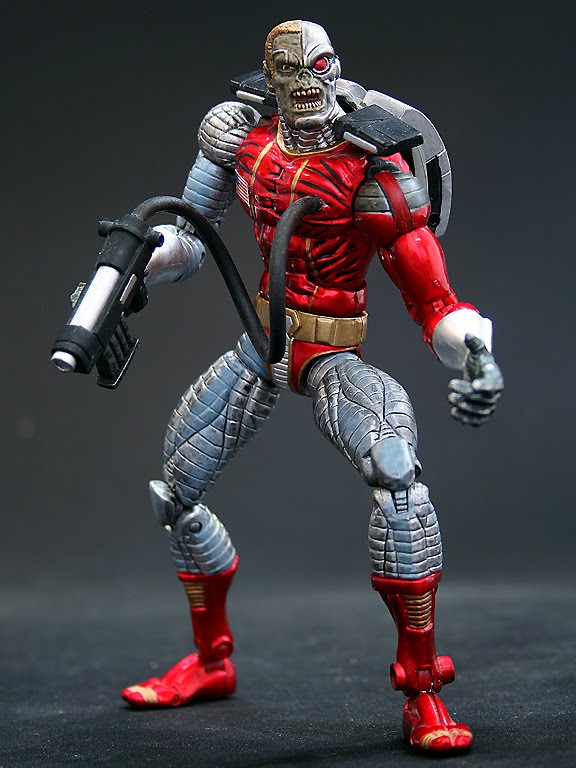
Like Rickey and many other people I know, I’ve got a deep-seeded attachment to Deathlok and get super-excited whenever he shows up in a comic despite not quite understanding why, outside of the fact that he’s a zombie cyborg from the future who I think has tried to kill Captain America once or twice. Actually, Rickey does have some tangible reasons for his Deathlok fandom as I’m sure many of his other devotees like Mike Perkins do as well, but for me it really does come down to the fact that the guy looks like a bad ass to the Nth degree and every time I see his rotted skull and big ass eye I just assume there’s a ballet of violence to come. The Marvel Legend of Deathlok embodies everything I dig about the character, since I really know very little about what makes him tick, but love the fact that he looks like a death metal song come to life, as is made evident with his figure. The toy seems to take elements of the 90’s version I’m more familiar with as far as his costume, mix in some of the original’s facial features, then finish off with a clunky backpack to plug his giant gun into via a tube in his chest—a true recipe for success from where I sit.

Tuesday, January 19, 2010

Hallmarks of the Silver Age part two

Picking up from where we left off...

1963: Iron Man
It’s possible 1963 may have been Marvel’s biggest year of the Silver Age, with Doctor Strange making his debut and both the Avengers and X-Men coming together while the Fantastic Four, Spider-Man, Thor and the Hulk all continued to churn forward, introducing new villains and supporting characters as they went. However, I place Iron Man at the head of the class for this one, and would have done so even without the character’s recent big screen success (though that certainly doesn’t hurt). Just as Thor did with fantasy, Iron Man introduced the realm of technology into super hero comics in a way not done before; yeah, heroes and more often villains often wielded fancy weapons of some sort or another, but Iron Man was really the first high profile comic book character who relied solely on technology to provide him with his “powers,” with invention and innovation playing a huge part in his ongoing adventures. On the human side of the coin, Tony Stark was in many ways Bruce Wayne done over Marvel styles, with the same crazy wealth and playboy persona—though his was not a front—but also with his feet firmly planted in the clay of hubris and the unawareness of the idle rich. Iron Man was a richly flawed character from the start, and he’s never really completely reformed his ways, but he has persevered as a good guy in spite of them, which makes him a compelling character. It’s also worth noting that few tropes in super hero lore have been re-used as often as “guy in a suit of armor,” but not other similar character comes close to Iron Man’s success and popularity.

As a recently enlightened Doctor Strange fan, I was tempted to consider Doc here almost on the strength of Steve Ditko’s visuals alone—coupled with being comics’ most prominent magic-wielder—but like how Thor and Hulk get eclipsed by Spider-Man, so too does Strange by Iron Man. The Avengers was just the Justice Society or Justice League done Marvel style, with all the biggest names coming together, and while it’s proven a vital franchise, there wasn’t much innovation behind it and unlike with the year the JLA was created, there was actual competition here. The idea of misfit heroes embodied by the X-Men and Doom Patrol, both created in this year, took Spider-Man’s plight somewhat to the next level, but the latter have never really managed to hit it big, and the former have succeeded not really in much part due to its original incarnation.

1964: Daredevil
Way before the likes of Frank Miller, Brian Michael Bendis, et al. came along to reinvent him into Marvel’s hard-luck kid and most hardboiled costumed hero, Daredevil was in many ways a sort of second rate Spider-Man, ripping off his counterparts acrobatic moves, witty repartee and other trademark qualities in hopes of lightning striking twice. It was a success in some regard as DD remained a viable star who could support his own ongoing series until the 80’s where his renaissance took place, but he never achieved Spidey’s success, nor could he really be expected to given that he basically inherited all his big brother’s hand-me-downs. However, it’s not like Daredevil just exploded two decades after his creation without there being anything there, as Stan Lee, Bill Everett and their collaborators certainly invented a unique protagonist and took some pretty significant risks in his realization. The idea that a hero with a major handicap like blindness would swim as opposed to sink with an audience chiefly composed of young boys who were highly unlikely to find such a setback sexy or appealing certainly could have been enough to shoot the idea down, but Daredevil’s creators persevered and indeed his unique standing as comics’ first and most well-known blind hero—though not the last—laid the groundwork that gave Miller somewhere to start and that has always set him apart from his contemporaries enough to keep him noticed. Major credit must also go to artist Wally Wood, who created one of the medium’s sleekest, coolest looks by modifying DD’s somewhat gaudy original yellow togs into that slick red costume.

The other most significant creations of 1964 were both villains: Spider-Man’s true archnemesis the Green Goblin, and the Justice League’s evil counterparts the Crime Syndicate; both have endured and made for some excellent stories, but neither rates above Daredevil.

1965: The Inhumans
While both Marvel and DC were thriving in terms of the ongoing adventures of their existing characters, 1965 was a bit of a lean year for new characters in comics. However, I’d tag Stan Lee and Jack Kirby’s introduction of the Inhumans in the pages of the Fantastic Four as being the most noteworthy new arrival. Though nobody has ever found quite the perfect recipe to making the Inhumans true headliners—though Paul Jenkins made a damn good case—so many creators come back to them time and again wanting to give it a shot because the characters possess some intrinsic quality that makes them quite appealing. I’d say a large part of that can be attributed to Kirby doing some of the finest design work of a remarkable career, particularly with Black Bolt, whose costume has few peers when it comes to sheer radness. The bizarre and intriguing mix of personalities and powers within an extended family unit also presents an irresistible hook for fans and inviting challenge to writers and artists.

Speaking of great looks, the bizarre Metamorpho also hit the scene in 1965 and parallels the Inhumans somewhat in terms of being a consistently popular character with both fans and creators who has never really reached that upper echelon. These days Donna Troy is better known as being the greatest symbol of continuity’s potential damage, but years before her first retcon she was significant as the first female sidekick who really stuck.

1966: The Black Panther
This was maybe the toughest call of this little exercise, as three pretty iconic and impressive characters all debuted as part of Stan Lee and Jack Kirby’s ongoing Fantastic Four tour de force in 1966, but at the end of the day, I’ve got to go with the Black Panther. Obviously the major consideration here is that he’s the first African-American hero who really broke through comics’ color barrier and emerged as a legitimate star, but that aside, T’Challa really is a pretty great character on merits aside from that as well. The concept of the warrior king was hardly a new one in either comics or fiction in general by the time Lee and Kirby created the Panther, but I’ve always liked the way they made him a thinker first and fighter second—a trend pretty much every subsequent creator handle the character has continued and improved—who had an edge over opponents who outmatched him based on his ability to keep his cool and strategize. The idea of a technologically-advanced civilization in the middle of Africa may not have been born with Wakanda, but certainly Lee and Kirby gave this particular fictional nation more spark than any others. Ultimately though, great character or not, the Black Panther will always be most remembered for being a trendsetting black character not only due to his coming first (or darn close), but also for the respectability he has garnered.

The other guys I had under consideration for 1966 were the cosmic duo of Galactus and the Silver Surfer, introduced in perhaps the best Lee-Kirby collaboration ever. The Silver Surfer is one of the most incredibly tragic figures in all of comics, Galactus is the amazing realization of two of the medium’s most epic minds working at their biggest scope and both sport, again, great Kirby designs, an had they just been introduced a couple months earlier they would have been shoo-ins; oh well.

1967: Batgirl
While Wonder Woman has always been recognized somewhat de facto as DC’s top female character—and the biggest female character in comics history—I daresay the Barbara Gordon incarnation of Batgirl is not only more affable in many ways, but has also left a more fondly remembered impression on a wider audience (within comics at least; despite Yvonne Craig’s best efforts, she can’t topple Lynda Carter on her best day). At first thought, the idea of a teenage girl slipped into the grim world of Batman may seem an odd fit, and during some periods it would have been, but Barbara came about during the Dark Knight’s more innocent Silver Age days and acclimated perfectly. In the long view though, just as Robin gave Batman a necessary counterbalance to his darkness in the Golden Age, Batgirl added a just as crucial element of renewed enthusiasm as the 60’s began to wind down. With a great costume and that neat link to the civilian side of Gotham as Commissioner Gordon’s daughter, Barbara gained an acceptance among male fans many female characters never enjoy—and was probably the first crush for more than a few—and was certainly also a more than decent role model to young girls with her pluck, independent spirit and ingenuity. Her translation to various forms of multimedia (Alicia Silverstone aside) also demonstrates the character’s enduring value.

1967 also saw Steve Ditko leave the Marvel nest definitively with his creation of The Question perhaps his best-known character from outside the House of Ideas and another chance for him to explore his fascination with the ideals of right and wrong. Vic Sage has become a neat vessel for creators like Denny O’Neil to play with over the years and benefits from strong roots put in place by Ditko.

1968: Franklin Richards
As you’ve no doubt gathered by reading this list (and likely by being a comic book fan), a lot of first took place in the pages of Fantastic Four, including the first time two teammates entered into a lasting marriage, followed in 1968 by the Invisible Girl giving birth to Franklin Richards, the first child of super heroes after a fashion. Certainly Franklin has not always been the most beloved character, but his continued presence (and lack of aging—save for time travel hijinx) in the FF’s world over the last 30 years both speaks to a core of quality and the fact that once again Fantastic Four is not quite like most other comics. Some creators have also done some pretty neat stuff with Franklin over the years—not just in terms of Chris Eliopoulos’ laudable all-ages efforts, but in the Marvel Universe proper as well—including current FF scribe and major Franklin fan Jonathan Hickman.

Two other enduring figures who showed up in Avengers during 1968 were the yin and yang of the Marvel robotic set, Ultron and the Vision, with one becoming an implacable villain who has become only more terrifying with time and the other carving a niche as a unique hero and touching examination of humanity’s nature.

1969: Black Canary
DC wrapped the Silver Age as it had begun it: by taking a Golden Age concept, applying some polish, and creating a new superstar. In this case, the elevation was done in the form of Dinah Laurel Lance, the second and more well-known Black Canary. Though at the time the Canary was thought to simply be the same lady from the 1940’s migrating over from Earth-2 to Earth-1 following the death of her husband, she immediately displayed a new take-charge personality in fitting with the rising feminist movement, and we would learn years later via retcon this was in fact the daughter of the heroine who served in the Justice Society, so we’ll go ahead and recognize her first appearance as being in 1969. Regardless of her origins, the revitalized Black Canary represented a new breed of female characters who didn’t need the powers of Wonder Woman to break out of the role of damsel in distress, and gave the Justice League a feminine counter to the similarly non-powered Batman and Green Arrow. The romance between Arrow and Canary would also quickly become one of the most intense and popular in comics, opening up a whole new world in the 70’s.

Across the street at Marvel, Stan Lee and Gene Colan gave Captain America a new partner who couldn’t be more different from his original teen sidekick Bucky: the street-smart, mature, high-flying Falcon, who also happened to be a black man. Written with a combination of savvy and passion by Lee and successors, Falcon would prove popular enough to share billing with Cap on his series for several years.

Well this was fun and educational for me, so I hope you all dug it—anybody wanna see me tackle the 70’s next?

Saturday, January 2, 2010

Ben's First Minute New Years Comics Spending Guide 2010

Welcome to a new decade, ladies and gents! It may be 2010, but we’re still kids, we’re still cool and this is still our table.

Ugh. That was awful. I apologize.

Let’s forget all that mess and start the New Year off on the right foot with a tradition I started 12 months or so ago: The First Minute Holiday Comics Spending Guide. To sum it up, while other folks give you last minute guides to gifts you can buy for others, I’m lazier, so I provide some of what I thought were comics’ best products in 2009 for you to cash those Amazon and Borders gift cards on.

As always, I begin with the disclaimer that I don’t cover every comic I loved over the last year in this space as it would take several days and blog posts, but this is a nice start.

Onward!

BLACK LIGHTNING YEAR ONE
For my money, Jen Van Meter is one of the most consistently underrated and underutilized super hero comic book writers there is, with a clear understanding of what makes a fun, exciting story and firm grasp on how to get it done. Complementing those skills, Cully Hamner is an artist who has great design chops as well as the ability to make a quiet conversation pop just as well as an electricity-tossing brawl. Combine these two great creators with Black Lightning, a truly unique character who really needed a polish on his origin given the way continuity has played ping pong with his past of late, and you get a hidden gem of a limited series.

THE BOYS: WE GOTTA GO NOW
If you were a fan of Garth Ennis’ perhaps best-loved classic, Preacher, as I was, and don’t check out The Boys regularly for whatever reason, you’re definitely missing out. Boys has that same delightfully naught mix of over-the-top sex and violence with genuine heart and characters who straddle that line between lovable and excessive that Preacher did. This particular collection sees my personal favorite Boy, Wee Hughie, infiltrate an X-Men knock-off team—well, more a New Mutants or X-Force knock-off, as one of the tropes this arc plays with is the proliferation of X-teams—and try to solve a murder mystery while Ennis pokes a healthy bit of fun as the idea of mutants’ “outcast” status making them big-time corporate money-makers. Herogasm, a Boys spin-off mini that came out this year as well, was also a lot of fun, but while the capable John McCrea handles art chores there, few can top the energy of the great Darick Robertson, the regular series artist, when it comes to my personal tastes.

CAPTAIN BRITAIN AND MI13: VAMPIRE STATE
No question that Paul Cornell and Leonard Kirk’s brilliant and bizarre Captain Britain and MI13 series was far too short for this world based on how fun and well-executed it was, but if nothing else the book got an appropriately gonzo send-off with the Vampire State epic. As it has been put more eloquently on other blogs, basically any story that involves Dracula launching vampires at England from missile silos on the moon and then following at their heels in a glorified pirate ship has a lot going for it from minute one. But stripping away the so-crazy-it’s-awesome twists and turns, Cornell is so good with the emotional stuff, from the little beats to the epic romance; the stuff between Cap and Meggan, between Faiza and the Black Knight, between Spitfire and her son, and Pete Wisdom’s whole hero’s journey, all just wonderful stuff. And I’ll go ahead and say perhaps nobody has ever used Blade as uniquely effectively as Cornell and Kirk did in this series. I also dug huge the whole large-scale game of chess Wisdom and friends were waging with Dracula the whole time and how every time the stakes got upped, the counters had to become more clever and unorthodox. Sorely missed, this book.

DEADPOOL: SUICIDE KINGS
No lack of quality material starring the Merc With a Mouth in 2009, the completely unexpected Year of Deadpool, but perhaps the most fun had with Wade Wilson and friends (in his head) came from this little firecracker courtesy of Mike Benson and Carlo Barberi. The big picture stuff of Deadpool getting conned into taking a job that leads to him being framed for killing a bunch of kids because a guy owns Tombstone a gambling debt seems like a lot to swallow, but it’s easy to follow as you go. More importantly, it puts ‘pool at odds with Daredevil, Spider-Man and the Punisher, all of whom Benson instantly nails and creates beautiful chemistry and comedy with. The Deadpool-Spidey banter is top notch and the Punisher-created cliffhanger that ends one chapter is just perfect. At the end of the day though, I’m not a hard man to please; give me Tombstone and Deadpool making self-aware jokes about how crazy it is that he has as many titles as he does and I’m a happy fellow.

EX MACHINA: DIRTY TRICKS
There are certain books I consistently enjoy but don’t mention all that much because they’re so reliably of high quality month in and out that I don’t really have anything to say other than “still great” (Sean T. Collins during our Wizard days would probably have called this the “Brubaker Daredevil Syndrome”). Ex Machina is one of these books. However, I did think the “Dirty Tricks” arc, in which a sexed-up and crazed old groupie of the Great Machine attempts to become a super hero herself and causes Mitch Hundred all sorts of problems was a cut above even the excellent norm; Brian K. Vaughan is always good, and Tony Harris really shines in his design of the would-be super savior.

FABLES: THE DARK AGES
I’ve really been enjoying Fables with a renewed vigor of late, as the conclusion of the years-long war with the Adversary and brassy killing of several main characters has forced writer Bill Willingham to basically reinvent the series in many ways, and he’s taken to the challenge quite nicely. It all started here, with the post-war status quo of Fabletown and its inhabitants getting set up along with the introduction of Mister Dark, a comic book villain who actually creeps me out even when I close the issue I’m reading, so that’s something. Mark Buckingham remains one of comics’ artists most deserving of much more touting and there’s some stuff here with Boy Blue and Rose Red that is simply heartbreaking.

FINAL CRISIS: LEGION OF THREE WORLDS
Technically most of this series came out in 2008, but it wrapped in 2009 and it’s also just soooo pretty. Basically any excuse to see George Perez draw a zillion characters and I’m there, but this also happens to be the Legion of Super-Heroes, among my favorites characters, and is penned by Geoff Johns, one of my favorite writers, so I’m more than there (whatever that is). Kudos to Geoff for crafting a crackerjack cosmic epic here that has some great beneath-the-surface arcs going on, but also not losing sight of the fact that, again, perhaps the book’s biggest draw is the aforementioned Perez drawing a zillion characters, which he cheerfully provides along with all the continuity minutiae and trivia winks a true Legion nerd would ever want. Double kudos to both men for balancing a literal cast of thousands, bringing back two fan favorite characters, disposing of a big-time villain and much much more yet still finding time to give just about every character right down to Gates and Kinetix their moments to shine. And for the record I called the Legion of Earth Prime revelation two or so issues early, so ha!

HOUSE OF MYSTERY: THE SPACE BETWEEN
On a monthly basis, House of Mystery is a great series if for no other reason than you get double bang for your buck, with Matt Sturges’ ongoing story always being supplemented by a short yarn with a talented artist. However, issue #13 broke format (not the last time the book has done so) and presented a series of stories, some with the regular cast and some without, just focused on the number 13 and utilizing the artistic talents of no less than Neal Adams, Eric Powell, Sergio Aragones and Ralph Reese. This is the closing bookend for an arc in which we get to learn more about the intriguing quagmires surrounding our “heroes” and this creepy house they’re all stuck in; House of Mystery is kinda like the “LOST” of comics sometimes, both in its central dilemma and also in its willingness to push boundaries when it comes to neat format experiments.

INCREDIBLE HERCULES: LOVE AND WAR
It’s quite possible that Incredible Hercules is my favorite ongoing comic book being published by anybody at the moment—I’m not sure I could defend that opinion at gunpoint (primarily because I’d be distracted by the gun aimed at me over a really weird question), but it’s possible. Every issue Greg Pak and Fred Van Lente deliver the perfect blend of action, intelligence, humor and pathos as they craft one of the best buddy books ever in this medium starring Herc and Amadeus Cho. However, amidst a sea of killer arcs, “Love and War” may well remain my favorite. No it’s not just because Herc sees Amadeus about to score with an Amazon and gives him the greatest thumbs up and shit-eating grin ever, but if I had to sum it up in a panel that might be it. It’s the playful romance between Herc and Namora, mixed with Amadeus falling in love for the first time, mixed with Namor showing up and being a cock, mixed with the actual throwbacks to Greek mythology that the book does so well, mixed with Clayton Henry’s fun-tastic art, mixed with the big alternate reality brouhaha that ties it all in a bow and so on; it’s all good.

INVINCIBLE IRON MAN: WORLD’S MOST WANTED BOOK 1
Did you like the “Iron Man” movie? Of course you did; everybody did. But dig this: Marvel’s got a monthly comic starring Iron Man where writer Matt Fraction has mastered translating the smarmy brilliance of Robert Downey Jr.’s big-screen turn as Tony Stark and meshing it with all that has come before in terms of the character’s continuity while Salvador Larroca is in top form on art chores. This past year, they put poor Tony on the run as an international fugitive courtesy of Norman Osborn, and this is the beginning of the balls to the wall thrill ride that sees him jumping from armor to armor and getting dumber as time goes on since he’s erasing knowledge from his brain he can’t let the bad guys get their hands on while everybody from Namor to War Machine is chasing him down. Also, after years of being kinda grating, Maria Hill becomes awesome. Tell your friends.

IRREDEEMABLE: VOLUME 1
Yes, the whole “What if Superman were evil?” road has been travelled many times before, but when it’s Mark Waid behind the wheel, you (or at least I) pay attention, because he’s really good at this sort of thing. I’ve been a bit surprised at how invested I’ve gotten in the story of The Plutonian and his rampage against all he once protected and loved, but I guess I really shouldn’t be, given what a Waid mark I’ve always been (see what I did there?). The things that really make the series work I think are how far Waid is really to take things in order to convey how dangerous this guy really is without it ever being cheap or depraved, and also Mark’s real love of Superman shines through in his passion for writing this book. Also, Peter Krause is a solid artist from the Jerry Ordway school of drawing, so that helps quite a bit.

THE MUPPET SHOW COMIC BOOK: MEET THE MUPPETS
I already did a whole post on how much I love this comic, and I feel no real need to add anything other than I got to meet Roger Langridge at San Diego where he did a Nova sketch for me and he’s a lovely man.

RUNAWAYS: HOMESCHOOLING
In their brief tenure on Runaways, Kathryn Immonen and Sara Pichelli really did an incredible job at capturing that lightning in a bottle Brian K. Vaughan and Adrian Alphona harnessed way back when for a terrific little story arc collected here. The voices of the kids really rang true for me as Immonen brought them to life, not just because they resonated with what Vaughan did, but because I could really imagine teenagers in the Runaways’ situation sounding like that, which reminded me how simultaneously horrible and awesome the Runaways’ situation is and why I loved this book to begin with. Pichelli’s art sidles up nicely to this feel of fantastic but real, and I also totally have a crush on her Karolina. The idea of a prom for four people is a great place to start, and then the disasters that follow just spin you for a total loop—in a good way.

SCOTT PILGRIM VS. THE UNIVERSE
The first Scott Pilgrim volume I actually had to wait for (I only read the other four towards the middle of 2008), so it was a different kind of experience, but totally worth it. Unlike the previous Scott Pilgrim joints, I found the fights and craziness to be less the star here, and the growing ennui of Scott and Ramona’s relationship to be more center stage, which intrigued me, as I’m a sucker for a good tale of romance realistically going sour as much as I am fairy tale love stories. Of course the usual Scott Pilgrim video game tropes and general weirdness isn’t traded in the bargain for this renewed focus on a young man whose personal life seems to be stalling out, but I guess I found this to be the most relatable SP yet. And as with every other book in the series, I flipped the last page needing to know what happens next in the worst way, so Bryan Lee O’Malley definitely still knows what he’s doing.

THE UMBRELLA ACADEMY: DALLAS
I did not expect to like the original Umbrella Academy, but I did, so this go-around I wasn’t taken unaware by how rockin’ the sequel was, but it still upped the ante nicely and blew my mind appropriately. I love the wacko layers Gerard Way adds to 00.05 and the funny/sad existence of Spaceboy. All the characters continue to be really well-realized and bizarre while at the same time endearing and the plot spirals all over the place in a finely-planned chaos that spins you round but makes you smile. Gabriel Ba is just a virtuoso on art, so that certainly helps.