Showing posts with label force works. Show all posts

Thursday, September 16, 2010

Where is Force Works now?

If you haven’t read Kiel’s post from yesterday about Force Works and its prescience in terms of comic book trends, I urge you to do so now, as it’s a brilliant piece.

For my part, I figured I’d pitch in by helping flesh out the world Kiel outlined a bit and shed some light on who comprised and what became of Force Works’ semi-sprawling cast. I’m not talking about the core former West Coast Avengers guys like Scarlet Witch, USAgent and Spider-Woman, who most people know their states and whereabouts (batshit in Eastern Europe, new warden of the Raft in Thunderbolts and new Madame Web in the Spider-Verse respectively), or Iron Man, who is in limbo or something, but rather the fairly ambitious and oft-impressive original creations that Dan Abnett and Andy Lanning brought to the table over their 22 issues.

Because seriously, guys? As my good close personal friend TJ loves to say all the time, sometimes Force Works!

CENTURY
Kiel more or less covered Century yesterday and I think he’s got more to say about him yet, but I just wanted to note that every time I ask Dan and/or Andy about why he hasn’t shown up in one of their various cosmic epics, they always look at each other with little grins and give me some joke answer. I totally suspect those boys have at least one big Century story up their British sleeves…

THE SCATTER
Seriously, of the numerous alien races who populate comics, most seem pretty tame, but a few are genuinely creepy, most notably the Brood for me, but also these fuckers. Their deal was that they didn’t just conquer, but would basically descend upon planets that had already been weakened by some sort of previous threat like a swarm of locusts, set up a beachhead, and then just start consuming everything and everybody in sight until they completely hollowed the place out; they were the universe’s ultimate omnivores (besides Galactus, I guess). The grosser thing was that the alien-looking bodies we saw were actually just shells for hives of little insectoid creatures, as Spider-Woman discovered much to her horror. Lotta credit to MIA artist Tom Tenney for making these guys so icky. To the best of my knowledge, their two-issue stint in Force Works was the only time we’ve ever seen them, which seems something of a waste.

EMBER
Another neat DnA idea aided by a terrific Tenney design, Ember was the tribal champion of the Dudak, an oppressed class of people in The Scarlet Witch’s native Slorenia. Interesting twist was that there was really no one Ember, as any Dudak who touched the mystic talisman that empowered the creature became him/her/it. Outside of Force Works, Ember fought War Machine once and then got chumped out by Ultron during the “Ultron Unlimited” story in Avengers by Kurt Busiek and George Perez (I always thought it was kind of cool that Busiek took the time acknowledge a Force Works creation myself).

BLACK BRIGADE
The slightly less interesting but still visually stunning yin to Ember’s yang, Black Brigade was just your run-of-the-mill Russian cyborg who the Slorenian government hired to keep the Dudak people down. His coolest aspect was probably all the little mini-robots he had hovering around him that did his bidding (and gave him the “Brigade” part of his name). Like Ember, he showed up in War Machine and then bought it during “Ultron Unlimited.”

DREAMGUARD
I didn’t actually read the issues where Dreamguard debuted, but from what I remember from solicits and interviews, he was basically an aborigine super hero who jumped into peoples’ consciousnesses via the Australian outback (maybe). He has not shown up again, but he makes frequent appearances in various incarnations of the Marvel Handbook, so clearly he’s got a fan or two.

VOLKHVY
Another Slorenian heavy, this time with mystic powers. He made less of an impact than Ember or Black Brigade and didn’t earn any appearances outside of Force Works, though he did get a solo fight against Spider-Woman (who, believe it or not, won a letters column poll as the most popular member of the team towards the end of the Avengers West Coast run).
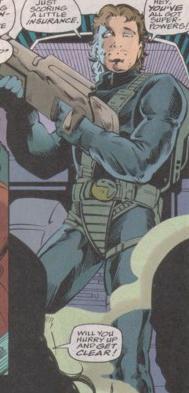
FISHER TODD
The Force Works tech support guy who was in love with Spider-Woman but always kinda came off as a weirdo stalker to me; after Force Works, he was never seen again.

AMANDA CHANEY
The poor PR rep for Force Works who got killed off by crazy Tony Stark during The Crossing because she figured out what he was up to. It’s kind of sad that likely more people remember Iron Man killed Luna’s nanny during that storyline than this lady. I initially suspected she was a spy or something, but if that was in the cards, DnA never got to it.

MOONRAKER
The mystery man who showed up during the early part of The Crossing as a founding member of the team and boyfriend of Spider-Woman as far as all the other characters knew, save for Spi’s daughter Rachel, who suspected something was up with him. He turned out to actually be Libra, founding Zodiac member and father of Mantis, who had altered time in order to thwart his daughter and Kang’s schemes. A few years later, Libra showed up again in Avengers Forever and flatly denied ever having been Moonraker (and made fun of the name); as that series later revealed The Crossing as being a big Immortus scheme with tons of Space Phantoms as doppelgangers of various characters, I’d suspect one of those was Moonraker.

CYBERMANCER
Suzi Endo showed up early on in Force Works during the “Hands of the Mandarin” crossover, appearing just as a scientist specializing in cybernetics at Stark Industries who got injured during an attack by the Mandarin’s Avatars and was later taken in by Iron Man as she recovered. During The Crossing, an alternate reality version of Suzi with super-powered armor named Cybermancer replaced her and worked with evil Iron Man. In the final issue of Force Works, Suzi escaped and defeated her alternate self, destroying the armor in the process. Years later, Cybermancer returned during Civil War, having created her own armor. Since then, she has helped War Machine during and after Secret Invasion plus joined the Iowa Initiative team, making Suzi Endo of all characters the sleeper breakout star of Force Works!

Wednesday, September 15, 2010

'Force Works' Was Ahead Of Its Time

Admission: I can't stop reading Force Works comics.


Super serial.

For anyone who doesn't know, Force Works was a Marvel team book published between 1994 and 1996 that was ostensibly a continuation of the publisher's slowly dying Avengers West Coast title with a '90s coat of paint. I'm sure even the most ardent fans don't consider the series much beyond a a footnote in Iron Man history, but the book is kind of notable for being one of the first major American efforts by reigning superhero sci-fi scribes Dan Abnett and Andy Lanning (AKA "DnA").

I don't have a tremendous amount of fanboy nostalgia for the book, though I did initially come to the series as a seventh grader. That Halloween, I went trick or treating at a buddy's neighborhood, and one of the houses there was owned by someone who must've had a comic shop because instead of Snickers or candy corn, they were passing out comics. Once the night ended, a bunch of the kids there passed their comics to me because...well, because I was that kid. So I ended up walking home with a few random things like Malibu's Deep Space Nine series and the first issues of Marvels "Marvel Action Hour" tie-ins, which were 22-page adaptations of the Iron Man and Fantastic Four cartoons in syndication – the former of which inexplicably featured Force Works prominently.

Over the rest of middle school, I watched that TV series (even though it ran at 8:00 AM on Saturday in front of a Canadian "Saved By The Bell" ripoff called "Boogie's Diner") start to finish because...well, because I was that kid too. In the meantime, I picked up a few more issues of the Iron Man Marvel Action Hour comic series – attractive to me as someone who'd never found a jumping on point to Iron Man, plus I liked the art by Anthony Williams – as well as a few scattered issues of Force Works (most memorably the series finale which I got mostly because Andrew Wildman drew it). After that, the team remained largely forgotten.

Earlier this summer, that DisneyXD cable channel started re-airing episodes of the '90s Iron Man 'toon in a little bit of inter-company cross-promotion for "Iron Man 2's" imminent arrival in theaters. When I'm up late transcribing (or writing CKT posts, even!) I end up flipping to DisneyXD's late night superhero marathons whenever MSNBC becomes too depressing, and this was no exception. Combine that confluence of events with a string of conventions this summer where the majority of my brief shopping time was spent diving in dollar bins, and I ended up nabbing a handful of the 22-issue Force Works run on a lark.

I caught up reading those books over the past week, and I'll be damned if DnA didn't turn out a story that while not an awe-inspiring game changer for the superhero genre was strangely prescient considering the trends I see in today's superhero team books. Let me show you what I mean.


1. Force Works Was A High-Concept IP Reinvention

Like I said above, when you get down to brass tacks, the Force Works monthly was a simple rebranding of the failing Avengers West Coast series. The big A franchise was hardly in the shape it is now back in '94 (I'm pretty sure the main title was in the throws of Ben's favorite "bomber jacket" era then), and so it's no surprise that the West Coast title was on its way out after a nice run of 102 issues. What is a bit different for the time was that said team would get a high-concept facelift so soon after its demise, and Force Works was the West Coast Avengers team in everything but its name. It featured most of the same characters (Iron Man, Scarlet Witch, U.S. Agent and, to start, Wonder Man) except that they got a new name, a few costume redesigns and a kitschy new tech-powered HQ.

More importantly, the big hook for the Force Works monthly was that this team wasn't just going to sit there on their laurels and wait for supervillains to attack. They were going to be proactive heroes! Or, as the tagline stated, Force Works was "The Best Defense In An Offensive World." If that hook sounds at all familiar to you, it's because the same essential idea is at the heart of a ton of current or recent hero books including Cry For Justice, JSA All-Stars, Uncanny X-Force, Outsiders and probably a half dozen other books I'm forgetting.

These days, almost every new title launched at either Marvel or DC is a tweak or twist on series or concepts from years past, generally pulled out of the back issue bin either to play on nostalgia for a former success or to polish up a good core idea with a modern allegorical twist. Force Works was both as it spent its first year showcasing how much more bad ass the West Coast cast could be in action by telling stories that allowed its heroes to get fake comic book political by taking on everything from rogue super general in former Soviet block countries to corporate raider revisions of old villains. In that respect, the book feels a lot less '90s than it probably should.


2. The Series Launched With The Death Of A Fan-Favorite Character

If you bought the first issue of that best-selling Busiek/Perez Avengers reboot and thought, "Oh hey, Wonder Man is back as an Ionic energy hero...wait! Wonder Man was dead?!?!?" (and I know some of you thought that), know that Force Works was the final resting place of former Hollywood hero hunk Simon Williams. In fact, our boy bought it straight out in the very first issue after the proactive superteam was (ironically?) caught off-guard by a rogue Kree battle ship that appeared in the skies above earth. To keep said ship from crashing into our planet and taking possibly dozens of people with it, Wonder Man flew it into the stratosphere and E-X-P-L-O-D-E-D.

Do I even need to point out how common this is these days? From ongoing series reboots like the recent killing of Ryan Choi in Titans to the death of Banshee in X-Men: Deadly Genesis and from the big events that kick off with shocking murders including Blue Beetle in Countdown To Infinite Crisis and Bullseye in Shadowland, killing an expendable but known character at the start of a story is now the go-to way to ramp up fan reactions to the book. And just as it went with Wonder Man in Force Works, the message being sent by C-list slaughter is clear: "This shit is fucking SERIOUS, you guys. You HAVE to buy our new book because EVERYTHING YOU THOUGHT YOU KNEW HAS CHANGED."

And in honesty, I'm going to give an edge to DnA and Force Works on this one too. While I know death has never been permanent in superhero comics, it still feels (to me at least) that death had a bit more gravitas attached to it back in the '90s than it did for most of the '00s. Back in the halcyon days of shoulder pads and ammo pouches, when a character like Wonder Man got killed, you had to accept that the creators who pulled the trigger weren't going to go back on that – unlike today when death and resurrection for a hero are planned from page one. In other words, back then you had to wait and see IF Marvel would bring back your fav character fro the grave. Today, you just wait to see WHEN it'll happen.


3. The Support Heroes Mattered Way More Than The Marquee Guys

All right, I know that it's been common knowledge that team books have been able to get more done with B-listers pretty much since Stan Lee introduced "Cap's Kooky Quartet" into Avengers. But even though the best team books hold the honor of kind of making the Hawkeyes and Martian Manhunters of the world feel like they might one day carry a long-running solo series, both Force Works and a number of modern team comics place extra importance on the lives of their marginal cast. And the real reason for this is that writers can fuck up the lives of said cast members.

Over their 22 issues, DnA bolstered the status of perpetual also rans like U.S. Agent and the Julia Carpenter Spider-Woman (who besides juggling an in-headquarters stalker and being a single mom ended up dating a mysterious boyfriend no one remembered appearing late in the series...though that last part was on purpose). But the most important thread in the series revolved around the alien warrior made up of 100 alien warriors' minds Century. The cosmic axe-wielding hero created by the writers specifically to work in the team got a TON of love for a complete unknown including several guest spots in Marvel Comics Presents and his own one-shot, and if I'm reading between the lines right, DnA had plans for Century to not just romance team leader the Scarlet Witch but to have a crazy space battler with her darker half on down the line.

Backstory building like this became more and more relevant as the book went along in a way that reminds me a lot of how Brian Michael Bendis essentially used New Avengers as a backdoor Luke Cage solo series here and there or how Dwayne McDuffie's entire Justice League run where seldom seen minority characters like Vixen, Bronze Tiger and Doctor Light earned more page time and development than anyone even when Superman and Batman were still on the team. In fact, the only time Iron Man – the supposed draw of the book – had a major impact on Force Works was when he was threatening to pull funding like a dad killing your garage band's practice or in one of two crossovers he anchored at the time whose plot threads were resolved in other, more important titles. Which brings me to my final comparison...


4. Ultimately, The Book's Big Plan Got Scuttled Thanks To An Event

Probably the biggest reason why Force Works left so little an impact on the Marvel Universe even for die-hard fans is because the series end dovetailed into an event called "The Crossing." If you've never heard of this story, the basic premise is that Tony Stark is driven insane by Kang (or Immortus? I honestly can't tell the fucking difference) and forced to kill a nanny who lives at Avengers mansion or some shit. In an effort to save the day, the other Avengers pull an alternate reality teen Tony from out of the past to kill the original Iron Man, and that was that. The story was so poorly received it helped convince Marvel to hire two of their biggest competitors to take over the entire Avengers franchise from scratch. So yeah...not good.

"The Crossing" pulled Iron Man out of his own team book for the better part of its second year, meaning that the "proactive heroes" high concept was largely scuttled AND that there was no big name character to help keep fan interest in the title much longer. DnA wrapped the run in the middle of a number of subplots with a story that both tied up threads from "The Crossing" probably no one wanted to have wrapped up and pulled a pretty solid "resurrection of Wonder Man" fakeout (I have no proof, but I'd like to think they did that last one just to stick it to the crybabies).

Once again, it may just be me, but this is a pattern I see repeated a lot in this era of Mobius Strip event comics which leap frog one off the back of the other again and again. From the reality TV reboot of New Warriors made cannon fodder for Civil War to half a dozen (surprisingly successful) attempts to tie Agents of Atlas to Marvel U shakeups via new #1 issues to that other New Warriors book that went from some kind of street-level teen rebellion thing to a mashup of leftover Generation X characters to a part of the Initiative and ultimately to a quiet death, the modern event era is littered with high-concept relaunches of old properties whose shelf life is somewhere between 12 months and whenever the next red sky shows up.

Ultimately, I don't think all these trends hold a lot of baring on whether or not any individual comic series is any good or not. The best creators can find ways to make cool core concepts sing no matter what the circumstances surrounding them. But I do wonder some days how many people are starting to see the reboots, redesigns and retcons of books like Force Works more as clichés rather than as creative realignment. Hell, I'm wondering if I myself can really tell the difference anymore.