Showing posts with label flash. Show all posts

Thursday, March 7, 2013

Emerald City Comic Con 2013: What I Got

Real talk: Emerald City Comic Con was an amazingly fun show. I feel like every time I go to a show I really love, I end up saying "This was the best show I've been to in ages," but this really was the best show I've been to in ages. I already went on a Twitter rampage talking about all the amazing people I got to catch up with, but I'd also be remiss if I didn't run down all the amazing comics I picked up.

Unlike so many media-focused cons that exist these days on the scene, there were no annoying people hocking mashmallow guns or Ugly Dollz or wrestler's autographs on the floor at ECCC. There were just rows and rows and rows of comic publishers, retailers and artists plying their wares. Since I'm contractually obligated by Uncle Money Bags to spend most of my time in panel rooms typing quotes, I didn't get to spend nearly as much time on the floor buying from people (artist's in particular) as I would have liked, but I did get some primo stuff from retailers that I'm excited to show off.

 The Steranko History of Comics, Vol. 1
With absolutely no embellishment, I can say that I've been looking to buy this book for a decade. Probably more than that. Jim Steranko's self-published history of the medium never got past two issues on its proposed six-issue run, but the volumes he did complete loom large amongst comic history nerds like myself.

I spotted this gem sticking up in a gathering of mid-70s Marvel treasury magazines, and immediately asked the vendor how much he wanted for it. It was a steal at $10, but I almost didn't get away with the book because when I handed duder the money, he stopped for a moment, looked at the cover with mournful eyes and went, "Can I just flip through it one more time?"

The guy proceeded to pour over page-after-page for about ten minutes, pointing out to me which Golden Age splash pages and Jack Kirby pencil recreations he scanned to make t-shirts with when he was younger. I can't laugh at him for this reaction. I'll likely be doing the same with some young turk in 2053.

 Palooka-Ville #s 10, 11 & 12

For years when I was a teenager, Seth's iconic series was one of my perpetual holy grail purchases at any con I attended, and I'd often only find a scattershot issue here or there. I think it took me two years to assemble the entire Kalo saga (he'd probably balk at my calling it that) in one place.

Today, I own all the material in these tree issue as reprinted in the Clyde Fans Vol. 1 collection, but I couldn't pass up the opportunity to snap these bad boys up for a quarter a piece!

Helheim #1, Fatherhood #1 & The Sands #1
Considering my job, I should probably come home from cons with a lot more new releases from publishers and creators alike, but as it stands, most of my purchasing of new books happens at Challengers. Still, I was very excited to pick up a copy of Cullen Bunn and Joelle Jones' new Oni series Helheim as I feel both creators have done their strongest work at the publisher. And Fatherhood was an ECCC print debut from writer Ryan K. Lindsay who I've gotten to know online as an infrequent CBR contributor (fun fact: I had no idea he was Australian until I heard him speak!). Thinking picking up books like these will be my #1 goal come WonderCon.

Meanwhile, I'm ashamed to admit that I'm just getting to know Tom Hart's work after picking up the amazing Daddy Lightning last year from Box Brown, so I was very happy to find some of Tom's early work at a steal.

Darkstars #s 4, 7 & 8
All Travis Charest art is worth owning, even early "Jim Lee clone" era Charest work. In fact, I'ma go ahead and call early Charest the greatest Jim Lee clone that ever lived. Thank God he outgrew that, but I still have a soft spot for this series in my heart after seeing its covers in DC house ads when I was young, being blown away by them and then never being able to find the book in my LCS.


Critters #s 2, 4, 6, 7 & 37 and A*K*Q*J #1
I've always been curious about the early funny animal comics put together by Fantagraphics' Kim Thompson (who we just learned has lung cancer. All thoughts and prayers for a strong recover, Kim. We need you), so it was great to find so many issues of Critters and related books in a quarter bin. Not only does the series feature some of Stan Sakai's earliest Usagi Yojimbo material, it also has some dynamite cartooning from the likes of Sam Kieth and people heretofore unknown to me like Mike Kazaleh. But maybe the artist I'm most excited to get to know better is Danish cartoonist Freddy Milton, whose Thompson-translated strips channel Carl Barks without being part of Disney's universe/corporate control. Why in God's name don't more people do stuff like that?

The Flash #347
For the past five years or so, I've been absentmindedly picking up issues of "The Trial" – the epic/lamented/seminal Flash story that brought Barry Allen's original run towards its final days. I can't honestly tell what most people think about the quality of this story overall, but I'm looking forward to chewing on my own opinions of it now that I've got this final chapter in hand. I do know for sure that I LOVE me some later Carmine Infantino work. The thin geometric lines he uses on everything including people's hair just does it for me, man.

Friday, May 18, 2012

Radical Comic Book Magazines: Hero Illustrated's 'Comic Book Who's Who' (1994)

[Yo, I really love magazines about comic books. Sadly, there aren't too many made anymore. But lucky for you, I have a ton of good ones in my basement. Here's one I found recently.]

Comic Book Who's Who
August, 1994
Published By: Warrior Publications/Hero Illustrated/Steve Harris
Editor: Mike Stokes
Assistant Editor: Joe Fielder
Contributing Editor: John Benton, Steve Spaulding, Fank Kurtz, Steve Darnall
$3.95 for 98 pages

I know one of the reasons (okay THE reason) that magazines are dying is that everything is easier and cheaper to find on the internet today. But I've always preferred magazines to spending all day on the web not because I'm some crusty old paper fetishist, but because frequently the money and monthly schedule behind a magazine's production affords for longer, more in depth writing. Hero Illustrated's Comic Book Who's Who contains no such writing. But still! The character dossier kinds of features that make up this volume are something I still think can be super fun in magazine form, particularly for younger readers. It's no wonder Disney magazines have started a new regular Marvel Super Heroes effort to present this kind of stuff to ten-year-olds in supermarkets across America. Yeah, those kids could find all the info on Wikipedia if they were so inclined, but a magazines like this can expose its readers to a ton of stuff they'd never go searching for. They're designy little gateway into comics radness. I know that's what this was for me.

I have very little memory of the monthly Hero Illustrated from when I was a young comic reader. Back then I thought of it as a less popular version of Wizard, and that's probably the best way to describe it today. I mean, I don't know what it's editorial voice was like, but how different could all the superhero-focused magazines that specialized in the "hotness" of the mid '90s comic market be?

Like Wizard, this collection places a premium on the kewl new characters and armored up reimaginings that were chromium-covering their way to speculator sales. If a hero had ever been a big seller, been killed and resurrected or launched with a #0 issue with a die-cut cover, they were featured here. And the basic format covered a lot of ground that was of interest to 13-year-old Kiel.

For example, I'd just started reading Mark Waid and Mike Weiringo's great Flash series before buying this mag (I actually picked up #92 at the grocery story). So for a chunk of time, these two pages became my bible for searching for the right back issues or just understanding the significance of parts of the character's history. The magazine definitely fed my habit on, so mission accomplished there, I guess.

But at the same time, this thing got pretty deep into the range of stuff published in the '90s and shined a spotlight on a lot of books that I'd heard of but was never able to buy in those days of month-old back issues priced at $20-plus. The Who's Who was the first place I saw the original comics of The Crow and The Mask, both of which seemed so much more illicit than their movie counterparts had (in particular, I spent weeks copying John Arcudi's blood soaked version of the Mask in preference to Jim Carey's sanitized cartoon character). It was the first place I heard about of lot of the weird off-color characters that have only ever been able to find a place in the world of comics (Megaton Man, Evil Ernie, Vampirella) and a slate of honestly cool comics that I wouldn't have picked up to flip through on my own (Madman, The Sandman, The Spirit!).

Even more importantly, the visual spotlight each feature put on the characters creators had me thinking in real direct terms about who it was that made these comics. Reading this magazine was the first time I really realized just how much Stan Lee and Jack Kirby had actually made as a team, the first time I saw photos of guys like Walt Simonson, Frank Miller and Neil Gaiman (in the leather jacket and sun glasses, natch) and the first time I'd ever really considered what kind of aesthetic difference there was in even genre comics that were creator-owned (outside the "seemed very much like Marvel and DC" Image books).

Best of all, some of the weird combination of creator, art and vague yet hyped up story points sent me out in search of the comics being summarized just to prove to myself that they existed somewhere else in the world. Case in point:

You guys have no idea how long I searched to get the Grendel comics these two pages described. The way even that tiny timeline on the side of the page is written makes it sound as though the story of Hunter Rose Vs. the Wolf Argent is a massive, sprawling killer crime epic and not a few random stories that Matt Wagner eventually condensed into one freaking volume. I bought Grendel comics for years after this magazine came out only to go back to the long boxes confused but wanting more. By the time I did get my hands on a copy of Grendel: Devil By The Deed over a decade later, I felt like I'd found the Ark of the Fucking Covenant.

When I stumbled upon this Who's Who a while ago, I was also struck by what a great little time capsule it was to the better parts of the '90s. I mean, everyone who's been following the business of comics for years knows about the worst associations made to the comics and practices of that decade. But as a kid who was reading then, there was this palpable excitement about reading and buying these stories. This magazine is so fucking pumped to tell you about Badrock, y'all!! And Firearm and Pitt and Breed and Black and White (that's who's on the cover)! People were ecstatic to be making and buying comics then, even if it was just for the quick money, and that sheer enthusiasm reads through.

And I just love the historical oddity of a Hellboy feature that was cut to one page because in 1994, Hellboy was a character who had starred in one mini series co-written by John Byrne:

But still, Mignola's single drawing of that character pulled me in. And come on, "Likes: John Steinbeck, Tom Waits...Dislikes: Cannibalism, Nazis." SOLD, BRO!

On the other hand, this mag features profiles that just scream the '90s in the most ridiculous way:

Who is DEATHGRIP?!?!? I'll tell you who he is. He's a character who only appeared three times to the best of my Googling knowledge: once in an anthology comic whose cover was a purple logo printed four times, once on a "Comic FutureStars" trading card and once in this magazine.

But ultimately, the real reason I think of this magazine fondly is because it served as a bridge for teenage me away from being a kid who thought of himself as a comic collector and into one who was just a comic reader. And that's came from features in Hero Illustrated's Comic Book Who's Who like this one:

I didn't know counterculture from cable TV back then, but even the plaid backdrop for these pages yelled out at me that whatever this comic was, it was something really different. It was a beyond the 50 neon bodybuilders that came before it. I remember reading the bios for Maggie and Hopey and thinking "Why are they labeled 'Heroes'? They look like real people." I wanted to know why two best friends were listed as living on opposite sides of the country from each other. I wanted to step into this world. This radical comic book magazine put me on a collision course with Jaime Hernandez, so I really can't bag on the '90s that much. Especially when it gave me stuff like this:

Monday, November 28, 2011

Five Comics Worth Reading - November 2011

ANGEL & FAITH
There’s a longer post to be written about this, I’m sure, but while I recognize that pound-for-pound Buffy the Vampire Slayer is a stronger TV series than Angel was, I always had a soft spot for the latter, often over the former, probably in large part because I watched both when I was in college, so supernatural aspects aside the “brooding young man with an old soul striking out in the world” motif resonated more with me at the time than “young girl and her friends finding themselves post-high school” for whatever reason (don’t get me wrong, I loved both). Now, once again, while I dig the Buffy Season Nine comic, I think I’m enjoying Angel & Faith that much more, not just because one has a prominent male protagonist though, it’s just well-done and exploring fresh ground. Aside from his Angelus periods, Angel has always been the stoic mentor, from his earliest appearance on Buffy guiding her into the world she’s embracing to leading his team on his own show, only really losing that control when he goes full evil. Conversely, Faith has always been the protégé in need of redemption, whether from Buffy, Giles or Angel himself. Here, Christos Gage is establishing a new dynamic where a reluctantly responsible Faith must look out not only for a band of neophyte slayers, but a penitent Angel, who is not just heaping his usual self guilt on for recent actions, but getting reckless without turning bad in his desperation to make things right. The plot is tight, but it’s getting to see both leads so out of their comfort zones and the characterization gold Gage is skillfully mining that makes this book tick. Rebekah Isaacs is also doing a slick job on art, walking that line between depicting characters with real life counterparts and finding ways to still own them yourselves.

BATMAN
This is probably the most dense comic I pick up, and I mean that as a total compliment. Some books I breeze through, but not Scott Snyder and Greg Capullo’s Batman, which I need to really pore over to appreciate every detail and development. The fact is, Batman has been around going on seven or eight decades now, and I don’t have much interest in most stories directly tackling his mindset or stuff of that nature because they’ve all been done to some extent. What does get me going is what Snyder is doing, and that’s focusing on the mythology of Gotham City or the Wayne legacy, making Batman the explorer rather than the discovery and in the process adding layers to the character as he builds the world around him. Snyder’s enthusiasm for the minutiae of detective work, forensics, or even architecture make the stories pop as it really is an almost interactive adventure you can follow rather than just having to be a passive observer of guys in spandex kicking and punching (though there is that too). He’s doing a nice job integrating the various generations of supporting cast as well as adding his own creations, again making Gotham feel like a living and evolving organism. I was a big mark for Capullo’s X-Force as a kid, so it’s cool to see him back with quite a few years experience and refinement under his belt knocking out dark, beautiful work that also has some nice bounce to it.

THE FLASH
I may have to rethink my top five Flash artists, because honestly, few people have ever captured the pure energy of the concept in my mind like Francis Manapul has. Other guys may have conveyed speed better or drawn better figures and fight scenes, but I can’t think of anybody whose work at its essence feels like it is the burst of light, movement and pure joy I think of better than Manapul and Steve Buccalleto’s. The innovation and verve they bring to the visual aspect of The Flash undeniable, but as anybody who has read this blog for a little while knows, the real challenge is getting me to even tolerate Barry Allen; well, I’m still not the guy’s biggest supporter and can argue why he shouldn’t be wearing the red and yellow with the best of them, but I’m slowly coming around to some degree. I believe few characters have benefitted from the DC re-launch quite like Barry, as the removal of his Crisis sacrifice status as well as the Silver Age albatross of moral boredom goes a ways toward giving him a shot at being a likable protagonist. Right now, Manapul and Buccaletto’s art is so strong and their story hooks have enough pop that I’m going to try to like Barry Allen—I can give few higher compliments.

MAGNETO: NOT A HERO
There are few characters in comics more interesting and complex than Magneto. His actions make him an ostensible villain, but it’s hard to argue with his justification. At his best, he invokes conflict in readers where you’re torn between rooting against his evil plots but for his gaining vengeance for past atrocities. At his best he is also more charismatic than brutal as far as “bad guys” go; you perhaps want him to reform—and are disappointed when he ultimately can’t—but there’s also that part of you that enjoys his wicked streak. Skottie Young—best known for his exquisite art but rocking his writing muscles here—captures all of this, every last bit, in this series. He gives you Magneto the philosopher, arguing his case for why any means really are necessary, but also throws enough cold inhumanity behind those words that you question your support almost immediately. He plays with the idea of the character’s reformation, both how possible it is and even if it’s necessarily right or needed. He explores all sides of Magneto, from the ruthless and violent crusader who tears through human lives to the eyebrow-raising rogue who mocks Iron Man’s rubber suit of armor. It’s a fascinating character study from start to finish just in issue one, but there’s also great action, an intriguing mystery and skillful use of continuity and the concept of the shared universe; again, for a guy who has made most of his name drawing beautiful pictures, Skottie Young has incredible skill and finesse as a writer. He also doesn’t need to fret over the visuals for this book, as Clay Mann turns in his finest work to date; as my friend and co-worker Ryan noted, the level of detail he puts just into one of Magneto’s boots blows you away to the point where when you get the full figure it’s just something else.

SIX GUNS
Whereas once upon a time young Ben Morse could not stand for any other genres to get mixed in with his super hero comics the same way he freaked out if a mushroom found its way into his soup, I’ve matured and reversed my position on both, allowing me to enjoy my wife’s delicious fried mushrooms as well as a great books like Six Guns. This series isn’t just a Western done in modern times or within a world with guys who can fly, it’s a mash-up of a noir story, a crime procedural, a mystery and straight action with the sensibilities of cowboy lore driving it. It reminds me a little bit of 100 Bullets in some regards—high praise—but with its own distinctive flavor to be sure. Andy Diggle is a master of taking tropes like sci fi or Western and knowing not only where to take a sharp turn in a new direction but also where to not fix what ain’t broke; Six Guns delivers fun stuff you’d expect from a story about cowboys, bikers and other thugs trying to out-tough one another, but it’s also smart in where it diverges. There are only the most tangential ties to the Marvel Universe in the form of the female Tarantula being a player and somebody who would seem to be a modern Two-Gun Kid showing up at the end of issue #2, but it’s enough to give a cool edge for a fan. Davide Gianfelice is in the zone on art and this certainly seems like the stuff he was born to draw. He’s seamless when it comes to bad looking dudes, hot ladies, nice bikes and dirty action—everything a book like this needs.

Friday, October 28, 2011

How to make a Flash Halloween costume

If I did it when I was seven, you can do it too! Here we go...

1. Get a pair of red sweatpants or pajama bottoms.
2. Get a long sleeve red shirt.
2a. If you can, use a pair of red pajamas, preferably a onesie, but a two-piece can work. If it's got footies, bonus.
2b. No footie pajamas? Locate a pair of yellow rain boots (or just wear your sneakers).
3. Grab some paper, cut out a white circle; color a lightning bolt in yellow--or use yellow paper--cut that out and then glue it on the circle. Use staples, tape, glue, whatever you prefer to adhere the symbol to your chest.
4. The secret weapon: A red swim cap.
5. Cut a domino mask out of red paper and either tuck it in under the cap or cut holes on the sides and run a rubber band or string through to hold it on your face.
6. Take some yellow pipe cleaners you can make little wings out of and stick them behind your ears.
7. Take remaining yellow pipe cleaner and make a "belt" that you can stick by your method of choice to the waist.
8. Voila!

NOTE: I did not make this costume for Halloween, I was just bored.

Be safe out there and have fun!

Friday, July 29, 2011

I found a Barry Allen story I liked

On my plane ride back from Comic-Con International in San Diego on Sunday night, I re-read Mark Waid, Brian Augustyn and Mark Waid’s 12-issue JLA: Year One from 1998 in its entirety. It’s not the first time I’ve done this; JLA: Year One is one of my favorite trades I own and a story I like to revisit at least once a year for various reasons.

First, it’s wonderfully written as Waid doesn’t just turn in great work per usual, but is wonderfully complimented by Augustyn, who also helped steer his awesome Flash run as both an editor and co-writer. You won’t find many stories that better balance varied action with heartfelt character development while also throwing in resolutions and twists both clever and perfectly “comic book-y” in their fun goofiness.

Second, it’s Barry Kitson at his finest, and that’s saying a lot as I love Barry Kitson. He’s an artist who seems equally comfortable with Silver Age square-chinned heroism and bizarre sci fi flourishes as he is with modern dynamic storytelling and effects, so he’s the ideal choice to bring the tales of the original Justice League from the 1960’s into the present.

(At this point I guess I should note that JLA: Year One is the then-definitive and expanded telling of the Justice League’s first 12 months together with the post-Crisis On Infinite Earths, pre-Infinite Crisis/Final Crisis/New 52 continuity of Black Canary replacing Wonder Woman as a founding member as well as Superman and Batman’s roles having been minimized)

Third, it’s a giant Easter Egg fest with all my favorites from around the DC Universe dropping by in guest roles or cameos so Kitson can draw them, Waid and Augustyn can shoot them some dialogue, and you can get a sense where everything fits. The Justice Society, Superman, Doom Patrol and Green Arrow all get significant screen time—particularly the DP in an awesome two-parter—but there’s also nice bits for everybody from Batman to the original Blue Beetle, plus a funny little subplot with the Blackhawks and little in-jokes involving Ted Kord, Maxwell Lord and others.

Fourth and foremost (so I guess it should have been first), I love stories about super heroes coming together as allies and becoming friends along the way, putting the concept of a shared universe to full use. The five member JLA—Aquaman, Black Canary, Flash, Green Lantern and Martian Manhunter—start the series as tentative associates, but have their bonds forged, tested, broken and solidified several times over. I’ve always had a soft spot for team books in comics because I love camaraderie, and I’m a sucker for series like this or Joe Casey and Scott Kolins’ Avengers: Earth’s Mightiest Heroes where they take legendary groups that initially had pretty cut and dry “we’re teaming up to fight” origins back in the day and inject some heart and pathos.

However, this time around, I discovered yet another reason this is a great piece of work: It made me really like Barry Allen.

I think my negative feelings toward Barry Allen have become exaggerated over time, both by myself and others. I don’t hate Barry Allen, he’s just obviously not my Flash and as such I’m somewhat predisposed to look at him a bit negatively. I’m not against Barry Allen so much as I’m against anything that prevents Wally West from being the A-1 Fastest Man Alive and thus his flaws stand out to me.

My biggest knocks against Barry have always been that he was kind of bland and his heyday and also that his death was an amazing story but one that rendered him such an untouchable beacon of heroism that as a living character he becomes tough to relate to.

The first note is really a product of the period he was created in more than anything else; as the very first major hero of the Silver Age, Barry predated the more three-dimensional characters that would fill the next couple decades and thus emerged as a weird hybrid of stoic Golden Age champion and nerdy 50’s era science protagonist. He remained this way up through the 80’s and then missed out on getting reinvented the way most of his contemporaries did because he was the big Crisis sacrifice. Geoff Johns has already made inroads in updating Barry with a personality more compelling to a modern reader, but he had an uphill battle; I’m actually thinking the upcoming reboot will helps Barry perhaps more than many as being a couple years younger and having a cleaner slate could really benefit his development.

Then there’s that big Crisis sacrifice I mentioned. Barry Allen literally gave his life to save the multiverse by running so fast he destroyed the Anti-Monitor’s big ass weapon. You can’t really top that as a final act. He was perfectly cast from that point forward as the patron saint of the DC Universe; the role model Wally West can never really live up to and the hero of heroes everybody else speaks of in glowing reverential tones. It’s hard to pull a guy like that down from the heavens and have everybody treat him as just a dude again.

But in JLA: Year One, Barry Allen is years away from saving the multiverse and also anything but bland.

The cast in JLA: Year One is roughly analogous to the cast of a high school movie/TV show; Green Lantern is the cocky jock, Black Canary is the hot girl with an attitude, and Aquaman and Martian Manhunter represent the two stereotypes of foreign exchange student: brooding loner and well-meaning outcast. Barry Allen is the nice guy who lacks the bluster of GL, but is more confident than J’onn and more comfortable than Aquaman; Black Canary shows a romantic interest in him because he’s clearly the most well-adjusted and likeable of her options. If JLA: Year One were The Breakfast Club, Barry would be about halfway between Emilio Estevez and Anthony Michael Hall, which happens to be exactly where I think most readers—certainly myself—would identify themselves (Hal Jordan is halfway between Estevez and Judd Nelson).

Waid and Augustyn retain the heart of Barry’s Silver Age incarnation by showing his work life and having him display his scientific knowledge, but they don’t let his—for lack of a better term—nerd side define him. It’s not hard to figure out why a bombshell like Iris West is interested in him as while he may be chronically tardy, he is demonstratively caring and considerate toward her, not closed off and cerebral with a love interest just because the formula dictated it. Likewise, the dynamic between Barry and Hal makes sense; they may have different personalities, but they also have a starting commonality in this super hero life and look out for one another. I like the scene where Barry super speed paints a machine Hal needs to move yellow to blue so GL won’t be embarrassed that his ring won’t work on it, not because he’s trying to win the cool guy’s affection but because he’s a nice guy and they’re genuinely becoming friends; it’s a little thing, but it makes him more human.

The romantic subplot between Flash and Black Canary is one I enjoy as well. For one, the cool girl gravitating towards the soft spoken gentleman as opposed to the bombastic loudmouth will always be a winner with the geek crowd. But Barry’s end does a lot to flesh him out as well. Of course he’s attracted to the gorgeous girl he can talk to about the things he needs to hide from his fiancée and who is expressing interest in him over the more obvious choices; again, he’s only human. That he weakens, that they share a kiss, builds the drama but also adds a layer of vulnerability and flaw to him that he never had in his original incarnation; that he ultimately chooses Iris makes him a guy we still look up to.

But without a doubt my favorite scene really in the entire series is when the entire team is on the verge of breaking up despite the threat of an alien invasion looming because they feel like they can’t trust each other, as they’re going their separate ways Flash pulls off his mask and then it flips to a full splash page close-up of his face with him saying “My name is Barry Allen. I’m a forensic scientist with the Central City Police Department.” The rest follow suit, revealing their identities, and then the Justice League charge off to save the day.

It’s not running to his death on a treadmill of doom to save countless universes, but it’s still the turning point moment and it’s still The Flash who gets it done.

Barry steps up in that moment because he is the leader of the team, though that’s a fact they’ve only just acknowledged. He’s the leader not because he’s the loudest, the most confident or the most powerful, but because they trust him. Because he’s a good guy. He’s not the token scientist or the guy who gives his life to save reality; he’s just a good, solid guy doing his best.

That’s a Barry Allen I’m very interested in reading more about.

Upcoming in September, a new era begins for The Flash and there’s great potential we could be following the adventures of a Barry Allen more along these lines. He’s going to be younger. Hopefully he’ll be a bit more at ease with himself as he was in this series. Hopefully he won’t have the Crisis sacrifice hanging over his head like a Sword of Damocles forcing everybody around to walk on eggshells around him. Francis Manapul seems like he’s got great enthusiasm for the character so I’m excited to see where he takes him.

And I implore him to check out JLA: Year One.

Friday, April 22, 2011

Kyle Rayner for the Justice League

I’m not saying anything revolutionary or controversial when I say I think Kyle Rayner belongs on the Justice League. I’m well aware of this, but just for kicks, let me state the case anyhow.

In the recent past, I’ve stumped for Wally West to be a fixture on the Justice League not only because he’s my favorite DC character, but also because he has tenure there, has proven value as a member of an ensemble cast, and quite frankly, because nothing else is being done with him and he’s too good to go to waste. Kyle and Wally have been kindred spirits since the former was introduced, sharing the whole successor to Silver Age icons deal as well as a certain demeanor that appealed to my generation, so in a perfect world I can’t see why both shouldn’t be sitting pretty on the Watchtower, but let’s deal with the guy I haven’t talked as much about this time around.

There are four Earth-based Green Lanterns at the moment, and three books in their franchise, leaving one guy the natural odd man out.

My personal least favorite GL, Hal Jordan, has the good fortune of being written by Geoff Johns, who has the uncanny ability to craft gold around even the most unlikable of leads—though I’m well aware plenty of people like Hal—and he’s also got Ryan Reynolds playing him in a movie this summer, so he’s sitting pretty in the catbird seat as star of the lead Green Lantern title. While Hal was a Justice League stalwart for many years, most of his generation has cycled out at this point, and the last thing anybody needs is the current face of the franchise looking like an elder statesman, so him doing his own thing is for the best right now.

Guy Gardner was an awesome and essential part of Justice League International and I’ve always been curious to see how he’d function in a more traditional League line-up, but frankly his personality may be a bit too big for the average team setting. He deserves his own book and is nicely carrying Green Lantern: Emerald Warriors right now; if Justice League: Generation Lost gains a well-deserved ongoing birth of some sort, Guy would certainly be an in demand guest star or late addition there.

Ostensibly, Kyle Rayner and John Stewart share the lead of Green Lantern Corps, with Ganthet and others thrown in for good measure. Of late, however, there seems to have been a resurgence among writers as far as a desire to flesh out Stewart’s character—I’m all for this. There is a lot to explore when it comes to John Stewart. The military man who is socially enlightened, the lost loves, the guilt of letting a planet die, that time he was a Darkstar, that time he was crippled—all fertile ground perfect for a book like GLC where he can share the spotlight with a few lesser players but not get lost in the shuffle of an A-list team.

That leaves us with Kyle, who’s way too solid on his own to be John or Guy’s sidekick, but also unlikely to regain top billing from Hal anytime soon.

So put him in the Justice League.

Grant Morrison got a lot of good years out of Kyle being the rookie Leaguer trying to live up to the shadow left by Hal Jordan. With the nearly fully cycle rotation of the League now being filled with newbies and claimants to legacies like Supergirl, Starman, Dick Grayson as Batman and so on, the once neophyte Green Lantern would have a new role as the young veteran who has been where these guys are. As the more iconic figures return—because you know inevitably they will—Kyle becomes a bridge between generations much in the same way Wally was for him when he started out.

Kyle has always been a wish fulfillment character in my opinion more so than anybody else in the Green Lantern franchise. Getting handed a magic ring is basically a modern day take on the Aladdin fable and one that’s perhaps easier to buy into as a fan because you don’t have to be born with superhuman abilities or be on a mad vengeance quest because your loved ones died; as implausible as Green Lantern’s origin is, strangely enough it’s one we can picture happening to us because it doesn’t rely upon predetermined conditions or personal tragedy, you just have to be in the right place at the right time. Despite that, Hal Jordan and even Guy Gardner or John Stewart were still somewhat removed from the average dude since they were selected based on their unflappable resistance to fear; Kyle Rayner became a Lantern literally because there was nobody else and Ganthet happened upon him in an alley (I know there have been debates and retcons about this, but I choose to keep reading it as it was originally written based on my own preference). That Kyle turned out to be a good guy and a great hero without being inherently built for it like Hal made him infinitely more relatable—at least for me—because here was proof that given the right opportunity, anybody can prove to be a champion.

Taking all that into consideration makes Kyle Rayner even cooler as a member of the Justice League. With Hal in there, it’s just another square-jawed alpha male joining the herd; Guy is the malcontent; John is a bit of a cipher; Kyle is us blessed with a chance to be great and stand shoulder-to-shoulder with guys like Superman not because he was destined to, but because he earned it.

Kyle’s an insecure, sensitive artist and also a romantic, all stuff that plays great in a team environment; heck he’s already dating another in a line of hot alien chicks at the moment, but two of his former ladies are on the current League and he’s just the kind of character who seems to have instant chemistry with everybody around him. He’s great as the best buddy, as the workplace crush, as the “little brother” and so on.

For these and many other reasons, Kyle Rayner deserves to be and would be a great fit in the Justice League. Would I love him and Wally West to have their own solo books? I suppose I would, but for some reason, right now I’d like them both in the JLA more. I like the idea of the League being a showcase for those “lost” characters too old to be Teen Titans but who can’t be the alpha members of their fraternities because of the legacy nature of the DC Universe. I dig the League being a hipper group of characters who were once sidekicks or big in the 90’s all grown up like Dick Grayson, Wally West, Kyle Rayner, Donna Troy and maybe even Connor Hawke.

My buddy Sean T. Collins talks about the need for the Justice League to be filled with icons, and I agree with him, but I think if the characters are named Batman, Flash, Green Lantern, etc. anyways, it’s not so much important who’s under the masks. Let Hal Jordan and Barry Allen get the exposure they need from their own books and let the guys who carried the ball shine as cornerstones of the team they’re too busy for right now. A lot of people prefer the Big Seven League because it feels important, but there’s the pitfall of the characters not being able to develop outside of their own titles, but here’s a great opportunity to have your cake and eat it too.

So there’s my pitch: Put Kyle Rayner back in the Justice League. Oh, and while you’re at it, Wally West too, please.

Thursday, March 17, 2011

The Problem with the New Teen Titans

It’s no secret to anybody who has read this blog semi-regularly or spoken to me about comics more than once that Marv Wolfman and George Perez’s New Teen Titans is not only high among my personal favorites, but in my opinion a shining example of the super hero medium at its finest; I’ve gone on about why at length.

However, as great as the NTT glory years of Wolfman and Perez (and later Wolfman with others) were, they’ve also plagued the characters who starred in those stories ever since.

The prime seven of New Teen Titans—like many I always think of Kid Flash as being more of a core member than Jericho though I believe the latter had tenure—occupied a unique spot in the hierarchy of the DC Universe back in the 1980’s in that they were able to age from their traditional role as kids into older teenagers and still have a place; the Justice League were obviously the adults, but the closest thing to a truth youth movement was going on in the 30th century with the Legion of Super-Heroes, so the Titans had their niche.

In the decades since, a new generation of true Teen Titans has come along while the JLA has remained stationary as far as aging, wedging the NTT into an awkward spot. Folks get their fix of grown-up heroes with Superman, Batman and company; if they want a younger take, they’ll check out Teen Titans; you’ve even got the buffet option of the JSA where the generations match up. The former New Teen Titans have in large part become the super hero equivalent of the townies that graduate high school and then rather than go to college or move on, just hang around their old haunts trying to relive their glory days but often just coming off desperate; they’ve become Matthew McConnaghy in Dazed and Confused or Tim Riggins on Friday Night Lights, but unfortunately not always as cool.

The go-to solution to “the Titans problem” tends to be just tossing them in a group together and give them a book, but more than once this strategy has just reinforced how tough it is to recapture lightning in a bottle, particularly when you want your characters to grow and mature. It’s not a conundrum limited to the Titans either, as this went on for years with the New Mutants as well; fortunately Zeb Wells finally found a take that made the New Mutants work again—and I look forward to Dan Abnett and Andy Lanning running with that baton—but it took a lot of swings and misses before the bat connected there.

For better or worse, I think the Titans have outgrown one another, at least as far as being grouped together on a monthly basis. When they have reunions, it should be an event, something truly special, but that means keeping the characters relevant and growing on their own in between. Besides: Wolfman, Perez and their successors—as well as predecessors in many cases—created some remarkable figures that really should be seeded across the DC Universe.

Here’s where I personally would put the New Teen Titans in the interest of them living up to their tremendous potential rather than festering in limbo or going through the retread motions.

DICK GRAYSON
The current Batman of Gotham City is exactly where he needs to be right now both as the star of several Bat-books and, more importantly in my eyes, leading the Justice League of America. One of my favorite aspects of Dick Grayson has always been that though he’s Bruce Wayne’s protégé, he also learned a lot from and modeled himself in part after Superman, and in the process really became the best of both. While the prime Batman is too anti-social and intimidating to be a leader but uses his genius-level strategic mind to direct things from behind the curtain and Superman does better as an icon since he can inspire but not really plan, Dick amalgamates those two skill sets and is the best pure leader in the DC Universe, a point that was made for years in NTT and then reinforced everywhere from The Obsidian Age to Infinite Crisis; he’s DC’s Captain America, able to direct his team both on and off the field. One of the best characters in comics, Dick Grayson has never really been hit by any sort of “New Teen Titans curse” and is right where he belongs at the forefront of the heroic community.

DONNA TROY
On the other hand, I appreciate James Robinson’s efforts with Donna Troy in Justice League of America—a book I feel compelled to note I quite enjoy, by the by—but something’s just not working for me. Obviously when you look up “damaged goods” in the imaginary encyclopedia of comics books I just created in my mind, there’s a picture of Donna staring back at you; the character has had her origin broken and glued back together so many times by sweeping continuity changes that along the way her sense of identity shattered and each subsequent fix seems to do more harm than good, regardless of the creators involved having best intentions. While she’s not a bad sub for the Wonder Woman spot in JLA, something about “den mother Donna” from New Teen Titans seeming so angry all the time doesn’t jive; certainly if any fictional character has earned the right to have a chip on her shoulder, it’s Donna Troy, but she also became so beloved lo those many years ago because she was the levelheaded Amazon who would put people in their place with kindness before resorting to throwing fists. You risk aging her by doing so, but it always seemed a natural fit to me that Donna would reside in the permanent mentor/bridge to their past role for the current Teen Titans that Cyborg and Starfire have filled in recent years to limited success. I’d enjoy seeing Donna in the big sister position not to just Wonder Girl, but the rest of the next gen heroes as well, and it would certainly give her a unique spot to fill in the DC Universe as a veteran taking an interest in the future who the kids could actually still relate to—and crush on—in contrast to the octogenarians of the JSA. Or maybe she should just stay in the JLA doing what she’s doing; Donna Troy is always going to be a tough knot to untangle.

WALLY WEST
I’m not going to get into a rant here, but Wally West belongs as The Flash in the Justice League of America. The beauty of having so many guys calling themselves The Flash should be that you can disperse them around where needed and everybody who needs a speedster gets one, plus every speedster gets some love. Barry Allen has the solo book, and besides, a big plot point for him thus far seems to be that he’s having a bit of a hard time readjusting to being around his old friends, so the JLA is no place for him. Wally, on the other hand, is one of DC’s most tenured and talented team players and was a fixture of the League for years; he’s not doing anything else and no starring roles seem in the offing, so put him where he belongs on the premiere team that happens to be led by his best friend. Obviously I’d personally be fine with jettisoning Jesse Quick to accommodate this—no offense to Ms. Quick—but if you wanted you could have both on the team like back during Devin Grayson’s Titans run, where it seemed to work fine.

RAVEN
I don’t dislike Raven’s current role as a revitalized—i.e. young again—member of the Teen Titans, but I could also see her doing more in the DC Universe at large, and with the character supposedly getting a CW show in the near-ish future, that seems like a good idea for all concerned. Given the substantial amount of younger mystic heroines already kicking around—Traci 13, Black Alice, etc.—Raven could be nudged back up into her late teens as she was when NTT wrapped and perhaps establish herself as the next level up from those ladies but still a bit beneath Zatanna or Doctor Fate. In the same way that Doctor Strange is the go-to guy whenever any Marvel hero needs magic help, Raven could be the DCU’s guide to the mystic realms and become a valuable guest star that stars in the occasional miniseries when somebody has a good idea. This may seem redundant given the folks I already mentioned, but with her demonic heritage, Raven is a more sensible shepherd than stage magician Zatanna or the still-novice new Fate when it comes to exploration into other dimensions or whatnot; she could be akin to Daimon Hellstrom in some senses, but she’s got a far richer background and more years of good stories to her name. In short, I think a break from the Titans would benefit Raven and give her a chance to grow into a vital part of the heroic structure of the DCU rather than just serving as a plot device to spawn new Trigon-related threats for her old teammates.

CYBORG
In recent years, Cyborg has become one of the science experts who get called in when Red Tornado gets broken or Arsenal needs a new arm, which has never rung true with me as it seems totally out of line with the core of the character. Vic being a smart guy should certainly be an aspect of his persona, but not the dominant trait; he shouldn’t just be played as Mr. Terrific with cool robot parts. I’m not suggesting Cyborg should be in angry young man mode indefinitely and certainly he no longer has the giant chip on his shoulder he had back when NTT kicked off, but even as recently as the Grayson Titans, he still had a healthy bit of attitude and street smarts to go with his burgeoning brain. I’m glad that the character has grown, but it feels sometimes like they went from point A to point Z skipping all the steps in between. I’d love to see Vic as a strong-willed team leader, rather than just the muscle, tech support or even mentor for a group. With the Outsiders name going into limbo again shortly, it would be neat to see some of DC’s true outsider characters, the ones who have been screwed over by normal society, band together—which is honestly how I’ve always wanted to see that name used—with Cyborg at the helm as a guy who found friends, family and acceptance, but also knows what it’s like to be desperately seeking.

STARFIRE
Of all the New Teen Titans characters, Starfire is the one who was among the richest back in the day, but has aged most poorly. Unfortunately, so much of what made Kory work when she was introduced was that naiveté and her raw displays of emotion that made her so alien even amongst a fantastic cast; she was the hot foreign exchange student and it worked great. However, when a character has been around for 30 years, you can’t write her as if she’s fresh off the bus—or spaceship—so a lot of what fueled Starfire has been stripped away and she’s too often played as bitter to try something different or falsely bright-eyed in attempt to recapture the glory. She’s at her most interesting around Dick Grayson playing off their long history, but he has evolved so much since they were seriously together that she’s almost like an anchor. I’m not sure quite what to do with Starfire, but I do feel she has too much untapped potential to waste. Her current spot in R.E.B.E.L.S. has some merit, but I think she’s more interesting as a stranger in a strange land on Earth. Perhaps with the Outsiders group I already mentioned? Serving as one of Oracle’s Birds of Prey and bonding/feuding with the other love of Dick Grayson’s life could certainly be interesting.

BEAST BOY
Gar Logan is another tricky fix as he embodies the Titan who is probably still a bit young to be in the big leagues—sure Supergirl is technically younger, but she’s more iconic and that carries with it a weird illusion of security—but comes off a bit as the skeevy college dropout who moved back home on the Teen Titans. A lot of Changeling was wrapped in being the “baby” of the NTT, but as with Starfire, it’s unrealistic for him not to have grown since that era. Geoff Johns and Ben Raab actually did a great job breaking Beast Boy out when they penned his miniseries, moving him up the dial a bit in large part by introducing his even more irresponsible cousin Matt for contrast and giving him a less experienced hero like Flamebird to provide guidance for. I think the Titans L.A. pitch that never was remains a good place for Gar and would like to see him heading up something like with guest appearances in the Titans book and elsewhere and whatever side projects the characters can support.

Sunday, February 6, 2011

Five Favorite (Non-Flash) Speedsters

Since I spent some time last week waxing on how awesome super speed would be, it only seems right I now list off my favorite practitioners of said ability in comics, right?

To make things a bit more interesting though, I’m taking my obvious number one, Wally West, out of the—pun intended—running. To make things even more interesting, I’ll also remove anybody called The Flash (or Kid Flash) just because. And finally, I’ll endeavor to make this a list where it’s more about how the characters relate to and reflect the ability of super speed than their overall coolness, but of course the lines will inevitably blur.

Dig? Cool.

Honorable Mention: MEANSTREAK
No real discernibly cool personality, but I always just thought he had a rad codename.

Honorable Mention: JOHNNY QUICK
I like Johnny, but I haven’t read enough of All-Star Squadron to really know him as anything else but the dude from The Golden Age, and one story alone—even a really good one—doesn’t get you on the list.

5. XS
Combine your typical overexcited and oft-insecure teenage girl with the hyper kinetic nature of a person with super speed and you get XS, a bundle of fun from the 30th century. I always got a kick out of how Jenni would be incredibly enthusiastic over everything to the point where she spoke fast than her teammates could hear and then immediately flipped to extreme embarrassment once she realized just what she had done. Very endearing character and I hope she gets some play in Legion soon, as every team can use a good speedster.

4. MAKKARI
The Eternals’ Makkari combines my love of speedsters with my love of mythology in one gaudily-but-awesomely-costumed package. Mak’s the most inquisitive and adventurous of the Eternal bunch as befits an immortal god-type who can run really fast. Rather than cool his heels in Olympia with the rest of the gang, he made frequent incursions into the mortal world, be it to teach Plato philosophy or serve among the Marvel heroes of the Golden Age. Besides just the fact that he’s fast, I’m a fan of Makkari since he’s always on the move, jumping from one thing to the next with a natural curiosity that matches his ability to physically accelerate—he’s the James Franco of the Eternals.

3. JESSE QUICK
They don’t really play it up at all these days, but the era where Jesse Quick was not just a super hero but also a high-powered business executive always seemed an appropriate and interesting use of a speedster character to me. Of course whether they used their powers or not somebody with super speed like Jesse would be ideal in the corporate world where deadlines and innovation are key and of course she’d be a workaholic able to create more hours in a busy day because those are her powers and the environment she likely grew up in given her parents creeping into her personality. Her status as a headstrong female character who in my mind was assertive but certainly not the b-word also made Jesse Quick a favorite of mine during her Flash and even Titans stints.

2. MAX MERCURY
This is the flipside of my number one, but there is of course the aspect of super speed that allows you to live each moment as if it stretches a lifetime, so the idea of a “zen master of speed” such as Max Mercury both appeals and makes a lot of sense to me. After you pass the just running fast period of being a speedster, you’re going to get bored, and while frustration is one response, it’s cool that at least one guy took the road less traveled and spent the extra time his power affords him learning as much about it as he could. It’s neat the way Max has a better intuitive understanding of stuff like the Speed Force and also how he counters pretty much every other person with a similar ability set by having also learned near infinite patience and becoming the ideal mentor figure (though Impulse forced that “near” qualifier pretty well). There’s also a lot of untapped potential in Max Mercury as far as his crazy origins and not-fully-explored traipses through time, so an appearance by him is always welcome.

1. QUICKSILVER
In the years since Pietro Maximoff was introduced and then fully fleshed out and then further fleshed out as a character, there have been other speedsters who do the “I’m a total dick because I’m perpetually frustrated by how slow the rest of the world is” routine, but none as well, and of course inarguably none who innovated it. Quicksilver is a great character because cool powers aside, you really do have to find a reason to root for him; sure he loves his family and does generally save lives, but he’s also a former terrorist with a superiority complex who tends to lose his mind every so often. Probably no writer did him a great service than Peter David in X-Factor when he established the idea that Pietro isn’t a tool for no reason at all, he’s really just annoyed for the rest of us to figure out how to work an ATM machine. Kurt Busiek also had the great bit in JLA/Avengers where Quicksilver finally meets somebody faster than him in The Flash and rather than embrace him immediately becomes jealous, insecure and obsessed with winning a race. Quicksilver isn’t the most likable character and never will be, but he’s wonderfully layered and, more than that, probably a pretty realistic depiction of how most folks would handle super speed once the initial buzz wears off.

Monday, January 31, 2011

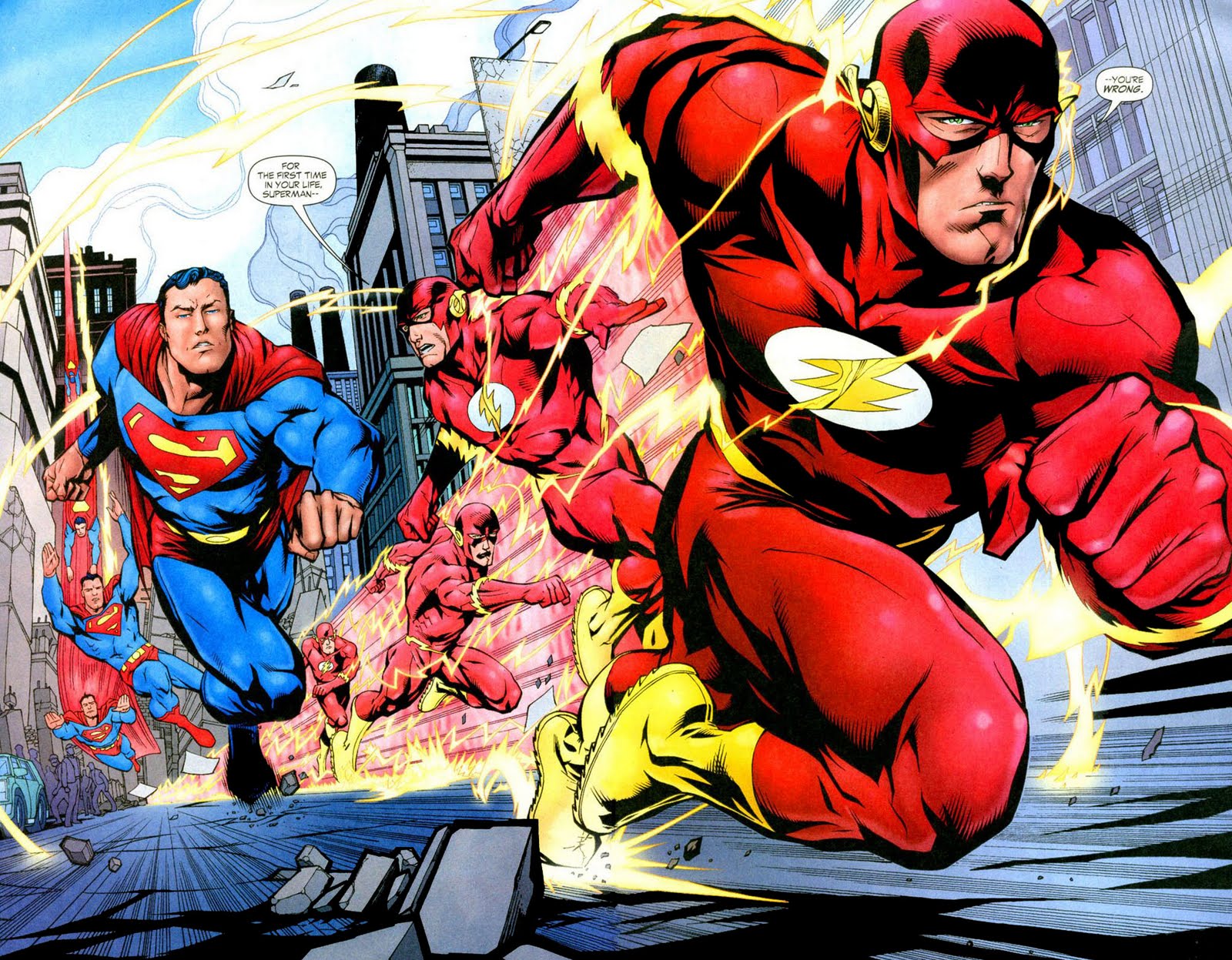
Why super speed beats flight

If you ask most people what super power they’d like to have, most will say flight. Yes, some pervs will say telepathy and Tim Dillon will say the ability to generate and manipulate ice, but seriously, on the whole, two out of three times, you get flight. Not entirely sure why, but so it goes.

Not me. Hands down the answer has always been super speed.

It’s been this way for me since I was little. I always thought being able to whiz by everybody on the ground seemed much cooler than hovering thousands of feet above them. Perhaps it’s because I crave human companionship and feel flight would be an extremely lonely super power? Maybe it’s that while being in a plane doesn’t fully simulate the experience, it comes closer than, say, a car being able to replicate true super speed? Whatever the initial reason, I dressed up as The Flash when I was five, not Superman.

But of course, there’s the rub: Superman can do more than fly. Really there are very few comic book characters that can only fly because while it seems initially neat, it’s fairly weak in terms of the offensive capabilities it can provide. Guys like Superman or Martian Manhunter or Captain Marvel (either one) or dozens of others have flight as their “showiest” power, but then always have the requisite super strength plus loads of other stuff piled on to make them more formidable.

The traditional “flight only” characters in comics, Hawkman and Angel of the X-Men, even got beefed up when it became evident just being able to kick a guy from slightly higher up wasn’t much of a tactical advantage, getting centuries of weapons training and razor-tipped killer wings in the bargain.

But getting away from super heroics and back to as close to real life as a post like this can get, super speed has it all over flight in the practicality department, and that’s the reason I’ve stuck with it beyond my formative years. There would certainly be a “wow” factor in terms of being able to go up into the clouds the first few times, and no doubt you could elicit some attention from members of the opposite sex (provided you don’t drop them), but once the novelty is gone, you’re going to get bored among the birds, so to say.

However, if you’re incredibly fast, your life will always be better. You will never be late again. You will be able to travel lengthy distances without being bored or inconvenienced. You can acquire awesome gifts and goodies for your friends, loved ones and the objects of your affection in an eye blink.

And that’s just with running!

Per the lame joke I have made many times to groaning response and once for the world to see when I interviewed the Motor City Machine Guns and asked this very question (Alex Shelley said he’d want Jamie Madrox’s powers for similarly convenience-minded reasons—truly a man after my own heart), I would not want to just run fast, but do everything fast, except that one thing (kids, ask your parents). That’s how guys like The Flash have always rolled, and so it would be for me in this fantasy land I have constructed for myself.

My room is dirty? Nope, now it’s clean. I need to do some reading? I just did it. Afternoon of errands to run? It just became five minutes of errands to run (albeit probably having stolen multiple items rather than paid for them).

Unlike flight, super speed makes everything in everyday life easier!

And yes, were I somehow to find myself as an adventurer fighting the good fight, I could punch the bad guy 100 times in a second and he’d be done as opposed to staying two feet above his reach until somebody actually useful came along to help.

To end on a poetic note, if super speed is indeed like a Geoff Johns-written Flash comic, it would be pretty neat to be able to literally dance between the raindrops, watching them each as they slowly fall to the ground and the people around me go by in slow motion; actually, that second part sounds somewhat terrifying, but the first part sounds pretty.

And so concludes one of my nerdiest posts to date. Which says something.

Sunday, January 16, 2011

Art Attack: Anniversary/Birthday Present

I am blessed for so many wonderful things in my life, but nothing more than my amazing wife, Megan. A few months ago, we celebrated our one-year wedding anniversary and coming up next weekend is my 29th birthday; to commemorate both, Megan commissioned me an amazing piece of art from our buddy Todd Nauck...
It's me and Megan surrounded by my very favorite characters, Nova and The Flash, as well as her namesake, Miss Martian. Oh, and also Captain America (Megan wanted to include another Marvel icon). We're all chilling at the spot Megan and I took photos following our wedding in Newport, Rhode Island with us in our tux and dress.

I'm fortunate enough to have a great many original art pieces from Todd, but no question, this is my favorite yet. His incredible talent is undeniable and wow does he draw a wicked Flash.

In conclusion: I may be getting up there in the years, but I'm a luckier dude than ever! Thank you Todd and I love you so much, Megan!