Showing posts with label new teen titans. Show all posts

Wednesday, November 28, 2012

The Terror & Triumph of Trigon


New Teen Titans by Marv Wolfman and George Perez, one of my favorite and most well-regarded comic book runs of all-time, featured a varied and wonderful cast of heroes as well as villains, without any of whom the end product would not be so special (maybe Azrael), but at the end of the day, it’s the story of Raven. She’s the first presence we sense in the first story (not New Teen Titans #1, but the preview in DC Comics Presents #26), she brings the team together, and the scope of her story and the threat she’s on the run from immediately established that this iteration of Teen Titans were more than just the Justice League’s sidekicks, they were the gateway to worlds and stories not yet explored.

In that very first issue of NTT, the Titans ostensibly come together to rescue Starfire from the alien Gordanians, but Raven’s foreboding concern over a larger evil sets the stage that this is an epic in the making; a crafted piece of serial storytelling, not just the relatively standalone adventures of past Titans series and really of the JLA as well up to that point (it was closer to Chris Claremont’s Uncanny X-Men than anything, hence the years-long battle the two titles would wage through the first half of the 80’s for the top spot in the hearts and wallets of discerning readers clearly eager for this type of fare).

Over the next three issues, the Titans would face Deathstroke the Terminator for the first time and have their initial skirmish with Dr. Light’s Fearsome Five, but every step brought them closer to confronting Raven’s greatest fear: her father Trigon.


Short form on Trigon: he’s an incredibly powerful demon from another dimension formed from an entire race’s cast-off evil who killed his mother and everybody around him at birth, destroyed a planet as a toddler and has conquered millions of worlds by adulthood. He comes to Earth at one point as the result of a Satanic ritual, disguises himself, seduces a human woman who gives birth to Raven, then heads back home, occasionally murdering from afar anybody who threatens his daughter. He’s an imposing, impressive, downright scary character created from the combination of Wolfman using his horror writing background and pushing religious aspects generally shied away from in comics at the time, and an unsurprisingly dynamic design from Perez.

Raven is unable to get the Justice League to fight Trigon (Zatanna senses bad mojo about her), so she recruits the Titans, and in issue #5, they fight his henchman, Goronn, who they only barely defeat (not sure if Wolfman intentionally echoed Silver Surfer/Galactus there, but it worked for me), before getting annihilated by Trigon. Raven sacrifices herself and agrees to return home with her father if he leaves Earth alone. The next issue, the Titans pursue their teammate, get beaten by Trigon again, but are able to rescue Raven when her mother, Arella, basically distracts Trigon long enough for them to run back to Earth and close the dimensional portal behind them.

So what’s important to note is that the good guys do not win; they don’t even come close. They’re able to save Earth only because one of them basically surrenders, and then claim a small “victory” not by defeating the villain, but by turning tail and essentially lock the door behind them, keeping the killer outside the house for a bit.


What’s even more important is the restraint Wolfman and Perez then proceed to exercise with Trigon. The Titans escape him in New Teen Titans volume one #6, published in April 1981; he does not appear again until the kickoff of their second volume, over three years later in August 1984.

Between the two Trigon stories, the Titans battle the gods of Olympus, find the Doom Patrol, go to outer space, take a new member into their midst, lose two of their founding members—one of whom comes back with a new identity—get betrayed by that new member who then dies and see one of their own get married. They fight Deathstroke three times, Brother Blood twice, the Fearsome Five and Brotherhood of Evil a couple times apiece and take down the H.I.V.E., who had been orchestrating against them for over two years (our time).

All of this goes down without Wolfman and Perez giving into temptation and bringing back the most powerful Titans adversary. Instead, they namedrop him every so often and in both narrative and visually (seriously, pay attention to the art) show that something is up with Raven.

They had a plan and they did not deviate.


When it did come time from Trigon’s second act, he didn’t need to be revitalized or amped up, because in his original form, he had never been beaten. Indeed, with his first appearance showing off only a fraction of Trigon’s full power, it merely whet the appetite for what he could do unleashed—namely show up on Earth, handily run through the Justice League and transform the planet into a burnt out husk in moments (the most lasting image of the Terror of Trigon story for me is likely Superman turned to stone, an expression of eternally agony etched across his face, as we pan across the destruction).

The Titans are humanity’s last hope, not because they’re the most powerful group out there, but because of their ties to Raven, Trigon’s one weakness, the daughter he continues to believe will be his heir. It’s a touching coda in a way to Wolfman and Perez’s larger story and one of the big points they’ve been trying to make: it’s not about how much power you have, it’s about being there for your friends and family; ultimately, because the Titans focused on looking out for each other first and foremost, they’re the ones in a position to save the world when those who usually would are out of commission.

But they still can’t.

Trigon is way too powerful for the Titans and Raven ends up being corrupted by him. Rather than kill his daughter’s friends, Trigon infects them with his evil as well, creating spooky four-eyed demonic versions of Nightwing, Wonder Girl, Starfire, Cyborg, Changeling and Kid Flash who run their good sides through nightmare scenarios so they can take control. And then, in sharp contrast to the whole “friends and family” trip I was on before, the Trigon Titans turn on Raven and kill her…which allows her to defeat Trigon, though no plan of her own or of her friends’.
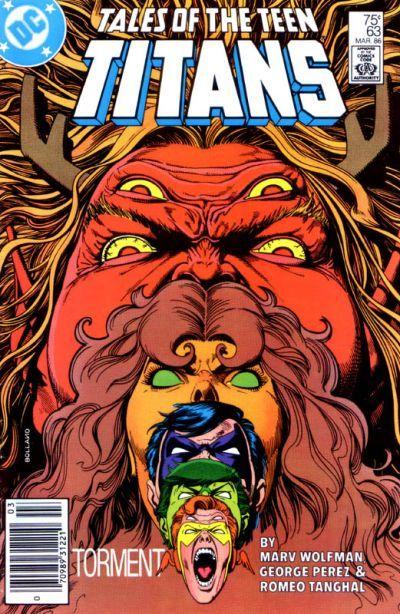

The souls of Azarath, the good side of all the evil that created Trigon, have been manipulating the whole thing all along, making sure the Titans got possessed and killed Raven so she could be transformed into a force of purity powerful enough to destroy her father. She does so and then disappears in a blinding flash of light, smiling for the first time and not to be seen again for 17 issues or so.

And Trigon is done.

There’s stuff to talk about there, like how the Titans lost more than they gained in this battle, how no heroic action could defeat the villain and so forth, but the important note for this particular essay is that Trigon perishes due to Raven’s sacrifice and that’s the last we see of him. The final issue of Wolfman and Perez’s initial collaboration, which yielded over 50 issues of story, concludes with the menace they started with being defeated; a perfect circle.

Now of course with comics being serial fiction, the story didn’t end completely, but for the most part, creators have been restrained and respectful when it comes to Trigon. Wolfman bent a few times as he remained on the title over a decade longer, with the seeds of the Trigon story coming back around in the form of the corrupted souls of Azarath, the return of Raven’s dark side and more, but the big red guy stayed buried. Geoff Johns reanimated Trigon’s skeleton to show that the new Brother Blood meant business when he took over the franchise, but he left the real deal deceased. In the first issue of Phantom Stranger from a couple weeks back (which kind of prompted me to write this), Trigon made his first New 52 appearance, but that’s a whole other discussion.


The point is that at the end of the day, Trigon appeared in two stories proper, never lost cleanly, and has never been brought back. If he were to come back, it’s been established that it takes a miracle that goes beyond the combined might of the DC heroes to defeat him, so that right there sets the stage for a whopper of a story (that probably shouldn’t be told).

I believe Wolfman and Perez’s best intentions for The Terminator (he wasn’t really Deathstroke aside from as a fleeting nickname until he got his own book over a decade later) were similar to Trigon in that he had a super arc with a definitive beginning, middle and end. As I said, he was introduced in the second issue wherein we also met his doomed son Ravager who tried and failed to destroy the Titans, dying in the process and honor binding his old man to take on the contract. Slade and the Titans clashed a few times over the next four years, like Trigon with him never really going down in full defeat, but unlike Trigon without him dominating so thoroughly that he couldn’t show up again a couple issues later.


The big showstopper for Terminator is of course The Judas Contract, where he plays the Terra card, delivers the Titans to the H.I.V.E., and then is pretty much ready to coldly walk away from the whole thing, his duty done, until it blows up in his face. His subsequent trial is the cool down and as I’ve said before, “Shades of Gray!” from Tales of the Teen Titans #55, where Changeling is prepared to kill Terminator and Slade says go ahead, willing to pay for his crimes, but they instead end up talking things out and understanding each other, is one of my favorite stories ever. That should have been the end for The Terminator; his story was done, and indeed apart from a Crisis cameo he stayed gone (as far as I know) for around four years before Wolfman brought him back just before Titans Hunt and to set up his solo book as a protagonist.

Part of me likes the idea of Slade Wilson playing his part and then exiting with dignity, but the larger part understands why it makes more sense for Deathstroke to be a larger part of the DC Universe, because he’s a great character who as opposed to Trigon can realistically appear without jeopardizing all of reality. Also, whereas The Terminator was originally the sole property of the Titans book just like Trigon, he’s been able to branch out since, which has led at times perhaps to overexposure, but also some really great stories extending far past Judas Contract.


Ultimately, the comic book medium—or at least the mainstream super hero part of it—needs good recurring villains who can jump around a shared universe, as it’s that larger ongoing narrative that demands servicing. But stories like what Wolfman and Perez did with Trigon demonstrate that finite threads can exist and thrive beyond creator owned and genre comics, and that when done right they can elevate the craft and create villains and stories that further the heroes that survive them better by being closed and gone.

Wednesday, August 31, 2011

Farewell to the(se) Teen Titans pt. 2

Picking up from where we left off…

As an interesting bit of trivia, just as New Teen Titans writer Marv Wolfman was chosen to helm Crisis On Infinite Earths in 1986, 20 years later Teen Titans writer Geoff Johns would get the nod for that classic event’s sequel, Infinite Crisis. Also parallel, both books’ original artists, George Perez and Mike McKone, would leave their Titans books around the kickoff of the corresponding events; however, while Perez would join Wolfman on the original Crisis, McKone headed over to Marvel to work on Fantastic Four (Johns would be assisted on Infinite Crisis by my good friend Phil Jimenez).

It spoke to the importance of the Titans franchise in both 1986 and 2006 that all or part of the creative team was transplanted over to the DC Universe-altering mega story of the day. There’s perhaps something to be said about DC operating at its peak when the Titans are flourishing and whether there’s a reason to that or if it’s just coincidence, but I’ll leave that to others (for now).

The first Teen Titans story of the post-McKone era was something of a full circle deal encompassing the first two years of the book as the “Insiders” crossover with Outsiders guest-illustrated by Matthew Clark came back around to elements of the Graduation Day limited series that launched both books and dealt with the long-gestating subplot of Superboy having Lex Luthor as of half of his DNA imprint that had been key to the series. It was an emotionally wrenching four-parter that I got quite invested in, watching poor Conner go mindless and attack his friends or Shift mercy kill Indigo; I was fully ensconced at Wizard by now and could read these books for free, but chose to buy them, knowing I’d want them for posterity no matter where my career took me.

As Infinite Crisis got underway across the DC line with tie-ins and lead-ins, Teen Titans acquired a new short term artist in the form of a blast from my personal past: Tony Daniel.

When I was younger and X-Force was among my favorite books, I was head over heels for the art of Greg Capullo, but then one month he mysteriously disappeared and was replaced by some dude I’d never heard of named Tony Daniel (as I relayed to Rickey on the train recently, as a young reader with Big Two tunnel vision, “going to Image” equaled “mysteriously disappeared” for me in the 90’s, and I was constantly wondering why so many artists “quit” comics in their prime). Within a few issues, Tony had won me over big time with ferocity of his work and landed a spot in my heart—before mysteriously disappearing a couple of years later, never to be heard from—by me—again.

Having not followed his work on The Tenth during or after my sojourn away from the medium, Tony working on Teen Titans really was a neat and surprising blast of nostalgia to me. I was speaking with Geoff pretty regularly at this point as I was covering Infinite Crisis for Wizard and would always impress upon him how awesome I thought Tony was when I was younger and how excited I was to see what he could do now; in turn, Geoff would send me e-mails with Tony’s beautiful pencil layouts (seriously, I sometimes wish his books came out in grayscale variants so people could see the raw work). Was I somehow responsible for Tony Daniel becoming the regular artist on Teen Titans and his subsequent success at DC? Next time I need a favor from him I’m going with yes.

Geoff landed a double emotional gut punch on me around this period with his handling of Superboy. First he penned the beautiful Teen Titans Annual #1, where Conner and Wonder Girl reminisced on and solidified the romance I’d watched build from awkward flirtations on the pages of Young Justice; it had a sincere ring of young love and again marked that well-handled aging process I commented on last time. It also made it even harder to read Superboy’s heroic sacrifice in Infinite Crisis, a death I’d been warned about months earlier but still had trouble reading. My then-girlfriend-now-wife, whom I had somehow kept it from and who loved Superboy and Wonder Girl, was furious and said she was going to write Geoff an angry e-mail. Teen Titans was the first comic she had ever read—she doesn’t read comics regularly anymore, but she read Geoff’s entire run on Teen Titans, which also got her reading Runaways, Buffy, Fables and a few others for a time—and this was her first brush with comic book death; she didn’t care for it.

As with the entire DCU, Teen Titans experienced a seismic shift following Infinite Crisis and the One Year Later gap. Familiar, friendly faces Superboy and Kid Flash were gone, replaced by the supposedly reformed Ravager and an inventive take on Blue Devil’s forgotten sidekick, Kid Devil. Robin and Wonder Girl remained, but had been hardened by loss and found comfort in one another. The book as a whole felt darker—a change probably spurred on by Daniel’s moodier art in place of McKone’s comparatively bouncy work—and had in many ways gone from the story of friends hanging out and having fun to survivors being there for one another, and there was mileage in that.

I thought Johns’ attempt to clean up the muddled continuity of the Doom Patrol and bring them back into the Titans’ world was very strong. His work with Kid Devil made for compelling reading, particularly the one-off spotlight issue drawn by Peter Snejbjerg, as Eddie Bloomberg was an optimist who belonged in the Titans during better days but made do with the hand he was dealt even as he hid his own personal tragedy. “Titans Around the World” introduced some great new characters, not the least of whom was Miss Martian, aka Megan Morse.

But despite these high points, you could feel an era coming to an end. Geoff was juggling a lot of books coming out of Infinite Crisis, including Green Lantern, a re-launched Justice Society, and Action Comics; something had to give. In the exit interview he did with me for Wizard’s web site, he said he enjoyed the post-Infinite Crisis period of Titans and had a lot of ideas he was sorry he wouldn’t be able to get to, but also admitted that losing Superboy and Kid Flash had been tough and made his decision on which book he had to drop at least a little easier.

As Geoff prepared to exit Teen Titans, I was finishing up my run as DC contact at Wizard. In one of the very last DC articles I did for the magazine, I pitched the idea of introducing the villainous Titans East through a series of sketches Tony would do exclusively accompanied by “dossiers” Geoff could write; with his schedule slammed, I offered to help with the bios, written from Deathstroke’s perspective as he was the group’s founder. I turned my drafts into Geoff and he paid me an extreme compliment saying they sounded “just like Deathstroke” and he made very few modifications; that piece remains one I’m extremely proud of—you can see it in full here—and Geoff’s kind words still resonate.

“Titans East” would provide a nice capper to the Geoff Johns era of Teen Titans, bringing the focus back to the Wilson family once more and providing some closure to the story that had begun back in issue #1. It also wrapped around the time I left Wizard for Marvel, so it felt like a chapter of my life was closing as well (I mean, one was, obviously, but a more Teen Titans-centric chapter).

I continued to buy Titans after I started at Marvel. The book was creatively adrift for a little while as Adam Beechen, Geoff’s co-writer on “Titans East” and planned successor, ended up leaving for other things after only a few issues. Sean McKeever, a writer whose work I wasn’t entirely familiar with—what I’d read, I’d liked—but also a fellow I knew from conventions and got along well with took over for a solid year and a half, with most of his run drawn by Eddy Barrows. Sean had a knack for writing Ravager in particular and did some neat stuff with revisiting the Titans of Tomorrow, bringing back Brother Blood, and adding some interesting new members such as Kid Eternity and Static. In retrospect, a lot of art shifts, roster changes and event crossovers threw some instability into Sean’s run that was a bit of a shame, because I remember his high points fondly and will always wonder what more he could have done with just a touch more traction.

Following Sean’s departure, Teen Titans gained something of a revolving door. Bryan Q. Miller, a name I recognized and appreciated from Smallville, stepped in for a bit, but didn’t stay long enough for my liking. Felicia Henderson took over for a spell and seemed to have some cool ideas, but never quite nailed the voices of the characters for me. It was a strange thing to watch a book like Titans, which had such a solid sense of self and cohesion for the first few years of its existence, bounce around so much between creators and characters. Geoff and Mike McKone came back for a short untold story of their team for issue #50, and with all due respect to the creators who followed them, the “those were the good old days” message couldn’t help but resonate a bit. I could hardly believe when issue #75 came around and I felt like while the past two and a half years had been packed and eventful in my life, they flew by for the Titans.

I own just about all 100 issues of Teen Titans, but there’s a gap of a few issues I kind of regret now that I don’t own in the mid-80’s; I was still reading monthly, but feeling more and more removed from characters I once felt so close to—Superboy and Kid Flash had both made their way back but seemed like strangers—I pulled back to just reading the office copies.

I came back with issue #88 when J.T. Krul and Nicola Scott took over. I had exchanged pleasantries with J.T. back in the day and he left a solid enough impression that I wanted to give him a shot (that’s all it takes sometimes!). Nicola was a different story as I had “met” her via the Comic Bloc message board back when she was still trying to break into the business and pitched a quick “Introducing” bit for Wizard centered around the unique fact that she had been a Wonder Woman model in her native Australia but that also provided a chance to show off her art; Nicola’s undeniable talent and winning personality no doubt got her where she deserved to be drawing comics in the big time not long after the article, but since I’ve already taken credit for Tony Daniel’s career, let’s go ahead and chalk this one up to me as well.

J.T. and Nicola also brought back a pared down and familiar roster consisting of Wonder Girl, Superboy, Kid Flash, Raven, Beast Boy and Ravager. They threw in the novel wrinkle of adding Damien Wayne, the new Robin, as a wild card, which provided some really fun stuff, before completing the reunion by returning Red Robin to the book as well. It truly did feel like a return to form, as the characters I dug sounded like themselves again, the balance of soap opera with action felt right, and the art shined to accompany fun, heartfelt stories.

The icing on the cake was that right there in the credits, my buddy Rickey Purdin’s name now appeared as the assistant editor. It had been wild enough for me to go from simple reader to a dude who knew the writer and artist, but it honestly felt even crazier in the coolest of ways that a friend who had been in my wedding and whom I talked about Teen Titans with in the cafeteria at Wizard and the train into New York City was now playing a role in controlling their destinies.
And I may be biased, but Rickey Purdin writes the best damn non-Steve-Wacker letters pages in the business (Steve gets his own special division).

Of course that brings us pretty much up to speed, as J.T. notched 12 issues of Teen Titans to be proud of, wrapping with the landmark #100, but the sun has now set as we prepare for the dawn of a new DC Universe.

I’m glad I took this look back at Teen Titans and me, as it reminded me of a lot of the good times the book and its creators provided me over the past eight years, as a fan and a professional. I’m glad in my own small ways I got to be a part of the series, even if it was from off to the side and behind the scenes. I’m also glad that at the end of the day, this book and these characters finished up in a place I’ll fondly remember; as we move to the next step, I’m able to picture those final pages and be happy knowing Conner, Bart, Tim, Cassie and the rest ended up miles away from Young Justice and even their early days as Teen Titans, but recognizable and still together.

Speaking of that next step, I’m pretty excited for the new Teen Titans #1 headed my way, certainly a changed attitude from 100 issues ago. Scott Lobdell—another favorite from my formative years—and Brett Booth are taking these characters even further abreast from where they’ve been than Geoff and Mike did the Young Justice gang nearly a decade ago, but as I was shown back then, change might be scary, but it can also be awesome. Superboy isn’t the only one who did some growing up over the last decade.

Geoff, Mike, Tony, Sean, J.T., Nicola, Rickey, et al., thanks for an awesome ride.

Bring on tomorrow.

Thursday, March 17, 2011

The Problem with the New Teen Titans

It’s no secret to anybody who has read this blog semi-regularly or spoken to me about comics more than once that Marv Wolfman and George Perez’s New Teen Titans is not only high among my personal favorites, but in my opinion a shining example of the super hero medium at its finest; I’ve gone on about why at length.

However, as great as the NTT glory years of Wolfman and Perez (and later Wolfman with others) were, they’ve also plagued the characters who starred in those stories ever since.

The prime seven of New Teen Titans—like many I always think of Kid Flash as being more of a core member than Jericho though I believe the latter had tenure—occupied a unique spot in the hierarchy of the DC Universe back in the 1980’s in that they were able to age from their traditional role as kids into older teenagers and still have a place; the Justice League were obviously the adults, but the closest thing to a truth youth movement was going on in the 30th century with the Legion of Super-Heroes, so the Titans had their niche.

In the decades since, a new generation of true Teen Titans has come along while the JLA has remained stationary as far as aging, wedging the NTT into an awkward spot. Folks get their fix of grown-up heroes with Superman, Batman and company; if they want a younger take, they’ll check out Teen Titans; you’ve even got the buffet option of the JSA where the generations match up. The former New Teen Titans have in large part become the super hero equivalent of the townies that graduate high school and then rather than go to college or move on, just hang around their old haunts trying to relive their glory days but often just coming off desperate; they’ve become Matthew McConnaghy in Dazed and Confused or Tim Riggins on Friday Night Lights, but unfortunately not always as cool.

The go-to solution to “the Titans problem” tends to be just tossing them in a group together and give them a book, but more than once this strategy has just reinforced how tough it is to recapture lightning in a bottle, particularly when you want your characters to grow and mature. It’s not a conundrum limited to the Titans either, as this went on for years with the New Mutants as well; fortunately Zeb Wells finally found a take that made the New Mutants work again—and I look forward to Dan Abnett and Andy Lanning running with that baton—but it took a lot of swings and misses before the bat connected there.

For better or worse, I think the Titans have outgrown one another, at least as far as being grouped together on a monthly basis. When they have reunions, it should be an event, something truly special, but that means keeping the characters relevant and growing on their own in between. Besides: Wolfman, Perez and their successors—as well as predecessors in many cases—created some remarkable figures that really should be seeded across the DC Universe.

Here’s where I personally would put the New Teen Titans in the interest of them living up to their tremendous potential rather than festering in limbo or going through the retread motions.

DICK GRAYSON
The current Batman of Gotham City is exactly where he needs to be right now both as the star of several Bat-books and, more importantly in my eyes, leading the Justice League of America. One of my favorite aspects of Dick Grayson has always been that though he’s Bruce Wayne’s protégé, he also learned a lot from and modeled himself in part after Superman, and in the process really became the best of both. While the prime Batman is too anti-social and intimidating to be a leader but uses his genius-level strategic mind to direct things from behind the curtain and Superman does better as an icon since he can inspire but not really plan, Dick amalgamates those two skill sets and is the best pure leader in the DC Universe, a point that was made for years in NTT and then reinforced everywhere from The Obsidian Age to Infinite Crisis; he’s DC’s Captain America, able to direct his team both on and off the field. One of the best characters in comics, Dick Grayson has never really been hit by any sort of “New Teen Titans curse” and is right where he belongs at the forefront of the heroic community.

DONNA TROY
On the other hand, I appreciate James Robinson’s efforts with Donna Troy in Justice League of America—a book I feel compelled to note I quite enjoy, by the by—but something’s just not working for me. Obviously when you look up “damaged goods” in the imaginary encyclopedia of comics books I just created in my mind, there’s a picture of Donna staring back at you; the character has had her origin broken and glued back together so many times by sweeping continuity changes that along the way her sense of identity shattered and each subsequent fix seems to do more harm than good, regardless of the creators involved having best intentions. While she’s not a bad sub for the Wonder Woman spot in JLA, something about “den mother Donna” from New Teen Titans seeming so angry all the time doesn’t jive; certainly if any fictional character has earned the right to have a chip on her shoulder, it’s Donna Troy, but she also became so beloved lo those many years ago because she was the levelheaded Amazon who would put people in their place with kindness before resorting to throwing fists. You risk aging her by doing so, but it always seemed a natural fit to me that Donna would reside in the permanent mentor/bridge to their past role for the current Teen Titans that Cyborg and Starfire have filled in recent years to limited success. I’d enjoy seeing Donna in the big sister position not to just Wonder Girl, but the rest of the next gen heroes as well, and it would certainly give her a unique spot to fill in the DC Universe as a veteran taking an interest in the future who the kids could actually still relate to—and crush on—in contrast to the octogenarians of the JSA. Or maybe she should just stay in the JLA doing what she’s doing; Donna Troy is always going to be a tough knot to untangle.

WALLY WEST
I’m not going to get into a rant here, but Wally West belongs as The Flash in the Justice League of America. The beauty of having so many guys calling themselves The Flash should be that you can disperse them around where needed and everybody who needs a speedster gets one, plus every speedster gets some love. Barry Allen has the solo book, and besides, a big plot point for him thus far seems to be that he’s having a bit of a hard time readjusting to being around his old friends, so the JLA is no place for him. Wally, on the other hand, is one of DC’s most tenured and talented team players and was a fixture of the League for years; he’s not doing anything else and no starring roles seem in the offing, so put him where he belongs on the premiere team that happens to be led by his best friend. Obviously I’d personally be fine with jettisoning Jesse Quick to accommodate this—no offense to Ms. Quick—but if you wanted you could have both on the team like back during Devin Grayson’s Titans run, where it seemed to work fine.

RAVEN
I don’t dislike Raven’s current role as a revitalized—i.e. young again—member of the Teen Titans, but I could also see her doing more in the DC Universe at large, and with the character supposedly getting a CW show in the near-ish future, that seems like a good idea for all concerned. Given the substantial amount of younger mystic heroines already kicking around—Traci 13, Black Alice, etc.—Raven could be nudged back up into her late teens as she was when NTT wrapped and perhaps establish herself as the next level up from those ladies but still a bit beneath Zatanna or Doctor Fate. In the same way that Doctor Strange is the go-to guy whenever any Marvel hero needs magic help, Raven could be the DCU’s guide to the mystic realms and become a valuable guest star that stars in the occasional miniseries when somebody has a good idea. This may seem redundant given the folks I already mentioned, but with her demonic heritage, Raven is a more sensible shepherd than stage magician Zatanna or the still-novice new Fate when it comes to exploration into other dimensions or whatnot; she could be akin to Daimon Hellstrom in some senses, but she’s got a far richer background and more years of good stories to her name. In short, I think a break from the Titans would benefit Raven and give her a chance to grow into a vital part of the heroic structure of the DCU rather than just serving as a plot device to spawn new Trigon-related threats for her old teammates.

CYBORG
In recent years, Cyborg has become one of the science experts who get called in when Red Tornado gets broken or Arsenal needs a new arm, which has never rung true with me as it seems totally out of line with the core of the character. Vic being a smart guy should certainly be an aspect of his persona, but not the dominant trait; he shouldn’t just be played as Mr. Terrific with cool robot parts. I’m not suggesting Cyborg should be in angry young man mode indefinitely and certainly he no longer has the giant chip on his shoulder he had back when NTT kicked off, but even as recently as the Grayson Titans, he still had a healthy bit of attitude and street smarts to go with his burgeoning brain. I’m glad that the character has grown, but it feels sometimes like they went from point A to point Z skipping all the steps in between. I’d love to see Vic as a strong-willed team leader, rather than just the muscle, tech support or even mentor for a group. With the Outsiders name going into limbo again shortly, it would be neat to see some of DC’s true outsider characters, the ones who have been screwed over by normal society, band together—which is honestly how I’ve always wanted to see that name used—with Cyborg at the helm as a guy who found friends, family and acceptance, but also knows what it’s like to be desperately seeking.

STARFIRE
Of all the New Teen Titans characters, Starfire is the one who was among the richest back in the day, but has aged most poorly. Unfortunately, so much of what made Kory work when she was introduced was that naiveté and her raw displays of emotion that made her so alien even amongst a fantastic cast; she was the hot foreign exchange student and it worked great. However, when a character has been around for 30 years, you can’t write her as if she’s fresh off the bus—or spaceship—so a lot of what fueled Starfire has been stripped away and she’s too often played as bitter to try something different or falsely bright-eyed in attempt to recapture the glory. She’s at her most interesting around Dick Grayson playing off their long history, but he has evolved so much since they were seriously together that she’s almost like an anchor. I’m not sure quite what to do with Starfire, but I do feel she has too much untapped potential to waste. Her current spot in R.E.B.E.L.S. has some merit, but I think she’s more interesting as a stranger in a strange land on Earth. Perhaps with the Outsiders group I already mentioned? Serving as one of Oracle’s Birds of Prey and bonding/feuding with the other love of Dick Grayson’s life could certainly be interesting.

BEAST BOY
Gar Logan is another tricky fix as he embodies the Titan who is probably still a bit young to be in the big leagues—sure Supergirl is technically younger, but she’s more iconic and that carries with it a weird illusion of security—but comes off a bit as the skeevy college dropout who moved back home on the Teen Titans. A lot of Changeling was wrapped in being the “baby” of the NTT, but as with Starfire, it’s unrealistic for him not to have grown since that era. Geoff Johns and Ben Raab actually did a great job breaking Beast Boy out when they penned his miniseries, moving him up the dial a bit in large part by introducing his even more irresponsible cousin Matt for contrast and giving him a less experienced hero like Flamebird to provide guidance for. I think the Titans L.A. pitch that never was remains a good place for Gar and would like to see him heading up something like with guest appearances in the Titans book and elsewhere and whatever side projects the characters can support.

Monday, January 17, 2011

Celebrating Martin Luther King Day with comics

I’ve never been shy about saying I grew up in a primarily white, primarily Jewish suburb where, despite what the posters at our high school may have said, there wasn’t a terrible degree of racial diversity. I barely had any Christian friends, let alone friends of color. My buddy and X-Men sketchbook collaborator Husani was an African-American kid who lived closer to Boston and came to our school via a program, but we unfortunately did not stay close long. It wouldn’t be until I attended summer camp both as a camper and particularly as a counselor that I became close with a wider range of people from different ethnic, social and religious backgrounds. Into college and on through today, I’ve certainly come to appreciate richness of relationships with those different than you, perhaps in particular because it was not something I enjoyed when I was younger.

Even when I was young though, Martin Luther King Day always seemed important to me. Part of that was—to be fair to the community I just kinda bashed—because my elementary school in particular always went out of its way to impart upon us its importance. Another part though honestly wasn’t that I was some great advocate for equality as much as inequality didn’t make any sense to me. Maybe that was a side effect of not having any real difference around me and thus not having really been exposed to bigotry, so when I read about it, it seemed as fictitious and nonsensical as anything I’d see in a comic book. I mean, The Hulk had green skin and Superman was an alien but they were good guys—why would I have a problem with a brown-skinned person or somebody from another country as long as they were nice?

And that, as always, brings us to comics (and thankfully the end of me trying to do some sort of socially aware PSA or whatever that was—thanks as ever for indulging me).

The comics industry has a history filled with many flaws and there are still plenty today. I love this business and this medium, but even its most ardent supporter will admit to you things can and have often been dark behind the scenes. However, more often than not, I’m proud of what comics can do, and one area where I feel like we’ve got a lot of other genres of entertainment beat is racial diversity.

I wish I could say comics has always been ahead of the curve when it came to the promotion and appreciation of minority creators, but unfortunately, that’s a far larger issue than our little corner of the world. Though some of the true legends of the game have been and continue to be today especially folks of all colors, creeds and so forth, the bigger flaws of society held back those who were different in comics just as they did pretty much anywhere else. Thankfully, as in most places, this is no longer the case and talent rises to the top regardless of superficial factors.

But we can say as an industry that at the very least when it came to the fiction we created over the years (and yeah, I’m probably unfairly saying “we” here, but it’s a pride thing), we made strides to be more inclusive than the world around us. Whether it was The Black Panther on the Avengers, blacks being as accepted as anybody in the Legion of Super-Heroes, comics both mainstream and underground tackling the issue of racial inequality head on all the way to Milestone Media or The Truth, comics has always attempted to create worlds where not only could men fly, but they truly were all created equal. Smarter folks than me could probably poke the preceding paragraph full of more holes than Swiss cheese, but I like to let my optimism fly in this case.

To celebrate Doctor King’s dream, I thought I’d take the opportunity real quick to examine my own personal history with a couple of black comic book characters who I really liked. However, it’s important to note I never liked these characters simply because of the color of their skin, but because they were great characters whose skin happened to be that color. Because in the end I think celebrating races that were held down for way too long is crucial to this day, but the dream is for a world where none of that matters and we judge people not by how they look or where they’re from, but to put it in CKT terms, how rad they are.

NIGHT THRASHER
As has been documented many times on this blog, my first true favorite comic book was the first volume of New Warriors, and it just so happened that the titular team that starred in that title was led and founded by a black man: Dwayne Taylor, aka Night Thrasher. Being a young Nova fan at the time, it was somewhat natural that I didn’t love Thrash at first, given that was kind of the Cyclops to Rich’s wannabe Wolverine, but the difference there was that Dwayne was pretty much always more of a badass than even my favorite, a fact I respectfully accepted. I was used to dull, boy scout team leaders in the vein of Scott Summers or Leonardo on the Ninja Turtles—did not like him—so I took some pride in the fact that the dude in charge of my team could actually back up his bluster; Night Thrasher was that older brother who was always in your face, except for when somebody else was, and then he had your back and you were really proud.

In many ways, Dwayne Taylor was a pretty blatant Batman/Bruce Wayne rip-off: a wealthy young man whose parents were killed, leading him to dedicate his time and resources to doing good and fighting crime. What set Night Thrasher apart was that he still had a major chip on his shoulder—youth will do that—he learned to fight by taking down street gangs rather than traveling the world and, yes, that he was black. But a lot of what made Batman cool made Night Thrasher cool, and then the stuff that made him different—he actually wanted a team of friends for one—made him cool in his own way.

CYBORG
I think it’s understated what an important character Victor Stone is in terms of his historical significant to and impact on the DC Universe. A lot of things made Marv Wolfman and George Perez’s New Teen Titans one of the best and most successful works of the 1980’s and perhaps of all time, but Cyborg was among the most vital. He gave the Titans an edge they had lacked in previous incarnations and opened up new worlds for them to explore. Where they had once been a team of sidekicks nobody took entirely seriously, they now counted among their ranks power players like Raven and Starfire, but especially Cyborg. Beyond his raw strength and cybernetic abilities, Vic also brought to the table a level of experience in dealing with hard times that exceeded his age—he was the first Titan to turn 20—and brought other characters like Robin and Changeling into their own then helped them deal with their maturation processes.

I like Cyborg in that golden age of the Titans because he’s so multi-layered. If you barely scratch the surface, you only see the kid pissed off at his father and the world for losing a life he loved and being forced to survive as a freak, however if you go deeper you see he’s not only somebody who wants to be loved, but a guy capable of impressive empathy given his own trials. He was the hardened heart of the Titans who not only made them a force to be reckoned with in the DC Universe, but who you knew would get in the face of anybody who said otherwise. There was a reason he got the call up to be part of the Super Friends on TV; great character.

Tuesday, January 4, 2011

Who Digs Teen Super Heroes?

The short answer to that question is me—it’s the more in-depth version I’m interested in trying to figure out, and will attempt to do so with a little impromptu history lesson wherein the facts will hopefully be at least close to accurate given the minimal research I plan on doing.

As we all know—right?—the first major young character in comics was the original Robin, Dick Grayson, introduced in 1940 to be the boy/teen sidekick to Batman. Bucky, Speedy, Toro, etc. and a horde of other pre-pubescent tagalongs were created throughout the 40’s to accompany the hordes of hit or miss super heroes the industry was churning out at a feverish pace. The idea was that since a lot of kids and teenagers read comics, they’d like to have a character they could imagine themselves as; they could hero worship Batman and Captain America, but they could actually be Robin or Bucky.

Robin and other young boys hanging out with strapping men in spandex of course became a major target of Fredric Wertham in the mid-1950’s, so a lot of them went away over the course of that decade, as did super heroes comics as a genre in large part. This was likely just as well, since the kids who grew up in the 40’s were now hitting the cusp of adulthood and didn’t feel like identifying with a cheeky circus performer in pixie boots or precocious army mascot in a domino mask, preferring the edgier EC Comics-type fare you’d expect twentysomethings to cotton to. The only teen heroes who really thrived to any degree in the 50’s were Superboy because he was just Superman as a kid and Robin because he was mostly an accessory to Batman. The exception to the rule would be the Legion of Super-Heroes, introduced in 1958, but I attribute the fact that they had a unique gimmick—that whole being from the future thing—as offsetting a malaise in young protagonists at the time.

The game changed again in 1962 with Spider-Man, not just another teen character but a full-on leading (young) man with angst and depth his predecessors of 20 years earlier never came close to demonstrating. With Spidey, Stan Lee and Steve Ditko invented not just a hero their younger readers could fantasize about being, but in Peter Parker an alter ego who wasn’t all that far off from how they actually were real life, mixing the tried concept of a wish fulfillment character with an identifiable protagonist. It no doubt helped that the Wertham storm had been weathered and there were actual young readers to appreciate the effort again.

Whether because of Spider-Man, the return of teen fans, just because or a combination of them all, DC brought back their younger heroes in full force, grouping Robin, Kid Flash, Wonder Girl, Aqualad and Speedy together as the Teen Titans while also giving the Legion their own ongoing series in Adventure Comics. At Marvel, the X-Men were created perhaps in least in part with the idea that if one awkward kid did well, five would do even better, while Rick Jones became a fixture in Incredible Hulk, Avengers and later Captain America and other titles.

While the late 60’s did not bring the return of Frederic Wertham, there was the inevitable aging of another audience and ensuing lack of interest in teen heroes that killed off both Teen Titans and X-Men for a good bit. However, rather than go gently into that good night, the folks responsible for Spider-Man and the Legion came up with the novel solution to simply age their charges ever so slightly, meaning as their fans were going off to college, so was Peter Parker; as the readers were discovering romance, the Legionnaires were hooking up. Rather than lose that young audience who found Iron Man too old but were over the youthful adventures of Supergirl, a middle ground of hip characters in their early-mid 20’s were established, with many tenured leads being subtly slid back towards that demographic as well.

Once you buzz past the early 70’s and get toward the end of that decade on into the 80’s, things get interesting as far as teen and just-past-teen super heroes. The three most commercially successful ongoing series of the period for quite some time were Uncanny X-Men, New Teen Titans and Legion of Super-Heroes.

In the case of the X-Men, a cast certainly not fit to be attending high school shot the book to popularity in the middle of the 70’s—Wolverine has never been a teen hero—but the ultimate entry level character for kids in Kitty Pryde cemented it’s spot as in many ways it became about the one kid being your access point to hanging out with the coolest group of older friends you could imagine.

New Teen Titans showcased a mix of high school and college age characters that all happened to be extremely physically attractive—but in distinct and thus more believable ways thanks to the talent of George Perez—having incredible adventures and also exploring their friendship and sexuality. Legion of Super-Heroes was a similar set-up but in the far-flung and awesome 30th century. Whereas Robin and Bucky had been endearing but fairly goofy wish fulfillment fantasies to kids in the 40’s, the Titans, Legion and X-Men were far sexier versions who were able to hold the attention of their audience regardless of age—young readers wanted to spend time with them, slightly older fans wanted to be them, and those who had been following along since the 60’s saw their glory days. As a result, these books stayed on top for most of the 80’s.

As the 90’s dawned, for whatever reason, the 70’s backlash of disinterest in teen heroes seemed to resurface and the answer of the comics community was to take the previous solution of aging their young characters even further. The X-Men—the presence of Jubilee aside—became comprised more or less entirely of adults, and ones with a hard edge at that. The Teen Titans became the New Titans, ditching the optimism of youth for a seemingly endless wave of tragedy (see Donna Troy’s life). The Legion jumped ahead five years and became grown-ups in a now dystopian future. Even the New Mutants, who remained among Marvel’s younger characters, transitioned into the paramilitary X-Force, with gray-haired Cable at the helm and as the focal point.

In spite of this, there were a lot of great teen books and characters in the 90’s—I should know since it’s when I started reading comics. You had my beloved New Warriors, Tim Drake as Robin and the new Superboy, not to mention a wave of would-be Spider-Man surrogates who went on to various levels of success like Darkhawk and Sleepwalker. Even A-listers like Green Lantern and Flash became part of the youth movement, with Kyle Rayner and Wally West taking the mantles, plus good stuff outside of Marvel like Harbinger at Valiant or Prime at Malibu.

Of course there were also simply so many comics in the early 90’s that the “throw everything at the wall” approach to publishing was guaranteed to yield at least a bit of quality in every category across the board including with teen heroes.

Give or take 10-15 years or so that brings us to today. We’ll leave out the bit where the market collapses and nothing is doing well because it’s not really relevant to any points I’m trying to make or explore.

The comic industry has rebounded from the abyss with vigor over the last decade, experiencing rebirth in publishing as well expansion into other mediums like film and television. There’s a whole component about the indys and how coming of age graphic novels and standalone stuff about growing up has surged of late, but again, not really what I’m talking about here, so we’ll stick to super heroes.

If there’s been any knock on mainstream super hero comics in the 00’s—and there has been more than one, but this is a biggie—it’s that kids don’t read them anymore. If that is the case—and for the sake of the argument we’ll assume it is—then the original reasons why we had Robin in the 40’s, Spider-Man in the 60’s and Kitty Pryde and the Titans in the 80’s has evaporated somewhat in that the median age older reader probably doesn’t want to self-project as a younger character, particularly when the big guns are perpetually situated around the late-20’s/early-30’s age range most fans find themselves at or wish to get back to already.

Indeed, these days the rules that apply to an “adult” book like Avengers or Green Lantern carry over to “teen” books—or to put it more simply: It doesn’t matter how old the hero is, if it’s a good comic, it will succeed. Thus even with a dearth of younger readers, quality stuff like Ultimate Spider-Man or Young Avengers continues to experience success. Geoff Johns’ Teen Titans or Brian K. Vaughan’s didn’t so much do well because they spoke to a younger generation; they did well because they were kid. On the flipside, I don’t think Blue Beetle or Young Allies had trouble because they starred teenagers; they had trouble because it’s a tough market to launch new books in period (which sucks because those were some quality comics).

So coming full circle, what is I like about teen super heroes? It may have started out as an “Ooh, I could be Superboy!” or “Ooh, I want to hang out with the New Warriors!” thing back in the 90’s, but at this point I’m 28 and comics starring the younger set like Avengers Academy or the latest iteration of Teen Titans still tend to grab my interest.

For me, I think it’s that I’m an unabashed fan of the soap opera element of comic books just like I am of television or movies, so I’ll naturally gravitate to stuff starring teens or young adults where that is dialed up to 11 (I love Gossip Girl, but my parents have been on me for months and I still haven’t given The Good Wife a shot). If I’m going to get lost in a world of pathos, angst, romance and heroics, I want my escapism writ large and to the extreme, the way teenagers tend to view life (and the way me and most of my friends do too, since we’re largely in a collective state of arrested development). There’s something about every new crush being the love of your life, every test you face (written or super villainous) being the most devastating ever, and this group of friends being the one you’ll keep forever that appeals greatly to me.

Do I love teen super heroes because I’m a romantic? Because I’m a drama queen? Both? Does it matter? I don’t think it does.

I do hope more kids read comics again someday for lots of reasons—health of the industry, good way to learn to read, etc.—but for sure one is so that teen super heroes get another shot and another generation gets to see how cool they are.

And I’ll still be reading too.

Monday, September 13, 2010

The Definitives: Dick Grayson

A couple months back, I wrote about the evolution of the Robin character, in the course of doing so hitting largely on the progression of Dick Grayson, the original Boy Wonder as a character.

Whether as Robin, Nightwing or currently Batman, Grayson has always been one of my favorite comic book heroes. This is a bit a departure for me as I’m generally more beholden to the snarky rebel types as my touchstones, but there’s also that well-concealed nice guy side of me who really roots for the true blue Heroes with a capital “H” of comics. With Dick Grayson, he’s a guy who represents both sides of my fandom there, as he’s certainly among the more wholesome good guys even in the virtuous DC Universe—particularly when you consider his mentor—but also has that devil-may-care swashbuckler attitude born of the carnival.

Perhaps the most impressive thing about Dick Grayson is that in addition to his longevity, he’s probably been successful in more diverse identities than any other major character in comics as noted above. Sure lots of heroes and villains undergo the occasional name or costume change, but Dick has full-on reinvented everything about himself twice now and not really missed a beat as far as remaining at the forefront of the DCU as one of its most popular leading men.

Given that Dick Grayson has a history stretching back to 1940, I certainly make no claim to have read anywhere near even a majority representation of his appearances—I haven’t really read any Batman comics pre-dating the 80’s, including the crazy Silver Age stuff and really good 70’s stuff—but even so, I’ve got quite a few stories that spring to mind when thinking about why I dig comics’ original sidekick.

ROBIN: YEAR ONE
Few writers of the modern era have more familiarity with Dick Grayson than Chuck Dixon, who spent over five years writing him on the Nightwing ongoing title. Here, Dixon teams with co-writer Scott Beatty and artist Javier Pulido not to re-tell Robin’s origin story, but to flesh out his earliest days with Batman. Pulido’s art is perfect here, as he nails the brightly-clad figure of the Boy Wonder but drags him into the slightly darker situations Dixon and Beatty have concocted without dimming his luster. This is a great coming-of-age story that sees young Dick Grayson attempting to prove himself worthy of the responsibility given him by Batman—your basic father-son dynamic cranked up to superheroic proportions—by taking on way more than he probably should be on his own and coming up against Two-Face, foreshadowing later feuds between the two characters across various identities. Dixon and Beatty also show Robin’s nascent relationship with Batgirl and emotionally explore his connection with Alfred, the series’ narrator.

“The Murder Machine” (NEW TEEN TITANS ANNUAL #2)
The climax to the simmering storyline that introduced Adrian Chase into his costumed role as Vigilante is also an extremely important chapter in the life of Dick Grayson, as he reaches his final days as Robin. Having grown distant from Batman, the now-Teen Wonder finds himself partnering with Chase for a harder-edged war on crime and searching his soul for what kind of man he wants to be as he draws closer to true adulthood, seeing both positive and negative reflections of himself in his new ally. This extra-sized tale by the superlative Titans team of Marv Wolfman and George Perez sees the crew team with Vigilante against an army of assassins in an action-packed thrill ride, but more importantly it is for all intents and purposes one of the last true Robin stories as far as Dick Grayson is concerned and key reading if you’re looking to understand the character.

“The Judas Contract” (TALES OF THE TEEN TITANS #42-44, ANNUAL #3)
Maybe Wolfman and Perez’s greatest Titans opus—and that’s saying something—this one has it all, from the origin of Deathstroke to Terra’s betrayal to Jericho’s introduction and much more, but for our purposes, no aspect of the story is more important than Dick Grayson’s dynamic debut as Nightwing. Even before putting on his new disco-collared duds, the former Robin proves the only Titans capable of eluding The Terminator, an impressive feat when one considers his teammates, but also a reminder of what makes the character so special. Again, a crucial stage in the larger Dick Grayson tapestry, not to mention of the best comic stories of all-time, so call this a win all around.

“Nightwing: Year One” (NIGHTWING #101-106)
Wrote a whole entry on this one.

“Wings Over Gotham” (ROBIN #13)
The conclusion of “Prodigal,” the 1995 storyline that saw Bruce Wayne temporarily hand over the role of Batman to Dick Grayson while recovering from a prior ordeal that saw Jean-Paul Valley sullying the mantel. This issue, written again by Dixon, has Bruce returning, ready to be Batman again, but Dick not quite ready to give up the cowl until they have a conversation years in the making that has been building ever since he abandoned the Robin persona. It’s another big growth moment for Dick as he stands up for himself against his father figure and asserts not only his independence, but calls Bruce out on his lapses in judgment; for his own part, the original Batman stands his ground, but admits he has sold his protégé short more than once. It’s a watershed encounter that re-establishes the Nightwing-Batman relationship more as one between equals and alters their dynamic moving forward (also, Tim Drake fights a bad guy, but that’s pretty secondary).

“A Knight in Bludhaven” (NIGHTWING #1-8)
Dixon and Scott McDaniel’s kickoff to their lengthy run on Dick Grayson’s first ongoing series and they hit the ground running, creating a brand new playground for Nightwing to establish himself in Bludhaven, a sort of mini-Gotham that’s even more gruesome than the original in some ways. For the next several years, Bludhaven would serve a key role in giving Dick Grayson his own identity separate from Batman or the Titans, complete with his own rogues gallery, supporting cast and unique locales, but especially establishing him as the sole guardian of a place that needed him, not just a stand-in or supporting player. The first eight issues have Nightwing setting up shop and declaring war on Blockbuster, the bulky and brilliant mastermind who would become the Kingpin to his Daredevil, so to say. My personal highlight from this initial run is “The Visitor” from issue #6, in which Tim Drake drops by and the two “brothers” spend a night talking over Dick’s latest adventures as they hop across rooftops and moving trains, really giving McDaniel a chance to show off.

“Till Death Do Us Part” (NIGHTWING ANNUAL #2)
You could argue all day whether Dick Grayson’s true destined love is Starfire or Barbara Gordon, but Marc Andreyko and Joe Bennett make a pretty heartfelt case for the latter in this touching, sweet and often heart-wrenching one-shot covering the “missing year” from after Infinite Crisis and what became of Nightwing’s marriage proposal to Oracle. As the star-crossed duo recovers from the latest upheaval and mull over what’s next for them, Andreyko revisits the high and low points of their lengthy courtship in great detail. That Robin-Batgirl kid crush that became something more is something I feel like is almost woven into culture beyond just the DC Universe, and it’s certainly one I feel like I can relate to, so to see it so thoroughly dissected here and ushered into adulthood not only makes for a good story, but feels integral to who Dick Grayson is. The creative team here does an excellent job showing why this may be DC’s best couple, and at the same time why they can probably never be together for too long.

“Batman Reborn” (BATMAN AND ROBIN #1-3)
Grant Morrison and Frank Quitely’s first arc in this brave and bold new era of Batman showed once and for all that Dick Grayson was more than fit to wear the cowl, but also that he’d be a very different kind of Dark Knight—and that’s a good thing. I remember being really impressed with how Morrison acknowledged every stage of Dick’s past, from jubilant sidekick to defiant young hero, and made this very much the logical destination for the character. Quitely’s art is dynamic and the creative duo usher in wonderfully creepy new villains and a nicely refined status quo for the latest Dynamic Duo.

Thursday, June 17, 2010

Cruel Summer: Deathstroke The Terminator

When I first started taking an active interest in DC comic books in the early to mid-90’s, I thought, despite his name, that Deathstroke the Terminator was a super hero.

On the surface, it certainly seemed that way. For one thing, he had an ongoing series, and as far as I could tell, villains didn’t get those (Eclipso was an anomaly to me and I figured that was why Venom only got minis). I also remember reading bits and pieces of Panic in the Sky and seeing that Deathstroke was in there fighting Brainiac alongside Superman and the Justice League, pretty vigorously at that. Heck, I think he even wore a black arm band when Superman died.

And it was the 90’s, so “Deathstroke” was hardly the worst name I saw affixed to a good guy.

Imagine my surprise several years later reading Marv Wolfman and George Perez’ seminal New Teen Titans and learning that The Terminator—who they never really called Deathstroke even though that name was used at some point briefly in his early appearances—was a bad guy!

To be fair though, Slade Wilson wasn’t really that bad a guy. Well, he was. I’ll try to explain.

The thing that pushed The Terminator from vigilante to villain particularly in his earliest appearances weren’t just that he was pretty hard line about the ends justifying the means; it was that his ends were pretty unimpressive from a moral compass standpoint. The guy was a mercenary; end of the day, he was looking to score a pay day, and thus whatever he did to you along the way was cool. It wasn’t personal, but it was still pretty douchey.

Of course the whole genesis of Slade’s introduction to the DC Universe and grudge with the Titans was that his son got killed trying to collect a bounty he turned down from the H.I.V.E. for the teens’ heads so now he feels obligated to finish the contract. On the one hand, it’s honorable in a sense that he’s doing this for his kid; on the other, he’s still trying to ice a bunch of teenagers. And the really nasty stuff he did—primarily using and bedding a (maybe) barely legal sociopath as part of his master plan—code of honor or not was pretty darn inexcusable.

However, The Terminator’s motivation wasn’t really power or even money-driven when it came to the Titans; it was about preserving his family name, which sets him apart from a lot of the villain set similarly to what I was talking about with Kraven recently.

Ironically or appropriately—probably a little of both—perhaps my very favorite Terminator story is entitled “Shades of Gray” and comes from Tales of the Teen Titans #55 by Wolfman and Ron Randall. It’s after Slade has fulfilled his contract and gotten away with it after being acquitted thanks to friends in high places, so Changeling comes after him for revenge over what happened to Terra. Terminator beats the crap out of Changeling but doesn’t kill him, then calmly invites him to join him for breakfast, where he more or less says it sucks that Terra is dead, but he was just doing his job and now that it’s over he’s not going to bother the Titans anymore because he’s got no issue with them.

It’s a pretty awesome issue and a pretty awesome scene. It was also the perfect cap to The Terminator story because there really was no motivation for him to keep coming after the Titans or any other heroes as his story was over and his goal accomplished. Wolfman provided a great coda to the saga of a wonderfully complex character he’d begun five years earlier.

Unfortunately, Deathstroke couldn’t fade quietly into the night because he was too darn popular. To his credit, Wolfman held off bringing him back for a solid few years, and then when he did, he didn’t just invent a new reason for him to oppose the Titans, he brought him back as their ally, which made sense as his son was a member of their team.

At first, Deathstroke was kind of cool as a bad ass pseudo good guy with a distinct dark side. Reading the full Panic in the Sky story, I dug how he’s the guy Superman doesn’t want to go to for help because of his past, but needs for his military experience. He did ok for a bit on the outskirts of the DCU.

But more and more, Deathstroke the headliner became contrived and forced. The guy was a mercenary, yet he wasn’t taking assassination jobs on a monthly basis because stars of their own books just didn’t do that (even with Deadpool, who’s had a much longer shelf life, you notice he always has the heroic impulses creeping up every few issues as opposed to actually being a straight up “Merc with a Mouth”).

So Deathstroke’s book got cancelled and he became a bit of a toxic character for a bit because he was so far afield from the guy he started out as. I think he had a few cool appearances in the Batman books as a dude just taking money to kick the crap out of Batman, which is really the perfect use for him, but they were few and far between.

Then along comes Brad Meltzer’s Identity Crisis in 2004 and the inspirational rebirth of Deathstroke as a viable ass-kicker. In issue #3, Slade takes on the bulk of the Justice League—no big three—in a matchup fans had dreamed of back in the 80’s yet never saw and he dismantles them with precision and forethought, immediately bumping him back up to A-level baddie. Admittedly some of the ways he took out the heroes could be seen as a bit contrived—I never really bought that he took control of Green Lantern’s ring by just “out-willing” him—but Meltzer wrote the sequence with such obvious enthusiasm and it was so well-laid-out by Rags Morales that the cracks were pretty hard to see beneath the fun.

Suddenly, Deathstroke is back and Deathstroke is cool and everybody wants to use Deathstroke again. Out of all this we get some pretty neat comics, but also some that just seem to miss the point; that point being that Slade Wilson is not a moustache-twirling, cackling, out-and-out villain, he’s shades of gray, baby.

Meltzer had Deathstroke as the “bad guy” in Identity Crisis in the sense that he’s beating up the Justice League, but he’s really more of a set piece than anything else; near as I can tell, Meltzer didn’t really have any sort of goal as far as stripping down Slade Wilson and telling some broad character arc, he just had an idea for a great fight scene and pulled it off nicely.

But in the ensuing half-decade, I feel like we’ve seen too much of Deathstroke as just a plain old super villain who takes things personally and goes after heroes just cos. It’s the flipside of why he didn’t work in the 90’s as a hero.

That first run of Titans stories was awesome because it gave The Terminator a clear mission statement and reason for doing what he did: he was going to finish the contract his son took on to deliver the Teen Titans to H.I.V.E. no matter what he had to do in order to accomplish that, and then he was going to move on. It was nothing personal; they were just a mission.

The Deathstroke of today, in my opinion, takes things way too personal. He’s not a pro anymore. He attacks guys because they pissed him off, not because of any debt of honor or because there’s money to be made; that’s not Slade Wilson to me, that’s just a super villain. You make Deathstroke just another bad guy who holds grudges and has archenemies, you take away what makes him unique and cool.

To be fair, some excellent stories have been written with Deathstroke as a bad guy (I dug his Judd Winick-written appearances in Green Arrow myself) just as some awesome stories were written with Deathstroke as a good guy, but I maintain the best stories have The Terminator awash in shades of gray. It will always be tough to reinvent Slade beyond where those first five years of his existence had him just because Marv Wolfman really did give him a perfect beginning, middle and end, but I also understand there’s too many cool aspects to the guy—his rad costume not being the least among them—to just let him sit in limbo, so I heartily root for those who take on the challenge of taking him into the future.

Ultimately, Slade Wilson is a decent hero and an ok villain, but he’s an excellent character.