Showing posts with label marv wolfman. Show all posts

Wednesday, November 28, 2012

The Terror & Triumph of Trigon


New Teen Titans by Marv Wolfman and George Perez, one of my favorite and most well-regarded comic book runs of all-time, featured a varied and wonderful cast of heroes as well as villains, without any of whom the end product would not be so special (maybe Azrael), but at the end of the day, it’s the story of Raven. She’s the first presence we sense in the first story (not New Teen Titans #1, but the preview in DC Comics Presents #26), she brings the team together, and the scope of her story and the threat she’s on the run from immediately established that this iteration of Teen Titans were more than just the Justice League’s sidekicks, they were the gateway to worlds and stories not yet explored.

In that very first issue of NTT, the Titans ostensibly come together to rescue Starfire from the alien Gordanians, but Raven’s foreboding concern over a larger evil sets the stage that this is an epic in the making; a crafted piece of serial storytelling, not just the relatively standalone adventures of past Titans series and really of the JLA as well up to that point (it was closer to Chris Claremont’s Uncanny X-Men than anything, hence the years-long battle the two titles would wage through the first half of the 80’s for the top spot in the hearts and wallets of discerning readers clearly eager for this type of fare).

Over the next three issues, the Titans would face Deathstroke the Terminator for the first time and have their initial skirmish with Dr. Light’s Fearsome Five, but every step brought them closer to confronting Raven’s greatest fear: her father Trigon.


Short form on Trigon: he’s an incredibly powerful demon from another dimension formed from an entire race’s cast-off evil who killed his mother and everybody around him at birth, destroyed a planet as a toddler and has conquered millions of worlds by adulthood. He comes to Earth at one point as the result of a Satanic ritual, disguises himself, seduces a human woman who gives birth to Raven, then heads back home, occasionally murdering from afar anybody who threatens his daughter. He’s an imposing, impressive, downright scary character created from the combination of Wolfman using his horror writing background and pushing religious aspects generally shied away from in comics at the time, and an unsurprisingly dynamic design from Perez.

Raven is unable to get the Justice League to fight Trigon (Zatanna senses bad mojo about her), so she recruits the Titans, and in issue #5, they fight his henchman, Goronn, who they only barely defeat (not sure if Wolfman intentionally echoed Silver Surfer/Galactus there, but it worked for me), before getting annihilated by Trigon. Raven sacrifices herself and agrees to return home with her father if he leaves Earth alone. The next issue, the Titans pursue their teammate, get beaten by Trigon again, but are able to rescue Raven when her mother, Arella, basically distracts Trigon long enough for them to run back to Earth and close the dimensional portal behind them.

So what’s important to note is that the good guys do not win; they don’t even come close. They’re able to save Earth only because one of them basically surrenders, and then claim a small “victory” not by defeating the villain, but by turning tail and essentially lock the door behind them, keeping the killer outside the house for a bit.


What’s even more important is the restraint Wolfman and Perez then proceed to exercise with Trigon. The Titans escape him in New Teen Titans volume one #6, published in April 1981; he does not appear again until the kickoff of their second volume, over three years later in August 1984.

Between the two Trigon stories, the Titans battle the gods of Olympus, find the Doom Patrol, go to outer space, take a new member into their midst, lose two of their founding members—one of whom comes back with a new identity—get betrayed by that new member who then dies and see one of their own get married. They fight Deathstroke three times, Brother Blood twice, the Fearsome Five and Brotherhood of Evil a couple times apiece and take down the H.I.V.E., who had been orchestrating against them for over two years (our time).

All of this goes down without Wolfman and Perez giving into temptation and bringing back the most powerful Titans adversary. Instead, they namedrop him every so often and in both narrative and visually (seriously, pay attention to the art) show that something is up with Raven.

They had a plan and they did not deviate.


When it did come time from Trigon’s second act, he didn’t need to be revitalized or amped up, because in his original form, he had never been beaten. Indeed, with his first appearance showing off only a fraction of Trigon’s full power, it merely whet the appetite for what he could do unleashed—namely show up on Earth, handily run through the Justice League and transform the planet into a burnt out husk in moments (the most lasting image of the Terror of Trigon story for me is likely Superman turned to stone, an expression of eternally agony etched across his face, as we pan across the destruction).

The Titans are humanity’s last hope, not because they’re the most powerful group out there, but because of their ties to Raven, Trigon’s one weakness, the daughter he continues to believe will be his heir. It’s a touching coda in a way to Wolfman and Perez’s larger story and one of the big points they’ve been trying to make: it’s not about how much power you have, it’s about being there for your friends and family; ultimately, because the Titans focused on looking out for each other first and foremost, they’re the ones in a position to save the world when those who usually would are out of commission.

But they still can’t.

Trigon is way too powerful for the Titans and Raven ends up being corrupted by him. Rather than kill his daughter’s friends, Trigon infects them with his evil as well, creating spooky four-eyed demonic versions of Nightwing, Wonder Girl, Starfire, Cyborg, Changeling and Kid Flash who run their good sides through nightmare scenarios so they can take control. And then, in sharp contrast to the whole “friends and family” trip I was on before, the Trigon Titans turn on Raven and kill her…which allows her to defeat Trigon, though no plan of her own or of her friends’.
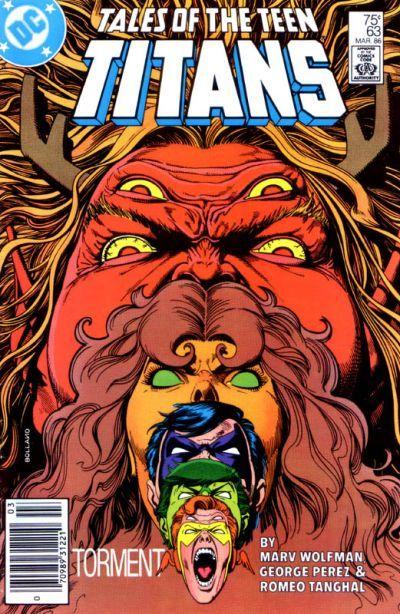

The souls of Azarath, the good side of all the evil that created Trigon, have been manipulating the whole thing all along, making sure the Titans got possessed and killed Raven so she could be transformed into a force of purity powerful enough to destroy her father. She does so and then disappears in a blinding flash of light, smiling for the first time and not to be seen again for 17 issues or so.

And Trigon is done.

There’s stuff to talk about there, like how the Titans lost more than they gained in this battle, how no heroic action could defeat the villain and so forth, but the important note for this particular essay is that Trigon perishes due to Raven’s sacrifice and that’s the last we see of him. The final issue of Wolfman and Perez’s initial collaboration, which yielded over 50 issues of story, concludes with the menace they started with being defeated; a perfect circle.

Now of course with comics being serial fiction, the story didn’t end completely, but for the most part, creators have been restrained and respectful when it comes to Trigon. Wolfman bent a few times as he remained on the title over a decade longer, with the seeds of the Trigon story coming back around in the form of the corrupted souls of Azarath, the return of Raven’s dark side and more, but the big red guy stayed buried. Geoff Johns reanimated Trigon’s skeleton to show that the new Brother Blood meant business when he took over the franchise, but he left the real deal deceased. In the first issue of Phantom Stranger from a couple weeks back (which kind of prompted me to write this), Trigon made his first New 52 appearance, but that’s a whole other discussion.


The point is that at the end of the day, Trigon appeared in two stories proper, never lost cleanly, and has never been brought back. If he were to come back, it’s been established that it takes a miracle that goes beyond the combined might of the DC heroes to defeat him, so that right there sets the stage for a whopper of a story (that probably shouldn’t be told).

I believe Wolfman and Perez’s best intentions for The Terminator (he wasn’t really Deathstroke aside from as a fleeting nickname until he got his own book over a decade later) were similar to Trigon in that he had a super arc with a definitive beginning, middle and end. As I said, he was introduced in the second issue wherein we also met his doomed son Ravager who tried and failed to destroy the Titans, dying in the process and honor binding his old man to take on the contract. Slade and the Titans clashed a few times over the next four years, like Trigon with him never really going down in full defeat, but unlike Trigon without him dominating so thoroughly that he couldn’t show up again a couple issues later.


The big showstopper for Terminator is of course The Judas Contract, where he plays the Terra card, delivers the Titans to the H.I.V.E., and then is pretty much ready to coldly walk away from the whole thing, his duty done, until it blows up in his face. His subsequent trial is the cool down and as I’ve said before, “Shades of Gray!” from Tales of the Teen Titans #55, where Changeling is prepared to kill Terminator and Slade says go ahead, willing to pay for his crimes, but they instead end up talking things out and understanding each other, is one of my favorite stories ever. That should have been the end for The Terminator; his story was done, and indeed apart from a Crisis cameo he stayed gone (as far as I know) for around four years before Wolfman brought him back just before Titans Hunt and to set up his solo book as a protagonist.

Part of me likes the idea of Slade Wilson playing his part and then exiting with dignity, but the larger part understands why it makes more sense for Deathstroke to be a larger part of the DC Universe, because he’s a great character who as opposed to Trigon can realistically appear without jeopardizing all of reality. Also, whereas The Terminator was originally the sole property of the Titans book just like Trigon, he’s been able to branch out since, which has led at times perhaps to overexposure, but also some really great stories extending far past Judas Contract.


Ultimately, the comic book medium—or at least the mainstream super hero part of it—needs good recurring villains who can jump around a shared universe, as it’s that larger ongoing narrative that demands servicing. But stories like what Wolfman and Perez did with Trigon demonstrate that finite threads can exist and thrive beyond creator owned and genre comics, and that when done right they can elevate the craft and create villains and stories that further the heroes that survive them better by being closed and gone.

Monday, September 13, 2010

The Definitives: Dick Grayson

A couple months back, I wrote about the evolution of the Robin character, in the course of doing so hitting largely on the progression of Dick Grayson, the original Boy Wonder as a character.

Whether as Robin, Nightwing or currently Batman, Grayson has always been one of my favorite comic book heroes. This is a bit a departure for me as I’m generally more beholden to the snarky rebel types as my touchstones, but there’s also that well-concealed nice guy side of me who really roots for the true blue Heroes with a capital “H” of comics. With Dick Grayson, he’s a guy who represents both sides of my fandom there, as he’s certainly among the more wholesome good guys even in the virtuous DC Universe—particularly when you consider his mentor—but also has that devil-may-care swashbuckler attitude born of the carnival.

Perhaps the most impressive thing about Dick Grayson is that in addition to his longevity, he’s probably been successful in more diverse identities than any other major character in comics as noted above. Sure lots of heroes and villains undergo the occasional name or costume change, but Dick has full-on reinvented everything about himself twice now and not really missed a beat as far as remaining at the forefront of the DCU as one of its most popular leading men.

Given that Dick Grayson has a history stretching back to 1940, I certainly make no claim to have read anywhere near even a majority representation of his appearances—I haven’t really read any Batman comics pre-dating the 80’s, including the crazy Silver Age stuff and really good 70’s stuff—but even so, I’ve got quite a few stories that spring to mind when thinking about why I dig comics’ original sidekick.

ROBIN: YEAR ONE
Few writers of the modern era have more familiarity with Dick Grayson than Chuck Dixon, who spent over five years writing him on the Nightwing ongoing title. Here, Dixon teams with co-writer Scott Beatty and artist Javier Pulido not to re-tell Robin’s origin story, but to flesh out his earliest days with Batman. Pulido’s art is perfect here, as he nails the brightly-clad figure of the Boy Wonder but drags him into the slightly darker situations Dixon and Beatty have concocted without dimming his luster. This is a great coming-of-age story that sees young Dick Grayson attempting to prove himself worthy of the responsibility given him by Batman—your basic father-son dynamic cranked up to superheroic proportions—by taking on way more than he probably should be on his own and coming up against Two-Face, foreshadowing later feuds between the two characters across various identities. Dixon and Beatty also show Robin’s nascent relationship with Batgirl and emotionally explore his connection with Alfred, the series’ narrator.

“The Murder Machine” (NEW TEEN TITANS ANNUAL #2)
The climax to the simmering storyline that introduced Adrian Chase into his costumed role as Vigilante is also an extremely important chapter in the life of Dick Grayson, as he reaches his final days as Robin. Having grown distant from Batman, the now-Teen Wonder finds himself partnering with Chase for a harder-edged war on crime and searching his soul for what kind of man he wants to be as he draws closer to true adulthood, seeing both positive and negative reflections of himself in his new ally. This extra-sized tale by the superlative Titans team of Marv Wolfman and George Perez sees the crew team with Vigilante against an army of assassins in an action-packed thrill ride, but more importantly it is for all intents and purposes one of the last true Robin stories as far as Dick Grayson is concerned and key reading if you’re looking to understand the character.

“The Judas Contract” (TALES OF THE TEEN TITANS #42-44, ANNUAL #3)
Maybe Wolfman and Perez’s greatest Titans opus—and that’s saying something—this one has it all, from the origin of Deathstroke to Terra’s betrayal to Jericho’s introduction and much more, but for our purposes, no aspect of the story is more important than Dick Grayson’s dynamic debut as Nightwing. Even before putting on his new disco-collared duds, the former Robin proves the only Titans capable of eluding The Terminator, an impressive feat when one considers his teammates, but also a reminder of what makes the character so special. Again, a crucial stage in the larger Dick Grayson tapestry, not to mention of the best comic stories of all-time, so call this a win all around.

“Nightwing: Year One” (NIGHTWING #101-106)
Wrote a whole entry on this one.

“Wings Over Gotham” (ROBIN #13)
The conclusion of “Prodigal,” the 1995 storyline that saw Bruce Wayne temporarily hand over the role of Batman to Dick Grayson while recovering from a prior ordeal that saw Jean-Paul Valley sullying the mantel. This issue, written again by Dixon, has Bruce returning, ready to be Batman again, but Dick not quite ready to give up the cowl until they have a conversation years in the making that has been building ever since he abandoned the Robin persona. It’s another big growth moment for Dick as he stands up for himself against his father figure and asserts not only his independence, but calls Bruce out on his lapses in judgment; for his own part, the original Batman stands his ground, but admits he has sold his protégé short more than once. It’s a watershed encounter that re-establishes the Nightwing-Batman relationship more as one between equals and alters their dynamic moving forward (also, Tim Drake fights a bad guy, but that’s pretty secondary).

“A Knight in Bludhaven” (NIGHTWING #1-8)
Dixon and Scott McDaniel’s kickoff to their lengthy run on Dick Grayson’s first ongoing series and they hit the ground running, creating a brand new playground for Nightwing to establish himself in Bludhaven, a sort of mini-Gotham that’s even more gruesome than the original in some ways. For the next several years, Bludhaven would serve a key role in giving Dick Grayson his own identity separate from Batman or the Titans, complete with his own rogues gallery, supporting cast and unique locales, but especially establishing him as the sole guardian of a place that needed him, not just a stand-in or supporting player. The first eight issues have Nightwing setting up shop and declaring war on Blockbuster, the bulky and brilliant mastermind who would become the Kingpin to his Daredevil, so to say. My personal highlight from this initial run is “The Visitor” from issue #6, in which Tim Drake drops by and the two “brothers” spend a night talking over Dick’s latest adventures as they hop across rooftops and moving trains, really giving McDaniel a chance to show off.

“Till Death Do Us Part” (NIGHTWING ANNUAL #2)
You could argue all day whether Dick Grayson’s true destined love is Starfire or Barbara Gordon, but Marc Andreyko and Joe Bennett make a pretty heartfelt case for the latter in this touching, sweet and often heart-wrenching one-shot covering the “missing year” from after Infinite Crisis and what became of Nightwing’s marriage proposal to Oracle. As the star-crossed duo recovers from the latest upheaval and mull over what’s next for them, Andreyko revisits the high and low points of their lengthy courtship in great detail. That Robin-Batgirl kid crush that became something more is something I feel like is almost woven into culture beyond just the DC Universe, and it’s certainly one I feel like I can relate to, so to see it so thoroughly dissected here and ushered into adulthood not only makes for a good story, but feels integral to who Dick Grayson is. The creative team here does an excellent job showing why this may be DC’s best couple, and at the same time why they can probably never be together for too long.

“Batman Reborn” (BATMAN AND ROBIN #1-3)
Grant Morrison and Frank Quitely’s first arc in this brave and bold new era of Batman showed once and for all that Dick Grayson was more than fit to wear the cowl, but also that he’d be a very different kind of Dark Knight—and that’s a good thing. I remember being really impressed with how Morrison acknowledged every stage of Dick’s past, from jubilant sidekick to defiant young hero, and made this very much the logical destination for the character. Quitely’s art is dynamic and the creative duo usher in wonderfully creepy new villains and a nicely refined status quo for the latest Dynamic Duo.

Thursday, June 17, 2010

Cruel Summer: Deathstroke The Terminator

When I first started taking an active interest in DC comic books in the early to mid-90’s, I thought, despite his name, that Deathstroke the Terminator was a super hero.

On the surface, it certainly seemed that way. For one thing, he had an ongoing series, and as far as I could tell, villains didn’t get those (Eclipso was an anomaly to me and I figured that was why Venom only got minis). I also remember reading bits and pieces of Panic in the Sky and seeing that Deathstroke was in there fighting Brainiac alongside Superman and the Justice League, pretty vigorously at that. Heck, I think he even wore a black arm band when Superman died.

And it was the 90’s, so “Deathstroke” was hardly the worst name I saw affixed to a good guy.

Imagine my surprise several years later reading Marv Wolfman and George Perez’ seminal New Teen Titans and learning that The Terminator—who they never really called Deathstroke even though that name was used at some point briefly in his early appearances—was a bad guy!

To be fair though, Slade Wilson wasn’t really that bad a guy. Well, he was. I’ll try to explain.

The thing that pushed The Terminator from vigilante to villain particularly in his earliest appearances weren’t just that he was pretty hard line about the ends justifying the means; it was that his ends were pretty unimpressive from a moral compass standpoint. The guy was a mercenary; end of the day, he was looking to score a pay day, and thus whatever he did to you along the way was cool. It wasn’t personal, but it was still pretty douchey.

Of course the whole genesis of Slade’s introduction to the DC Universe and grudge with the Titans was that his son got killed trying to collect a bounty he turned down from the H.I.V.E. for the teens’ heads so now he feels obligated to finish the contract. On the one hand, it’s honorable in a sense that he’s doing this for his kid; on the other, he’s still trying to ice a bunch of teenagers. And the really nasty stuff he did—primarily using and bedding a (maybe) barely legal sociopath as part of his master plan—code of honor or not was pretty darn inexcusable.

However, The Terminator’s motivation wasn’t really power or even money-driven when it came to the Titans; it was about preserving his family name, which sets him apart from a lot of the villain set similarly to what I was talking about with Kraven recently.

Ironically or appropriately—probably a little of both—perhaps my very favorite Terminator story is entitled “Shades of Gray” and comes from Tales of the Teen Titans #55 by Wolfman and Ron Randall. It’s after Slade has fulfilled his contract and gotten away with it after being acquitted thanks to friends in high places, so Changeling comes after him for revenge over what happened to Terra. Terminator beats the crap out of Changeling but doesn’t kill him, then calmly invites him to join him for breakfast, where he more or less says it sucks that Terra is dead, but he was just doing his job and now that it’s over he’s not going to bother the Titans anymore because he’s got no issue with them.

It’s a pretty awesome issue and a pretty awesome scene. It was also the perfect cap to The Terminator story because there really was no motivation for him to keep coming after the Titans or any other heroes as his story was over and his goal accomplished. Wolfman provided a great coda to the saga of a wonderfully complex character he’d begun five years earlier.

Unfortunately, Deathstroke couldn’t fade quietly into the night because he was too darn popular. To his credit, Wolfman held off bringing him back for a solid few years, and then when he did, he didn’t just invent a new reason for him to oppose the Titans, he brought him back as their ally, which made sense as his son was a member of their team.

At first, Deathstroke was kind of cool as a bad ass pseudo good guy with a distinct dark side. Reading the full Panic in the Sky story, I dug how he’s the guy Superman doesn’t want to go to for help because of his past, but needs for his military experience. He did ok for a bit on the outskirts of the DCU.

But more and more, Deathstroke the headliner became contrived and forced. The guy was a mercenary, yet he wasn’t taking assassination jobs on a monthly basis because stars of their own books just didn’t do that (even with Deadpool, who’s had a much longer shelf life, you notice he always has the heroic impulses creeping up every few issues as opposed to actually being a straight up “Merc with a Mouth”).

So Deathstroke’s book got cancelled and he became a bit of a toxic character for a bit because he was so far afield from the guy he started out as. I think he had a few cool appearances in the Batman books as a dude just taking money to kick the crap out of Batman, which is really the perfect use for him, but they were few and far between.

Then along comes Brad Meltzer’s Identity Crisis in 2004 and the inspirational rebirth of Deathstroke as a viable ass-kicker. In issue #3, Slade takes on the bulk of the Justice League—no big three—in a matchup fans had dreamed of back in the 80’s yet never saw and he dismantles them with precision and forethought, immediately bumping him back up to A-level baddie. Admittedly some of the ways he took out the heroes could be seen as a bit contrived—I never really bought that he took control of Green Lantern’s ring by just “out-willing” him—but Meltzer wrote the sequence with such obvious enthusiasm and it was so well-laid-out by Rags Morales that the cracks were pretty hard to see beneath the fun.

Suddenly, Deathstroke is back and Deathstroke is cool and everybody wants to use Deathstroke again. Out of all this we get some pretty neat comics, but also some that just seem to miss the point; that point being that Slade Wilson is not a moustache-twirling, cackling, out-and-out villain, he’s shades of gray, baby.

Meltzer had Deathstroke as the “bad guy” in Identity Crisis in the sense that he’s beating up the Justice League, but he’s really more of a set piece than anything else; near as I can tell, Meltzer didn’t really have any sort of goal as far as stripping down Slade Wilson and telling some broad character arc, he just had an idea for a great fight scene and pulled it off nicely.

But in the ensuing half-decade, I feel like we’ve seen too much of Deathstroke as just a plain old super villain who takes things personally and goes after heroes just cos. It’s the flipside of why he didn’t work in the 90’s as a hero.

That first run of Titans stories was awesome because it gave The Terminator a clear mission statement and reason for doing what he did: he was going to finish the contract his son took on to deliver the Teen Titans to H.I.V.E. no matter what he had to do in order to accomplish that, and then he was going to move on. It was nothing personal; they were just a mission.

The Deathstroke of today, in my opinion, takes things way too personal. He’s not a pro anymore. He attacks guys because they pissed him off, not because of any debt of honor or because there’s money to be made; that’s not Slade Wilson to me, that’s just a super villain. You make Deathstroke just another bad guy who holds grudges and has archenemies, you take away what makes him unique and cool.

To be fair, some excellent stories have been written with Deathstroke as a bad guy (I dug his Judd Winick-written appearances in Green Arrow myself) just as some awesome stories were written with Deathstroke as a good guy, but I maintain the best stories have The Terminator awash in shades of gray. It will always be tough to reinvent Slade beyond where those first five years of his existence had him just because Marv Wolfman really did give him a perfect beginning, middle and end, but I also understand there’s too many cool aspects to the guy—his rad costume not being the least among them—to just let him sit in limbo, so I heartily root for those who take on the challenge of taking him into the future.

Ultimately, Slade Wilson is a decent hero and an ok villain, but he’s an excellent character.

Thursday, June 10, 2010

The majesty of Diamondhead

I love Paul Tobin’s still freshly-re-launched Marvel Adventures Super Heroes for a litany of reasons, but certainly not small among them is the fact that he chose to place Nova on one of the neatest Avengers line-ups in recent memory/possibly ever (the other folks on the team are Captain America, Iron Man, Thor, The Invisible Woman, The Vision and Black Widow).

However, not only does Tobin clearly have an affection for The Human Rocket, as he demonstrated in the currently-on-sale issue #3—the one with Captain America adorning a gorgeous cover by Clayton Henry—he digs on his kooky rogues gallery as well!

In said issue, the pairing of Vision and the Widow are out getting lunch and trying to pick out a civilian name for Vizh—everybody but Nova thinks “Victor Shade” is too dark—when a reformed counterfeit artist approaches them seeking help getting her out of an extortion scam perpetrated by The Owl and his partner, none other than the devious Diamondhead! Of course once Nova gets wind of what’s going on, he charges the scene being all “He’s one of mine!” (he does actually say a close approximation of that) and the battle is on.

It’s a neat little in a series that is packed with them—Tobin is so good at balancing civilian life with action in stories that don’t just appeal to kids but are great for adults—but I love the fact that Diamondhead, in all his weirdness, has become something of a “go-to” villain for writers using Nova in their stories.

Now granted all of Nova’s personal villains are fairly eccentric, as I wrote a little while back, but Diamondhead has a special place in my heart. I’d love to hear his secret origin some time, but my guess is really that Marv Wolfman came up with a cool name, told Sal Buscema, and he did a wonderfully on-the-nose design of a guy who quite literally had a diamond for a head.

There’s really not a lot to Diamondhead other than that his real name is Arch Dyker (awesome) and he was a member of the fearsome Terrible Trio (no, not the Batman villains) alongside Condor and Powerhouse. Far as I know, the guy never got an origin, he’s just a dude made out of diamond who is really strong and indestructible (though he constantly gets shattered and then has to regenerate).

In many ways, Diamondhead has served as more of a litmus test for Nova’s evolving power level through the years than anything else. Back when he first appeared, he gave the inexperienced Rich Rider fits. When he came back during Fabian Nicieza’s 90’s series, he still posed a challenge, but not nearly as much. In his most recent main Marvel Universe appearance in the Dan Abnett/Andy Lanning Nova series, he literally waited outside of Nova’s house after the New Warriors’ secret identities were revealed in Civil War—which is just tremendous—and got his ass handed to him by post-Annihilation Rich.

So yeah, Diamondhead is never going to be the next Joker—though that would be amazing—but good on him for having a neat enough look and hook that it’s pretty rest assured whenever Nova shows up somewhere, he won’t be far behind for his token every-decade-or-so appearance.

Now back to my pitch for a team book starring Diamondhead, Diamondback and Blue Diamond called Diamonds in the Rough…