

New
Teen Titans by Marv Wolfman and George Perez, one of my favorite and most
well-regarded comic book runs of all-time, featured a varied and wonderful cast
of heroes as well as villains, without any of whom the end product would not be
so special (maybe Azrael), but at the end of the day, it’s the story of Raven.
She’s the first presence we sense in the first story (not New Teen Titans #1,
but the preview in DC Comics Presents #26), she brings the team together, and
the scope of her story and the threat she’s on the run from immediately
established that this iteration of Teen Titans were more than just the Justice
League’s sidekicks, they were the gateway to worlds and stories not yet
explored.
In
that very first issue of NTT, the Titans ostensibly come together to rescue
Starfire from the alien Gordanians, but Raven’s foreboding concern over a larger
evil sets the stage that this is an epic in the making; a crafted piece of
serial storytelling, not just the relatively standalone adventures of past
Titans series and really of the JLA as well up to that point (it was closer to
Chris Claremont’s Uncanny X-Men than anything, hence the years-long battle the
two titles would wage through the first half of the 80’s for the top spot in
the hearts and wallets of discerning readers clearly eager for this type of fare).
Over
the next three issues, the Titans would face Deathstroke the Terminator for the
first time and have their initial skirmish with Dr. Light’s Fearsome Five, but
every step brought them closer to confronting Raven’s greatest fear: her father
Trigon.

Short form on Trigon: he’s an incredibly powerful demon from another dimension formed from an entire race’s cast-off evil who killed his mother and everybody around him at birth, destroyed a planet as a toddler and has conquered millions of worlds by adulthood. He comes to Earth at one point as the result of a Satanic ritual, disguises himself, seduces a human woman who gives birth to Raven, then heads back home, occasionally murdering from afar anybody who threatens his daughter. He’s an imposing, impressive, downright scary character created from the combination of Wolfman using his horror writing background and pushing religious aspects generally shied away from in comics at the time, and an unsurprisingly dynamic design from Perez.
Raven
is unable to get the Justice League to fight Trigon (Zatanna senses bad mojo
about her), so she recruits the Titans, and in issue #5, they fight his
henchman, Goronn, who they only barely defeat (not sure if Wolfman
intentionally echoed Silver Surfer/Galactus there, but it worked for me),
before getting annihilated by Trigon. Raven sacrifices herself and agrees to
return home with her father if he leaves Earth alone. The next issue, the
Titans pursue their teammate, get beaten by Trigon again, but are able to
rescue Raven when her mother, Arella, basically distracts Trigon long enough
for them to run back to Earth and close the dimensional portal behind them.
So
what’s important to note is that the good guys do not win; they don’t even come
close. They’re able to save Earth only because one of them basically
surrenders, and then claim a small “victory” not by defeating the villain, but
by turning tail and essentially lock the door behind them, keeping the killer
outside the house for a bit.

What’s even more important is the restraint Wolfman and Perez then proceed to exercise with Trigon. The Titans escape him in New Teen Titans volume one #6, published in April 1981; he does not appear again until the kickoff of their second volume, over three years later in August 1984.
Between
the two Trigon stories, the Titans battle the gods of Olympus, find the Doom
Patrol, go to outer space, take a new member into their midst, lose two of
their founding members—one of whom comes back with a new identity—get betrayed
by that new member who then dies and see one of their own get married. They
fight Deathstroke three times, Brother Blood twice, the Fearsome Five and
Brotherhood of Evil a couple times apiece and take down the H.I.V.E., who had
been orchestrating against them for over two years (our time).
All
of this goes down without Wolfman and Perez giving into temptation and bringing
back the most powerful Titans adversary. Instead, they namedrop him every so
often and in both narrative and visually (seriously, pay attention to the art)
show that something is up with Raven.
They
had a plan and they did not deviate.

When it did come time from Trigon’s second act, he didn’t need to be revitalized or amped up, because in his original form, he had never been beaten. Indeed, with his first appearance showing off only a fraction of Trigon’s full power, it merely whet the appetite for what he could do unleashed—namely show up on Earth, handily run through the Justice League and transform the planet into a burnt out husk in moments (the most lasting image of the Terror of Trigon story for me is likely Superman turned to stone, an expression of eternally agony etched across his face, as we pan across the destruction).
The
Titans are humanity’s last hope, not because they’re the most powerful group
out there, but because of their ties to Raven, Trigon’s one weakness, the
daughter he continues to believe will be his heir. It’s a touching coda in a
way to Wolfman and Perez’s larger story and one of the big points they’ve been
trying to make: it’s not about how much power you have, it’s about being there
for your friends and family; ultimately, because the Titans focused on looking
out for each other first and foremost, they’re the ones in a position to save
the world when those who usually would are out of commission.
But
they still can’t.
Trigon
is way too powerful for the Titans and Raven ends up being corrupted by him.
Rather than kill his daughter’s friends, Trigon infects them with his evil as
well, creating spooky four-eyed demonic versions of Nightwing, Wonder Girl,
Starfire, Cyborg, Changeling and Kid Flash who run their good sides through
nightmare scenarios so they can take control. And then, in sharp contrast to
the whole “friends and family” trip I was on before, the Trigon Titans turn on
Raven and kill her…which allows her to defeat Trigon, though no plan of her own
or of her friends’.
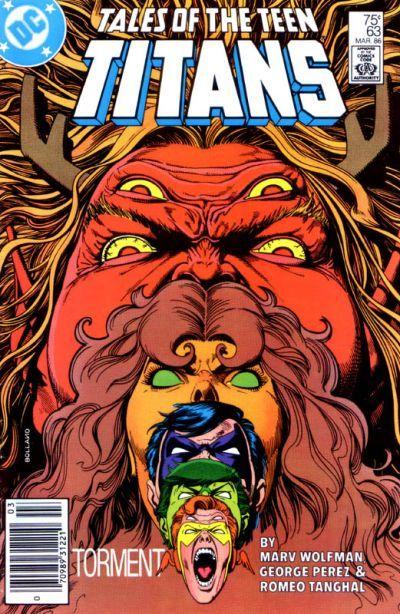
The souls of Azarath, the good side of all the evil that created Trigon, have been manipulating the whole thing all along, making sure the Titans got possessed and killed Raven so she could be transformed into a force of purity powerful enough to destroy her father. She does so and then disappears in a blinding flash of light, smiling for the first time and not to be seen again for 17 issues or so.
And
Trigon is done.
There’s
stuff to talk about there, like how the Titans lost more than they gained in
this battle, how no heroic action could defeat the villain and so forth, but
the important note for this particular essay is that Trigon perishes due to
Raven’s sacrifice and that’s the last we see of him. The final issue of Wolfman
and Perez’s initial collaboration, which yielded over 50 issues of story,
concludes with the menace they started with being defeated; a perfect circle.
Now
of course with comics being serial fiction, the story didn’t end completely,
but for the most part, creators have been restrained and respectful when it
comes to Trigon. Wolfman bent a few times as he remained on the title over a
decade longer, with the seeds of the Trigon story coming back around in the
form of the corrupted souls of Azarath, the return of Raven’s dark side and
more, but the big red guy stayed buried. Geoff Johns reanimated Trigon’s
skeleton to show that the new Brother Blood meant business when he took over
the franchise, but he left the real deal deceased. In the first issue of
Phantom Stranger from a couple weeks back (which kind of prompted me to write
this), Trigon made his first New 52 appearance, but that’s a whole other
discussion.

The point is that at the end of the day, Trigon appeared in two stories proper, never lost cleanly, and has never been brought back. If he were to come back, it’s been established that it takes a miracle that goes beyond the combined might of the DC heroes to defeat him, so that right there sets the stage for a whopper of a story (that probably shouldn’t be told).
I
believe Wolfman and Perez’s best intentions for The Terminator (he wasn’t
really Deathstroke aside from as a fleeting nickname until he got his own book
over a decade later) were similar to Trigon in that he had a super arc with a
definitive beginning, middle and end. As I said, he was introduced in the
second issue wherein we also met his doomed son Ravager who tried and failed to
destroy the Titans, dying in the process and honor binding his old man to take
on the contract. Slade and the Titans clashed a few times over the next four
years, like Trigon with him never really going down in full defeat, but unlike
Trigon without him dominating so thoroughly that he couldn’t show up again a
couple issues later.

The big showstopper for Terminator is of course The Judas Contract, where he plays the Terra card, delivers the Titans to the H.I.V.E., and then is pretty much ready to coldly walk away from the whole thing, his duty done, until it blows up in his face. His subsequent trial is the cool down and as I’ve said before, “Shades of Gray!” from Tales of the Teen Titans #55, where Changeling is prepared to kill Terminator and Slade says go ahead, willing to pay for his crimes, but they instead end up talking things out and understanding each other, is one of my favorite stories ever. That should have been the end for The Terminator; his story was done, and indeed apart from a Crisis cameo he stayed gone (as far as I know) for around four years before Wolfman brought him back just before Titans Hunt and to set up his solo book as a protagonist.
Part
of me likes the idea of Slade Wilson playing his part and then exiting with
dignity, but the larger part understands why it makes more sense for
Deathstroke to be a larger part of the DC Universe, because he’s a great
character who as opposed to Trigon can realistically appear without
jeopardizing all of reality. Also, whereas The Terminator was originally the
sole property of the Titans book just like Trigon, he’s been able to branch out
since, which has led at times perhaps to overexposure, but also some really
great stories extending far past Judas Contract.

Ultimately, the comic book medium—or at least the mainstream super hero part of it—needs good recurring villains who can jump around a shared universe, as it’s that larger ongoing narrative that demands servicing. But stories like what Wolfman and Perez did with Trigon demonstrate that finite threads can exist and thrive beyond creator owned and genre comics, and that when done right they can elevate the craft and create villains and stories that further the heroes that survive them better by being closed and gone.


