Sunday, January 23, 2011

Skins: The British version is better

I need to credit Chris Ward for this post, first because he got me and Megan watching the UK series Skins in the first place, but also because the title above is totally his doing. I was waffling on whether or not to even try to the U.S. version of the series, when he said to me, “C’mon, you have to—haven’t you ever wanted to be able to watch a show and be able to tell everybody the British version was better?” And he’s right; that’s a dream I didn’t even know I had, but I totally do.

And though I haven’t even watched the pilot of the U.S. Skins yet (it’s DVRed) I can safely say yes, the British version is better.

First off, for those of you not familiar with the show I’m talking about, here’s the quick description Wikipedia gives (and if you click that link, I’d highly advise just to skim and look at the pics, because you really should watch this show yourself at some point): Skins is a British teen drama that follows a group of teenagers in Bristol, South West England, through the two years of sixth form. The controversial plot line explores issues such as dysfunctional families, mental illness (including eating disorders), sexual orientation identity, substance abuse and death.

In about two weeks, we’ve devoured the first two seasons of 10 episodes apiece, which in a sense is almost like watching an entire series as they change over the entire cast with season three (apologies to our UK fans for using the terms “season” and “series” the American way). Once time has given the show its proper context, I’m not sure how it will ultimately rank among my all-time favorites, but I can say that I’m deeply impressed with the sheer amount it’s able to accomplish over the span of just 20 installments.

For one, I was amazed at how much the characters change over the course of the show, but also how natural it feels. Season two has a completely different—and markedly darker—vibe to it than season one that really keeps things fresh and incredibly interesting. In particular, I was pretty blown away by just how much of a 180 Nicholas Hoult does in his portrayal of central lead Tony Stonem, already an immensely complex and layered antihero type in season one who comes back with a completely altered personality in season two; Hoult changes everything from his posture on down to illustrate the shift and you get tingles when traces of the “old” Tony surface from time to time. Similarly but more subtly, Hannah Murray takes Cassie Ainsworth from, as my wife put it, “quirky to bitter” with an arc that feels almost sadly real. These are probably my two favorite characters on the show—though there’s not a single member of the ensemble I don’t like to at least some degree—because the actors portraying them are immensely talented as well as because of the weight of their stories.

Something that really sets Skins apart from, say, Gossip Girl, for me (and there are many things) is that on Skins some really tragic stuff happens to these kids, but it resonates. They never get over their tragedies fully, just like we never get over a lot of the bad stuff that happens to use in real life, at least not completely. For Tony, Cassie, Sid, Chris, and heck, really all of them, stuff just keeps chipping away at them, whether it’s “small” stuff like relationship trouble or comparatively big things like a loved one dying, and they do not emerge rebooted a few episodes later as characters on American teen soap type shows (most of which I love) tend to do; they don’t become completely joyless and the program doesn’t stop being fun to watch, but they gain a harder edge and for me they became more endearing as a result. I really cared what happened to these kids to a degree I can’t honestly say I feel for, say, Serena and Dan.

It’s also worth noting the degree the folks writing and producing the show go to in order to try and make sure you don’t latch onto just one or two members of the cast—though picking favorites is of course inevitable—but that you feel at least some connection to all of them. Each episode (aside from the finales) is titled after a specific character and makes them the focal point. Something I found frustrating to begin with is the way an episode will end with a cliffhanger involving the title character and then the next installment you find out what happened only matter of fact since they’re now a background player in the new focal player’s story, but it’s actually pretty ingenious and works only because they throw down the gauntlet to make you forget about what came last time in order to focus on the new story and pull it off just about every time.

So with all the hubbub about the U.S. version of the show on MTV and having heard I’d been watching the original, a couple of my friends asked me what exactly the big deal was.

More to the point, they wanted to know why the U.S. version was getting so much attention, much of it negative, alienating advertisers and critics and so forth who have described it as “just kids running around in their underwear doing drugs and having sex.” They also wanted to know what exactly set Skins apart from any other teen soap opera and why it’s anything different.

To the second question, I answered pretty much what I summed up above: There are no gimmicks or hooks that set the UK Skins apart from 90210 or what have you to me, just the fact that it’s a really well done show with impressive writing and excellent acting. As I got into a bit, the fact that the kids seem somewhat more real at least in terms of their reaction to hardships and forced maturation in the face of difficult times certainly makes it stand out, but it’s hardly groundbreaking, I just haven’t seen it done quite as well much elsewhere.

To the first question, I think the controversy and hullaballoo is coming primarily from the fact that the people making the American version (which, again, I have yet to watch) don’t seem to understand what makes the original special. They do indeed see a group of kids running around in their underwear having sex and doing drugs, but fail to realize that’s just the setting, not the meat of the show. Even just from watching commercials for the U.S. version and seeing ad after ad on the subway, I can see that they’re pushing the “kids gone wild” angle fast and furious, not really making much effort to say “and also, this is a really smartly-written and well-acted show,” which who knows, maybe it is. It’s a sad commentary on MTV and probably the American television industry that in this Jersey Shore era the logical ad campaign is “These barely legal kids like to fuck!” as opposed to anything else (and it’s also worth noting the cast of the UK version is meant to be and appears to be around 18, whereas the MTV crew looks about 13 tops).

I’ve been sparse on the spoilery details throughout here because I really do encourage anybody who hasn’t and is able to check out the UK version of Skins, the first two seasons in particular. It’s really something and I’m pleased to say my first true insight into some of the stuff you can do over there when it comes to making television as opposed to over here; I am proud to proclaim that in this case, the British version is indeed better.

Wednesday, January 19, 2011

Underrated/Overlooked: Legion of Super-Heroes "Year One"

I was, once upon a time, one of those great unwashed who found the Legion of Super-Heroes too intimidating and complicated.

To be fair, my primary exposure to the Legion growing up was through house ads for the “Five Years Later” incarnation in the DC books I did read, so to me it was a book about sad-looking middle-aged people dressing in shabby rags, sitting around looking forlorn (I’ve since come to appreciate that era of the mythos, but with no sense of context or what came before, it did not look terribly appealing, particularly to a kid who liked shiny super heroes). I picked up a couple issues of Legionnaires, but could not make heads or tails of where it fit with the other book or reconcile why there were all these characters with the same names and powers.

The first Legion book I vividly remember buying and reading was one of the middle chapters of the “End of an Era” crossover running through all three of the group’s titles (including Valor) prior to Zero Hour. It involved trying to collapse pretty much all of Legion history up to that point, attempting to sort out decades of inconsistencies in six issues and wrap up the group’s story once and for all to clear the decks for a full reboot.

In short: It doesn’t seem like there could be a worse issue for a Legion neophyte already wary of the towering continuity to try out.

And yet, it worked.

Or rather it worked in concert with something that struck me in the base framework of Legionnaires as well as the fact that both books were starting from scratch to tell a new version of the old story after Zero Hour wiped out all that had come before. The Zero issues of Legion of Super-Heroes and Legionnaires were great, and before I knew it, I became a full-fledged Legion junkie, with the franchise becoming probably the first DC one I really latched onto in the way I did Marvel books.

It’s interesting to me that when the publication history of the Legion gets summed up, generally it tends to jump straight from the Paul Levitz glory days of the 70’s and 80’s straight to when Dan Abnett and Andy Lanning came onboard in the late 90’s. If you go looking for the great Legion stories, you’re going to get directed to stuff like The Great Darkness Saga and Legion Lost, perhaps with a recommendation to check out Jim Shooter’s Silver Age stuff or Mark Waid’s “Threeboot” if you really want to look. And I love all of that stuff; Great Darkness is one of my favorite stories ever, the DnA run was some fantastic sci-fi that put my boys on the map, and I championed the Threeboot long and hard at Wizard. Yet it always confounds me that the post-Zero Hour re-launch gets more or less swept under the rug. Not only did it start off really strong, I do remember it being fairly successful commercially for a bit there, with lots of internal press for the books and the Final Night event more or less spinning out of Legion (before becoming a Green Lantern story in the end).

And as much as I’ve grown to love the Levitz Legion, DnA’s Legion, the Threeboot Legion and so on, that post-Zero Hour group remains the Legion I truly think of as mine.

I think the first year following Zero Hour is the strongest case for the “forgotten” Legion. After that, there were peaks and valleys and somewhere along the way when half the team was stranded in the present for what felt like forever I jumped off, but those first 12 months from the Zero issues to the Year One-themed annuals were rock solid, building a new mythology while also constructing a focused super story that paid off in spades. Mark Waid and Tom McGraw (I believe with the assistance of Roger Stern, though I’m having trouble confirming it, and later Tom Peyer) seemed to have a really clear idea of how they were going to prove to folks like me who had been so terrified of the Legion that here was a great concept when you stripped it down and focused on the basics of what made it cool.

Rather than being introduced as a sprawling and established organization coming back in time to recruit Superboy to their cause, this Legion started from the start, with three super-powered teens unexpectedly joining forces to save the life of a rich old man and giving him the idea that the future needed heroes. From there, Waid and McGraw did the slow rollout, introducing a couple new members each month, quickly enough so that they could fill out a clubhouse within a few issues and the requisite friendships and romances began to form, but with sufficient deliberation that we actually got to know the characters as individuals and not just names and powers in a virtual army.

Cosmic Boy was the natural leader. Live Wire was the dreamer with the wandering eye. Saturn Girl was the ice queen. Apparition was too perfect. Triad was conflicted. Leviathan had an inferiority complex he tried to mask with a false superiority complex. Invisible Kid was the guy you wanted to be friends with. XS was the schoolgirl in over her head. Chameleon was the foreign exchange student. Brainiac 5 was the arrogant jerk.

Each character was somebody you knew or could at least relate to, and as they interacted, you saw your own youth played out on a level you could only imagine. Because as I always say when it comes to the Legion, there is nothing better than the high concept of teenagers with super powers getting to live alone with other kids their own age in an awesome headquarters with no parents in sight and seemingly unlimited resources. Plus they got to save the universe every month. As somebody who loved summer camp, I think the Legion tapped into that part of me that thrived on escaping society a couple of months every year and getting to have responsibilities beyond my age thrust at me while also getting to act way younger—it still does.

Anyways, rambling aside, when you forget about the continuity crap, Legion is just a cool as it gets idea that should always be a lot of fun and wish fulfillment to the highest power. Waid and McGraw’s Legion was the embodiment of cutting through the smog of comic book complications and making the books a place you really wanted to spend time every month. It also helped that they had great artists in Stuart Immonen and Jeff Moy, each of whom brought something different to the table. Immonen in that early stage had a neat sort of gritty realism that he could pull off without making the stories seem dark. On the other end of the spectrum, Moy’s art was buoyant and full of life, but he could bring it for the emotionally heavy stuff as well. They complemented each other and what the writers were trying to do perfectly.

While the Legion grappled with an assortment of threats, Waid and McGraw also continued to add members like Shrinking Violet, Kinetix and the xenophobic Andromeda while also casting pre-Zero Hour Legionnaires like Ultra Boy in new roles—he was on a rival team but had a Romeo and Juliet love story going with Apparition in a nod to their classic romance—and throwing in curveballs like Live Wire being kicked off the team and replaced by his twin sister Spark. While I didn’t know everything about the Legion as it was before Zero Hour, I at least recognized many familiar characters or relationships, and enjoyed the wink by the creators as they found new ways to use old favorites like Matter-Eater Lad as the Legion’s chef or Bouncing Boy being a non-powered sort of intern (and having a crush of pre-Zero Hour wife Triad).

And the whole time, beginning right from Legion of Super-Heroes #0, something larger was going on off to the side. The people that tried to assassinate R.J. Brande were tied to a larger group called the White Triangle, a cabal of Daxamites founded on considering all other races inferior. Andromeda had ties to the White Triangle but hid them early on and also seemed to be slowly coming around. Members of the group beat one of Triad’s selves nearly to death. The plotline was very heavy stuff, dealing with tough issues like intolerance and hate crimes and doing it with maturity and weight in a fantastical setting like that of the Legion’s supposedly idyllic future. It hung around the fringes of the first year’s worth of stories, but with mastery, Waid and McGraw (at this point I believe with Peyer) brought it closer to the forefront until it reached a boiling point.

The Legionnaires Annual that wrapped the White Triangle story and carried the Year One banner which most books used to tell origin stories but here marked the conclusion of the new Legion’s first year of existence, felt very much like a season finale. The White Triangle finally found a way to get their Superman-level powers working on Earth and launched a full scale out in the open invasion. After months of working behind the scenes, the bad guys were here and they were terrifying.

It was all hands on deck as anybody who had left the team came back and every guest star available showed up to pitch in. Live Wire’s hero arc reached a dramatic crescendo as he returned to the team that had spurned him to help save the day. Andromeda was forced to finally pick a side. R.J. Brande showed up at the very last minute with a secret weapon that would make old school fans smile. Everybody got their big moments—and there were casualties. The deaths were not at all tossed off and had extreme gravitas to them; I remember getting quite emotional watching a couple of these new friends I’d gotten to know over the previous year get snuffed out.

That story still stands out to me well over a decade later as one of the best examples I’ve ever seen of how you build expectations and tension over the long haul and then end it right. It was just great storytelling.

So if the current Legion seems appealing to you but you’d a bit put off by the sheer number of characters or amount of continuity changes, let me make the suggestion that you try and track down the Legion of Super-Heroes: Beginning of Tomorrow trade and then scrounge up all the back issues you can. The post-Zero Hour Legion really is the ideal gateway to the concept working without any baggage, and if you’re like me, you’ll then be ready to take the training wheels off and start exploring forwards and backwards in the franchise. It’s a truly wonderful world to explore, you just need the right entry point, and I’m telling you, it’s the one even most hardcore fans forget ever existed.

Monday, January 17, 2011

Celebrating Martin Luther King Day with comics

I’ve never been shy about saying I grew up in a primarily white, primarily Jewish suburb where, despite what the posters at our high school may have said, there wasn’t a terrible degree of racial diversity. I barely had any Christian friends, let alone friends of color. My buddy and X-Men sketchbook collaborator Husani was an African-American kid who lived closer to Boston and came to our school via a program, but we unfortunately did not stay close long. It wouldn’t be until I attended summer camp both as a camper and particularly as a counselor that I became close with a wider range of people from different ethnic, social and religious backgrounds. Into college and on through today, I’ve certainly come to appreciate richness of relationships with those different than you, perhaps in particular because it was not something I enjoyed when I was younger.

Even when I was young though, Martin Luther King Day always seemed important to me. Part of that was—to be fair to the community I just kinda bashed—because my elementary school in particular always went out of its way to impart upon us its importance. Another part though honestly wasn’t that I was some great advocate for equality as much as inequality didn’t make any sense to me. Maybe that was a side effect of not having any real difference around me and thus not having really been exposed to bigotry, so when I read about it, it seemed as fictitious and nonsensical as anything I’d see in a comic book. I mean, The Hulk had green skin and Superman was an alien but they were good guys—why would I have a problem with a brown-skinned person or somebody from another country as long as they were nice?

And that, as always, brings us to comics (and thankfully the end of me trying to do some sort of socially aware PSA or whatever that was—thanks as ever for indulging me).

The comics industry has a history filled with many flaws and there are still plenty today. I love this business and this medium, but even its most ardent supporter will admit to you things can and have often been dark behind the scenes. However, more often than not, I’m proud of what comics can do, and one area where I feel like we’ve got a lot of other genres of entertainment beat is racial diversity.

I wish I could say comics has always been ahead of the curve when it came to the promotion and appreciation of minority creators, but unfortunately, that’s a far larger issue than our little corner of the world. Though some of the true legends of the game have been and continue to be today especially folks of all colors, creeds and so forth, the bigger flaws of society held back those who were different in comics just as they did pretty much anywhere else. Thankfully, as in most places, this is no longer the case and talent rises to the top regardless of superficial factors.

But we can say as an industry that at the very least when it came to the fiction we created over the years (and yeah, I’m probably unfairly saying “we” here, but it’s a pride thing), we made strides to be more inclusive than the world around us. Whether it was The Black Panther on the Avengers, blacks being as accepted as anybody in the Legion of Super-Heroes, comics both mainstream and underground tackling the issue of racial inequality head on all the way to Milestone Media or The Truth, comics has always attempted to create worlds where not only could men fly, but they truly were all created equal. Smarter folks than me could probably poke the preceding paragraph full of more holes than Swiss cheese, but I like to let my optimism fly in this case.

To celebrate Doctor King’s dream, I thought I’d take the opportunity real quick to examine my own personal history with a couple of black comic book characters who I really liked. However, it’s important to note I never liked these characters simply because of the color of their skin, but because they were great characters whose skin happened to be that color. Because in the end I think celebrating races that were held down for way too long is crucial to this day, but the dream is for a world where none of that matters and we judge people not by how they look or where they’re from, but to put it in CKT terms, how rad they are.

NIGHT THRASHER
As has been documented many times on this blog, my first true favorite comic book was the first volume of New Warriors, and it just so happened that the titular team that starred in that title was led and founded by a black man: Dwayne Taylor, aka Night Thrasher. Being a young Nova fan at the time, it was somewhat natural that I didn’t love Thrash at first, given that was kind of the Cyclops to Rich’s wannabe Wolverine, but the difference there was that Dwayne was pretty much always more of a badass than even my favorite, a fact I respectfully accepted. I was used to dull, boy scout team leaders in the vein of Scott Summers or Leonardo on the Ninja Turtles—did not like him—so I took some pride in the fact that the dude in charge of my team could actually back up his bluster; Night Thrasher was that older brother who was always in your face, except for when somebody else was, and then he had your back and you were really proud.

In many ways, Dwayne Taylor was a pretty blatant Batman/Bruce Wayne rip-off: a wealthy young man whose parents were killed, leading him to dedicate his time and resources to doing good and fighting crime. What set Night Thrasher apart was that he still had a major chip on his shoulder—youth will do that—he learned to fight by taking down street gangs rather than traveling the world and, yes, that he was black. But a lot of what made Batman cool made Night Thrasher cool, and then the stuff that made him different—he actually wanted a team of friends for one—made him cool in his own way.

CYBORG
I think it’s understated what an important character Victor Stone is in terms of his historical significant to and impact on the DC Universe. A lot of things made Marv Wolfman and George Perez’s New Teen Titans one of the best and most successful works of the 1980’s and perhaps of all time, but Cyborg was among the most vital. He gave the Titans an edge they had lacked in previous incarnations and opened up new worlds for them to explore. Where they had once been a team of sidekicks nobody took entirely seriously, they now counted among their ranks power players like Raven and Starfire, but especially Cyborg. Beyond his raw strength and cybernetic abilities, Vic also brought to the table a level of experience in dealing with hard times that exceeded his age—he was the first Titan to turn 20—and brought other characters like Robin and Changeling into their own then helped them deal with their maturation processes.

I like Cyborg in that golden age of the Titans because he’s so multi-layered. If you barely scratch the surface, you only see the kid pissed off at his father and the world for losing a life he loved and being forced to survive as a freak, however if you go deeper you see he’s not only somebody who wants to be loved, but a guy capable of impressive empathy given his own trials. He was the hardened heart of the Titans who not only made them a force to be reckoned with in the DC Universe, but who you knew would get in the face of anybody who said otherwise. There was a reason he got the call up to be part of the Super Friends on TV; great character.

Sunday, January 16, 2011

Art Attack: Anniversary/Birthday Present

I am blessed for so many wonderful things in my life, but nothing more than my amazing wife, Megan. A few months ago, we celebrated our one-year wedding anniversary and coming up next weekend is my 29th birthday; to commemorate both, Megan commissioned me an amazing piece of art from our buddy Todd Nauck...
It's me and Megan surrounded by my very favorite characters, Nova and The Flash, as well as her namesake, Miss Martian. Oh, and also Captain America (Megan wanted to include another Marvel icon). We're all chilling at the spot Megan and I took photos following our wedding in Newport, Rhode Island with us in our tux and dress.

I'm fortunate enough to have a great many original art pieces from Todd, but no question, this is my favorite yet. His incredible talent is undeniable and wow does he draw a wicked Flash.

In conclusion: I may be getting up there in the years, but I'm a luckier dude than ever! Thank you Todd and I love you so much, Megan!

Saturday, January 15, 2011

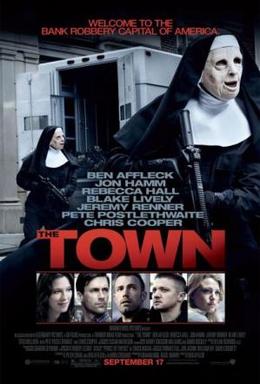
Paragraph Movie Reviews: The Town

If you don't have plans to see this movie, you can check the spoilers here and then come back.

All the pieces seemed to be there for this to be something special, and certainly it had great word of mouth, but for my money, things did not come together as they should have and I found myself quite let down. It was not so much a bad movie as a slow, plodding an uneven one, and there was some pretty terrible dialogue and painfully wooden monologues. I'd say Ben Affleck actually did a commendable job directing, as the technical aspects of the film were pretty top notch, but his acting performance was disjointed and all over the place, not really anchoring the story at all. I lay a lot of the blame for both the movie and Affleck's specific woes on Rebecca Hall being the female lead; I've yet to really enjoy her in anything I've seen her in and this was no different. I think her character is supposed to be naive or shellshocked, but she plays her just dumb, and the script does her no favors; her chemistry with Affleck is flat as I didn't buy their romance and the scenes they shared either dragged or made me groan. Jeremy Renner is the saving grace of the piece, bringing maniacal intensity and steely sadness to a part that could have been one-dimensional as well as coaxing Affleck's best stuff out of him and making me mourn the movie that could have been had it focused more on these two. Jon Hamm's smugness serves him well in some spots, not so much in others. Blake Lively is barely in the movie, but when she is she vacillates between sexy scene-stealing and awful parody. More or less each of the actors--with Renner and Hall being the exceptions at opposite extremes--did some pretty impressive stuff on occasion that was drowned out by blandness or awkward turns the rest of the time, which sums up the entire film more or less. Still, there was an awesome car chase and some good shootout scenes, so it wasn't a total waste outside of Jeremy Renner.

Tuesday, January 11, 2011

The Ka-Zar Conundrum

I swear I did not plan the timing of this post on purpose.

What I mean to say is that I don’t generally go in for shilling Marvel product on this blog. Yeah, if I like something the company I’m working for is putting out, which I do a lot, I’m not shy about saying, most frequently in Five Comics Worth Reading, which is designed in part with that function in mind. And yeah, I’ll pimp my own stuff in, well, Pimping My Stuff. However, I try not to set this blog up as a promotional machine to point out how cool upcoming projects look—aside from Art Attack—because I already do that quite nicely over on Marvel.com, I believe, and Kiel and his crew do the same on CBR.

So please believe me when I say I conceived of this post and began writing it in my head before I had any idea we’d be announcing today that my friend Rob Williams is writing what sounds like a dope series about Skaar going to the Savage Land and fighting Ka-Zar and a bunch of other folks for control of the kingdom. My intention in writing this piece was to talk about the coolness, both tapped and untapped, of Ka-Zar, Shanna, Zabu, etc., not to sell comics.

(But if this post does move you to learn more about these subjects, Skaar: King of the Savage Land by Rob Williams and Brian Ching starts in April)

Anyways, I finally got to read the first eight issues of Mark Waid and Andy Kubert’s much ballyhooed (or at least ballyhooed) Ka-Zar series of the mid-late 90’s, collected this very week. I was not let down. Waid’s doing what he does best, writing an endearing but flawed lead, exploring a strong but complex romantic relationship and packing in loads of action—it’s actually not totally unlike his Flash run, just with the hero in a loincloth as opposed to red and yellow spandex. Kubert gets to cut loose drawing dinosaurs, crazy cave folk, a darn hot Shanna and frankly the nastiest Rhino I’ve ever seen.

But I went in knowing I was going to dig Waid and Kubert’s work; Ka-Zar was the unknown commodity.

I like him. I like him a lot.

If you’re only familiar with Ka-Zar from guest appearances and maybe the 90’s X-Men cartoon, it’s easy to write him off as a typical Tarzan knockoff, the noble savage swinging around the jungle with his sabretooth tiger, fighting pterodactyls and hanging out with his hot leopard bikini-wearing lady. Indeed, many have depicted him as just that, but as Waid—and others—have demonstrated there’s more than that to the character.

Ka-Zar does not speak in grunts or say “Me Ka-Zar,” he is as witty and charming in his verbiage as any Marvel hero. He was not born in the Savage Land; he was raised for the early years of his life in England as Kevin Plunder, heir to British nobility. As Waid points out in his first issues, Kevin was nine when he came to the Savage Land, and though he came of age there, he still remembers his other life and retains a degree of it in his attitude.

While Ka-Zar has often been portrayed as weary to trust anybody or anything from outside the Savage Land, Waid writes him as a torn soul, divided between the wild kingdom he rules with mastery and the mysterious outside world he deep down harbors a rampant curiosity about. While outwardly the apex of manhood, Waid’s Ka-Zar is in many ways still a child, filled with wonder about the things he doesn’t know or fully understand, eager to explore. It’s certainly a fascinating dichotomy and in the hands of a skilled creator like Mark Waid, fertile ground for character exploration.

Speaking of dichotomy and contrast, another part of Ka-Zar’s appeal comes simply from the fact that he’s never alone: he and Shanna are a package deal. Unlike her husband, Shanna came willingly to the Savage Land as an adult, already having lived all the life she wanted to in the “real world.” There is no ambiguity in Shanna; she’s an incredibly strong woman who knows exactly what she wants and exactly where she stands and makes even her potent partner seem the tame one of the couple, no easy feat for a female character in comics. In Waid’s run, they bicker, and Ka-Zar seems justifiably intimidated by Shanna, but they’re also far stronger together, something they recognize. Oh, and by the way, despite being jungle adventurers who run around in next to nothing, they’re also loving and impressive parents of a young son! It’s a unique and special coupling that elevates both characters.

Yet despite the potential of both Ka-Zar and Shanna to be strong leads set apart from other Marvel Universe protagonists, a potential only scratched in stuff like Waid’s series or Christos Gage’s lead story in Marvel Comics Presents a few years back, it’s not difficult to discern what holds them back from becoming A-list characters, as it’s also one of their defining strengths: The Savage Land.

The Savage Land is one of the classic comic book locales and a go-to setting to show a different side of the typically urban heroes who populate the Marvel Universe. And you know if a character heads to the Savage Land, they’re going to inevitably run into Ka-Zar and Shanna, the same way there aren’t too many stories set in Wakanda where The Black Panther doesn’t at least cameo or in Atlantis that don’t involve Namor somehow. As much as I’m interested in all that other stuff I outlined above, the key component of Ka-Zar remains that he is the ruler of the Savage Land, and that if you go there he is the absolute best guy to have on your side.

Unfortunately, this means you’ve got basically two options if you want to tell a Ka-Zar story with some juicy conflict beyond him and Shanna hunting for food: Either a villain comes to the Savage Land looking to take it over/seek revenge on Ka-Zar/whatever, or Ka-Zar leaves the Savage Land for some compelling reason and fights villains in a more familiar setting like New York City and then goes home upon completing his mission. In the eight issues of Waid and Kubert’s run I’ve read, I’ve already seen both stories, and they were done well, but I can imagine coming up with continued reasons for either scenario to keep occurring is going to become straining. Besides that, if you’ve got an ongoing Ka-Zar series where bad guys and guest stars are finding reasons to come to the Savage Land, it probably means no other books are going to feature Savage Land adventures, which cuts off a valuable storytelling avenue.

The solution might seem to be to get Ka-Zar out of the Savage Land on a regular basis by having him join, say, the Avengers, but do that and you’re removing the character’s most defining trait and what makes him special; sure he’s got great survival skills and can hold his own in the occasional jaunt to the big city, but his whole deal is that he knows how to manage and thrive in a place few others can on a level that nobody else can. I’d argue no Marvel character is as closely tied to his home base as Ka-Zar is, including the aforementioned Black Panther and Namor, adding on guys like Doctor Doom or even the Inhumans.

The Savage Land is integral to Ka-Zar, but it’s also what prevents him from truly breaking out.

I wonder how different things might have been had Ka-Zar and the Savage Land been developed somewhat independently of the Marvel Universe in a separate series and then integrated later, following a similar model to how Warlord and Skartaris were created and built upon over at DC. That way you have the benefit of building a whole mythology of places and people, both allies and enemies, within the Savage Land that can sustain Ka-Zar’s adventures alone for years rather than just having the X-Men or Spider-Man visit every couple of years and only ever showing the same half dozen characters because that’s all you need. It may not have made a difference, as after all, Warlord has never really been among DC’s top tier or joined the Justice League, but he did have quite the long-running series once upon a time.

So yeah, there’s definitely something there when it comes to Ka-Zar and his family, but I’m not sure how it should best be handled, truth be told. Part of me wants to see another enterprising set of creators give a go at an ongoing series and take it where it can go. Another part is curious to see what it would be like if Ka-Zar and/or Shanna joined the Avengers (and I am getting to see it after a fashion in the Ultimate Universe, but they’re very different characters).

But I do think the largest pragmatic portion of me recognizes that certain characters simply aren’t destined to be headliners, serving rather as intriguing occasional players in the larger tapestry of their comic book universe. So I’ll take my Ka-Zar fix where I can get it, be it in guest appearances, back issues or the occasional limited series.

Starting with Skaar: King of the Savage Land, beginning in April.

Sorry about that.

Sunday, January 9, 2011

Brooklyn Comics and Graphics Festival 2010: What I bought

A little over a month ago was the Brooklyn Comics and Graphics Festival, a totally insane comics and art show that, per capita, was probably the highest quality of its kind that I've ever attended. Just nuts guests and publishers and new books all burbling up in a space that was (thank, God) much larger than the space used last year and on a day where the weather was much more manageable. Here's a picture snapped from the stage up front, as the show took place in a church basketball gym.


We skipped SPX this year, so I thought there was a lot of stuff I was hungry to buy, but it turned out I spent most of my cash on stuff that made its debut at BCGF. Here's what I bought at the show...


(above, clockwise from left)

  • PROGRAM GUIDE - Features a chilling illustration by Anders Nilsen.
  • BIGFOOT - A beautiful hardcover from Drawn & Quarterly by Pascal Girard, this was the first thing I bought at the show. The art has this fragile quality with its simple color palette and layout and I can't wait to read it! I should've by now, but I've been busy, so leave me alone.
  • SCENES FROM AN IMPENDING MARRIAGE - Adrian Tomine's collection of short comics surrounding his upcoming wedding! Getting new Tomine comics is like getting new Coen Brothers films for me. Always waiting for the next gem.
  • LA DIARY (yellow cover) and Diary (pink cover) - Did you know Tom Kaczynski has a small publishing company called Uncivilized Books and Gabrielle Bell puts out new autobio minis through it? I didn't, either, until a couple days before BCGF. Gabrielle was at the show selling these dense beauties.
  • TRANS UTOPIA - Speaking of Kaczynski! The fourth issue of his Trans series debuted at the show! I've waited years for this! Yaaay! And it even had a surprise ending...


(above, clockwise from left)

  • SMOKE SIGNAL #7 - Cover by Jordan Crane! Submissions by Marc Bell, Charles Burns, Michael DeForge, Domitille Collardey, Sammy Harkham, Jim Rugg and many many more.
  • SNAKE OIL #6: THE GROUND IS SOFT - A new volume of Chuck Forsman's handmade comic series! The specific pace Forsman's stories move with is probably my favorite part of the books.
  • ONLY SKIN #6 - This series from Sean Ford is so FANTASTIC and this volume reveals a lot about the mysteries that've been stirring since the start.
  • THE INCREDIBLY FANTASTIC ADVENTURES OF MAUREEN DOWD #1 - Bullets, car explosions, knives, mustaches, eye-patches, dudes crashing through windows with guns in their hands - this book from Benjamin Marra has everything you need.
  • TWO EYES OF THE BEAUTIFUL PART II - Ryan Cecil Smith based this series of hand-printed mini-comics on Umezu Kazuo's Blood Baptism horror manga and, yes, this book is as fun as that sounds.


(above, clockwise from left)

  • SPOTTING DEER - Michael DeForge has become the kind of creator whose work stops me in my tracks when I come across it. If I see a link online to a new strip or sample, I stop what I'm doing and check it out right away. He's exciting and this 12-page, full-color story is unlike ANYTHING I've seen before. People like Annie Koyama - the publisher behind Koyama Press, who put this title out - are absolutely my heroes. Just working to help put good comics out in the world. That's some noble shit.
  • SM - I was telling my friend David that I hoped to find a really great horror comic at the show. BAM: DeForge was selling this 12-page comic that I think debuted there. So so so disturbing.
  • UPTIGHT #4 - New issue of Jordan Crane's periodical series! There's a segment in the "Dark Day" story where he shows movement in a dark space using some technique I've never even seen before. HOW DOES HE DO IT?
  • Crickets #3 - Like with Uptight #4, I had no idea Sammy Harkham was going to debut Crickets #3, the newest issue of his one-man anthology. Larger in format and page count than previous issues, this new issue is PACKED with comics that're new to me. Ugh, I love comics.


So that's it. Beyond the main floor, there were panels on a below level. I usually skip those in favor of buying comics for as long as I can, but missed one featuring Sammy Harkham that I'd wanted to make. Otherwise, there was a selection of original art downstairs that just floored me. I've never seen one before, but they had this Jack Kirby page from an issue of OMAC:


I didn't buy it.

The show was amazing, it was great to run into friends, and it's terrific to have so many shows showcasing this type of art and comics in an area so close to us. Comics!