Showing posts with label ultraverse. Show all posts

Friday, November 27, 2009

Animated Origins & Observations

You can tell a lot about a comic book fan by what super hero cartoon they watched growing up.

Ok, you can't really tell all that much in terms of analysis of them as a person on a deeper level, but there is some insight to be gained about how they came to enjoy the characters and genres they enjoy rooted in which animated series they watched as a kid, particularly fans of my generation.

When I was at the prime age for getting into comics for real, there were really two choices if you wanted to watch a contemporary super hero cartoon on television: Batman or X-Men. I can't really imagine two series more diametrically opposed. X-Men was strictly Saturday morning fare, and while Batman also aired then, I knew it more for being a weekday show. And while X-Men actually debuted in prime time ("Night of the Sentinels" part one hit the airwaves on Halloween night, 1992; I remember it well), it very much fit in the more brightly colored weekend world whereas the more gritty and muted Batman would have seemed right at home playing 8:30 on weeknights (and often times it did).

Batman was a very street level show with stylized animation by Bruce Timm that did not become visual shorthand until a few years later. It kept a very tight focus on its one lead character and his modest supporting cast, as well as the villain of the day. Though there was some progression in terms of character arcs, for the most part, each episode was standalone, with the occasional two-parter but no season-spanning mega-stories. Violence on the show was also very realistic--i.e. guns shot bullets as opposed to lasers--and overall the series had a more mature feel, even though it was perfectly accessible to kids.

And even though now I recognize Batman: TAS as something of a revolutionary work that led to a real animated renaissance, at the time, it bored the hell out of me.
By contrast, X-Men was a larger-than-life comic book come to life that didn't have the intelligence or finesse of Batman, but compensated with wild energy or over-the-top action. The figures looked as close to Jim Lee's then iconic X-Men as animation could get. Every episode led in to the next in some fashion, with a running continuity that paralleled the comics on which the show was based and stories that took full seasons to culminate (even though some weeks you'd just get a wink to the big picture with Professor X and Magneto trapped in the Savage Land as a coda after the X-Men fought the Juggernaut or Mojo). The violence was cartoony in every sense, with cops packing laser guns and punches never actually making contact with their intended target (there was a lot of throwing and dodging as far as fight choreography).

Again, I can watch the compilations on YouTube now and see how ridiculous this show was, but I still remember it fondly despite, and when I was 12, it was the coolest thing on TV.

I think my preference for X-Men over Batman definitely foreshadowed that super hero comics were going to be the genre I'd be primarily loyal to, as clearly on the purest level even something that diverted as slightly as Batman into crime or noir wasn't my taste. I wanted bright colors, tons of characters and big, stupid action, not clever nuances. I like to think I've matured beyond that state (I'm 98% sure), but there's no denying there is still some baseline part of me that still recognizes that as my sweet spot. I remember still being at Wizard in 2007 and lighting up with an insane glee during the buildup to Messiah Complex as I realized we were reading a comic about Cable fighting Gambit and "Age of Apocalypse" Sunfire, a revelation which blew Sean T. Collins' mind (that's possibly an overstatement).

Flipping the script again, I find that my friends who were fiercely committed to the Batman cartoon as kids tended to discover stuff like Garth Ennis' Punisher and similarly off-the-beaten super hero path (but not too far off) work I've never really cottoned to.

Of course, there's also an ingrained loyalty to Marvel or DC that comes with how you spent your Saturday mornings or weekday afternoons as a kid. This expanded to folks who watched Spider-Man over Superman once those shows watched and had a lot of the same differences as X-Men and Batman. It's also interesting to note how DC went quite a few years between Superman/Batman and Justice League without a cartoon while Marvel had at least X-Men: Evolution; did that make a difference as far as hooking kids who were born in the late 80's/early 90's? Similarly, I wonder how the presence of Justice League Unlimited, Teen Titans and the newer Batman cartoons in the last decade in opposition to Marvel focusing more on DVD animated features until the last couple years with Wolverine and the X-Men as well as Iron Man: Armored Adventures has affected younger would-be fans.

But that's all a lot of thinking for me I don't feel like doing just now.

I do feel like my lack of enthusiasm for Batman: The Animated Series as a kid made the DC Universe seem like a muted, dour place I didn't feel like investing much time in, whereas X-Men made Marvel seem vibrant and crazed enough to really hook me. Years later, I really took to Justice League and then Justice League Unlimited, where I finally got to see huge casts, more epic stories and bigger action in a DC setting, which got me into the comics upon which that universe was based.

One last question for the group: Did any of you consider Ultraforce the formative super hero cartoon of your youth and, if so, have you just been wandering aimlessly for 15 years or so?

Tuesday, May 26, 2009

Make These Action Figures

As comic geeks, we are blessed to live in an age where Marvel, DC and beyond have catered to just about every whim we could have in the way of action figures, converting just about every conceivable hero, villain and big ass monster into immortal, articulated plastic form. And yet despite owning roughly four dozen Flash figures and an army of Marvel Legends, still I hunger.

Here are a few comic book icons (and Spymaster) who I still long to see translated into action figure form (or for somebody to let me know they already have been)...

The Eternals
Not too long ago, DC Direct put out a line of New Gods figures that replicated the one-of-a-kind style of Jack Kirby like noto too many licensed products I've ever seen. Kirby's exotic designs on his Fourth World characters is pretty untouchable, but his follow-up efforts on the Eternals were plenty rad as well--colorful and bold with energy to boot. I'd like to see a couple series of Kirby-inspired Eternals figures that could incorporate some of the updates by John Romita Jr. and Daniel Acuna, but the primary flavor should still be the King's; make Ikaris, Makkari, Sersi and Kro the first wave then follow up with Ajak, Thena, Druig and Karkas.

Walter West
Remember those 50-some Flash figures I mentioned up top? Well one incarnation of the Fastest Man Alive I don't own is the dark-hued other-dimensional doppleganger who replaced Wally West for a bit towards the end of Mark Waid's run, and that's because it doesn't exist, which is a shame because it's a cool ass look. This one is long overdue.

Shang Chi
My fascination with Marvel's Master of Kung Fu is a bit bizarre in that I've really never read a Shang Chi comic period, let alone a good Shang Chi comic, but I was heavy into Bruce Lee when I was younger, and martial arts characters generally rock. Gimme a Shang Chi figure so I can create a nice shelf display with the next duo I'd like to request...

Richard Dragon/Bronze Tiger
Simply put, Richard Dragon is one of the dopest, most underutilized characters in the DC stable; you gotta love a guy who gets by on discipline and toughness but who the biggest guns in the DCU back off of because his rep is that bad. Bronze Tiger is more of the same and he also happens to have a fantastic, unique look that's perfect for action figure form. Combine these two and you've got an awesome two-pack.

Spymaster
I honestly don't know much about Spymaster's background or character, but I know his costume rocks and I want an action figure of him--'Nuff Said.

Guy Gardner: Warrior
A decade too late? I think not! Mitch Byrd's redesign of Guy Gardner may scream 90's, but it was also begging for an action figure I'm fairly certain it never received. With the bold colors and ready-made weapon accessories that could be rotated through, this is a toy you could display and also have fun with.

Ultraverse
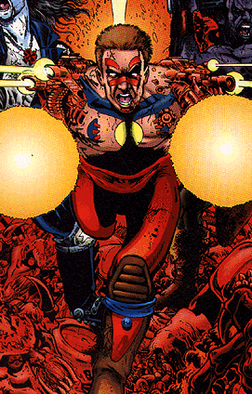
Remember these guys? With characters boasting visuals imagined by George Perez, Terry Dodson, Norm Breyfogle and several other visionaries, there's a deep pool of potential to be mined here. A Mantra figure would be hot and Prototype could carry his own line of variants ala Iron Man, but there could also be some neat gimmicks to try out, like a Prime figure where you build the hero body around Kevin Green or a Sludge made out of...man, I don't even know.

Agents of Atlas
You've got a gorilla, a killer robot, a spaceman, a mermaid, a secret agent and a love goddess in a slinky outfit--how is there not a box set of these guys yet?

Wednesday, April 8, 2009

Remember the Ultraverse?

In 1993, Malibu Comics launched a new super hero line called the Ultraverse. This wasn't an uncommon practice at the time, as it came on the heels of Image and Valiant's success and occured around the same period that other upstart spandex imprints like Milestone, Comics Greatest World, Defiant (which I remember way more vividly than I think I should) and more were sprouting like weeds.

I was 11.

I've got an inherent fondness for the Ultraverse that really isn't reflected in the body of actual work I own from its brief history. In total, I think I've got maybe two issues of Prototpye, an issue of Prime and an issue of Mantra in addition to both of the bookends to the Break-Thru crossover, the Ultraverse Origins primer/secret files one-shot (with a Joe Quesada cover), and the Ultraforce/Avengers two-issue mini that basically ended Ultaverse v1.

However, I can name just about every character from the Ultraverse, distinctly recall what they looked like and give you a pretty decent overview of the big events. I used to love drawing Prototype and the Night Man, and the one and only time I tried to enter Wizard's Homemade Heroes custom action figure building contest, I got three quarters of the way through turning an old Thundercats toy into a bootleg Solitaire. Solitaire!

So what was the inherent appeal that with less than 10 actual physical comics in my possession I dug the Ultraverse so much?

Well, in retrospect, I attribute a big chunk of it to the fact that the Ultraverse had no high concept, it was just some very talented creators trying to do good super hero comics. Look, I dig ambitious themes and whatnot as much as the next guy, but I also want to hurl every time I hear about a new team book that is going to be "different than the rest because these guys are pro-active!" Dude, every new team book is pro-active for the first five issues and then becomes like very other team because writing about characters going out and actively looking for villains is tough.

But that's a tangent and a rant.

My point is, sometimes it's nice to just see comic book folks just trying to do good work with the basics as opposed to overdosing on pretense. At a time when you had multiple super hero universes that were supposed to be set in the "real world," or where all the characters were multicultural, or where there had to be a mystic tie-in to everything, it was refreshing to see a non-Marvel/DC set of super heroes who were just that: a set of super heroes. I look at something like CrossGen and appreciate the goals, but wonder if they didn't also get a bit too cute for their own good; the Ultraverse never felt like that.

Not only did the Ultraverse not shun the general idea of just doing super hero comics, in some cases it outright borrowed from the classic tropes but put neat twists on them that set what they were doing apart. There was definitely an element of the original Captain Marvel in Prime, but Kevin Green's teenage inexperience and often warped idealism led down some interesting paths that the Big Red Cheese never really explored. Likewise, Prototype was a fresh take on Iron Man where the armored hero was a hotshot kid who didn't realize he was getting played by the corporate types as opposed to the boss wearing the suit. Hardcase was Wonder Man but as the most successful hero in the world. Sludge owed something to Swamp Thing/Man-Thing, Freex was part X-Men or Doom Patrol, etc., but none of these characters were strict carbon copies.

And I can't really think of anything else quite like the original iteration of Mantra.

It was also cool that the Ultraverse branched out beyond Super Hero 101 with stuff like Sludge, or a detective book like Firearm, or a straight up horror comic like Rune.

The roster of talented creators who worked there didn't hurt either. Steve Gerber, Gerard Jones and Steve Englehart were among the founding fathers of the imprint. James Robinson had a significant role. Up-and-coming artists like Terry Dodson, Darick Robertson and Paul Pelletier were honing their craft. And as the movement gained steam, legendary creators like George Perez and Barry Windsor-Smith signed on to be a part of it.

Break-Thru was actually the beginning of my love affair with the art of George Perez, as I had never seen his work before and was, of course, blown away. What with it being 1993 and the height of Image and all, I had truly never seen anything quite like George Perez before.

I have to also give the Ultraverse a lot of credit for being extremely new reader-friendly. I started with Break-Thru, which featured every single character in the fledgling universe (which was still a couple dozen) and by the end of issue one, I totally felt like I had at least a decent grasp on who each of them were and why I should care. A nice job was done taking snapshots of every corner of the world being created and bringing the different players on stage just long enough to let you know their deal without derailing the story. The very next month, there was some sort of "Origins Month" deal which included the one-shot I mentioned. In fact, they may have done too good a job being new reader-friendly, because I felt so immediately acquainted with the characters that I didn't feel any particular urgency to go out and get the individual titles as I was getting enough out of the samplers and was content to wait it out for the next line-wide event.

But of course this was the mid-90's, and longevity was not a gift many companies outside the big boys were gifted with.

By 1994, Marvel had purchased the Ultraverse, and by 1995 or so, it was no more, as there was only so much cash to go around in a rapidly bursting industry and keeping the X-Men and Spider-Man afloat had to be a higher priority than making sure Prime and Ultraforce stayed in circulation.

So the Ultraverse had a brief but potent impact on comics and on me as a reader. I do regret a little that I never made more of an effort to get into those books full-on, but on the other hand, it probably saved me from a good chunk of disappointment as well. Maybe next convention it's time for me to conduct an overdue expedition to fill-in the gaps in my Prototype collection between and around the two issues I actually own once and for all.