Showing posts with label ben's indy odyssey. Show all posts

Sunday, November 21, 2010

Ben's Indy Odyssey: Fred The Clown

My buddy Jordan recently recommended and lent to me a collection of Roger Langridge’s Fred The Clown, the material that from what I understand put Mr. Langridge on the map and led to such gigs as The Muppet Show and Thor: The Mighty Avenger. As more of a “civilian” than a lot of my other comic-reading buddies, Jordan certainly brings a different sensibility in terms of what he digs, so I was keen to read this just to try and get a handle on his tastes. However, that aside, I love Langridge’s work that I’ve seen in the mainstream, so I was even more curious to check out his signature series and see him really cut loose.

If like me you had heard of Roger Langridge peripherally prior to his more recent high profile stuff but are more familiar with his Muppet or Thor work, Fred The Clown is certainly a departure from that. This collection pulls together an unconnected series of strips and stories featuring a dim-witted and (mostly unintentional) clown in a series of misadventures that range from straight up slapstick to several somewhat bleak commentaries on a variety of subjects tinged with black humor. Again, if you know Langridge via his uplifting all-ages stuff—or just from meeting him, because he’s a heck of a kind gentleman—Fred The Clown may take you a bit by surprise with its often adult subject matter, fearlessness in embracing vulgarity and antithesis of the happy ending at most turns.

That’s not to say it’s not really good stuff, because it is.

To be honest, the very first story in the collection, “Dummies,” almost lost me. Despite knowing what I was in for, the darker elements definitely caught me off-guard, but Langridge infuses enough quirkiness in that even if the humor skews a little gallows for your personal taste, I think you’ll still find some appeal. What proved a challenge for me was that “Dummies” is a silent strip, most definitely not up my alley as while I can appreciate great art, I’ll always be a writing guy at my core and have trouble keeping focused on stories that don’t lead me with words. However, Langridge’s cartooning is so strong and adept that I still found enough to like not to bail out.

I’m glad I didn’t ditch after the first effort, because the enjoyment curve for me went sharply up. Langridge does a complete 180 with “Fred The Clown: An Illustrated History,” a text piece broken up by several short strips aping various classic cartooning styles over history and inserting the fictional evolution of Fred into the real life history of comic strips. It’s an absolutely brilliant piece of work that makes you wonder “is this real?” one sentence and the chuckle at the absurdity of it all the next. Langridge weaves a bizarre tapestry of Fred’s imagined creators and stewards, infusing sexual deviance, bizarre murder-suicide and illegitimate children into a piece that still packs in the humor and comments pretty incisively on the landmark movements in cartooning; it’s definitely Langridge at his best and showed a level of skill truly demonstrative of a great creator unfettered by restrictions.

“Illustrated History” sets the tone for the rest of the volume, as Langridge is wildly and boldly experimental, switching up formats by the page and proving up for anything; it’s a mix of hits and misses, but more of the first.

Stuff like “The Wretch,” a multi-page faux newspaper complete with articles, ads and miscellany, shows off the level of work Langridge is willing to put in. “Alphabent,” in which a Fred tale unfolds over a series of strips each hinging around a letter of the alphabet in the title, also demonstrates the creator’s ability to use clever formatting to improve upon an already-solid story. Also worth noting is something I already knew from Muppets but saw in spades here, and that’s Langridge’s proficient poetic ability and knack for creating sing-song rhymes that make you laugh with seemingly effortless skill.

There are some more “silent” bits and short stories that fell flat for me, but as I became ingratiated to Fred and what Langridge was doing in the stuff I did dig, I found myself discovering more redeeming qualities to just about every story and feeling genuine empathy for the poor clown in his professional and romantic misadventures.

Fred The Clown to me is a demonstration of the commendable imagination and impressive skill set of Roger Langridge, a man of capable of heartfelt drama, fun family fare, super hero work with a broad appeal and humor with a dark edge. I enjoyed seeing another side of his oeuvre and am anxious to see where else he can take me.

You can purchase Fred The Clown here.

Monday, July 6, 2009

Ben's Indy Odyssey: Further Grickle

I liked this Rickey Recommendation (TM) from the very first page, where a guy agonizes over not having said something witty enough at a dinner party to the point where his stomach is hurting and he can't sleep (his next step is to build a time machine and keep going back to try come up with a more clever interjection). I'm not sure if this collection of Graham Annable's short and slightly longer stories had a formal theme when he put it together, but I found most of them to have the common thread of dealing with insecuirty and the ensuing awkwardness that can ensue, something I can both relate to and am pleasantly surprised that I can be entertained by.

The book is essentially two parts: a series of unrelated (except tangentially in one case) strips of varying length make up the first half while one longer story takes up the back. As always with stuff like this, my enjoyment peaked a vallied (verb? maybe?) from segment to segment, but I must say I was entertained and chuckling a lot more than I wasn't.

My favorite stuff from the front half was the aforementioned time travel dinner party bit (it has a great ending) and another short about two friends hitching a ride to a party with a third guy who is a bit socially awkward and who one of them can't stand; it's an extremely mundane type of experience that even when it takes an unexpeced turn doesn't veer far outside the realm of everyday occurence and yet I was riveted for reasons I can't fully articulate; I'm going to just chalk that up to solid craftsmanship and call it a day.

There was a slightly more unorthodox story about a guy going to see a doctor for a bad cough and the doctor's bizarre approach to helping him which I also really liked. The visual gags didn't do so much for me, but the relatable stuff like just having to wait in a doctor's office really grabbed me; I guess Annable just has a real gift for storytelling when it comes to the commonplace where he so accurately depicts experiences I've had that seeing these bizarrely-rendered cartoon characters go through them is just neat. I had a cold this weekend and the visual of this poor guy just exploding--vibration lines and sound effects flying off him while his stick figure composition breaks down--every three panels is so spot-on how I felt represented in cartoon form that it gave me pause for a sec.

Some of the shorter, less sequential stuff didn't do much for me, but hey, it was short. I alo have to give a lot of credit to Annable for doing a story about farts that I actually kinda dug. Toilet humor is one of the least funny things in the world to me for whatever reason (yeah, I know, I suck), but he has this honestly heartwarming little strip about an old guy telling some kids where farts came from that made me smile; given my stuck-up tastes, that's about as high a compliment as I can give.

The longer story that makes up the book's second half is pretty good on its own merits, but I didn't get as into it because it seemed more standard fare as far as what I've read from indy books. Basically it's a day (or half day) in the life of a guy who is out of work and having trouble adjusting to living with his girlfriend and how he deals with his neuroses. There is some stuff with his dog and the old lady next door's pet wombat that held my attention and I'm sure there is more going on beneath the surface that I'm not digging into, but I couldn't shake the feeling of "been there, done that." It's a solid story, but it didn't jump out at me the way the stuff I described above did.

Given that the title of this book is Further Grickle, I'm sure there is a Grickle out there somewhere (I also know this because Rickey told me already) and I'm anxious to read that and to see what similarities and differences there are between the two volumes. I'm always intrigued when I like something and can kinda tell why but not quite nail it down, so I'm looking forward to reading more by Graham Annable and trying to figure out what in his work appeals to me so much; even if I don't figure it out, I'll still get to read some more good stuff, y'know? Slam dunk.

I already linked it earlier, but here is a link to Graham Annable's blog, where I presume you could purchase this book and other work by him, were you so motivated.

Tuesday, June 16, 2009

Ben's Indy Odyssey: The Mighty Skullboy Army

I've been meaning to check this out for a long while due to great word of mouth from many friends and after seeing the kick ass Nite Owl sketch Jacob Chabot did for Rickey at MoCCA, I decided to get to the borrowing.

It ended up being a relatively quick read that didn't change my worldview or anything drastic, but it entertained me and actually made me chuckle out loud more than a couple times; if a comic can do that, I deem it a successful venture.

First and foremost, I love the way Chabot draws, flat out. When it comes to humor comics, I'm a big fan of smooth Jeff Smith-style art that manages to take basic shapes and use them to tell as elaborate a visual story as need be without getting overcomplicated. Chabot pulls this off and makes his characters adorable and streamlined, but not simplistic, a point I can't stress enough. He also has a lot of energy in his art, right down to the small points like facial expressions and sound effects. I want a sketch from him really bad.

The premise of The Mighty Skullboy Army is one of those set-ups you'd only get in comics and it makes me love the medium: an elementary school kid named Skullboy who has a skull head and talks like a Bond villain also runs an evil corporation and tries to commit heinous crimes between classes with the help of his two henchmen, a robot and a monkey. I love the sentence I just wrote. I also love that Chabot doesn't give any backstory as to how this situation came about, it just is, as it should be (I'm not clamoring for a Skullboy: Year One mini...though now having thought about it for two seconds, maybe I am).

So with those ground rules established out of the gate, this collection is a bunch of short stories starring Skullboy and his cronies as they embark on various schemes. As you'd expect, some of the strips work better than others, some jokes soar while other fall flat. What I admire throughout is that while I got a kick out of this book, I totally think my kid cousins would as well, because at its heart it's a kids comic that also possesses a level of sophistication that adults can enjoy (at least I hope it's intended at least in part to be a kids comic, because otherwise I'm gonna feel like I just insulted Jacob Chabot without wanting or meaning to at all).

The humor that tickled my sensibilities the most came from the voices Chabot gives Skullboy and Unit 1 (the robot). Skullboy is more or less your typical megalomaniac, but aside from his situation setting him apart, he's also got this great unflappable confidence and drive about him that is totally endearing; he is never convinced he has been defeated and just can't understand why his sidekicks are unable to keep up.

Unit 1 was definitely my favorite character though. He's this fantastic mix of snivelling, condescension, arrogance, insecurity and wit. I love how he'll swivel from cowering in Skullboy's locker to firing his Death Ray to pining over his love for a soda machine. That's poetry, man! His inability to recognize the ridiculousness of his predicaments works perfectly with his unchanging expression to just make you smile. He's a great straight man. I wasn't that into Unit 2 (the monkey), probably because he doesn't say anything, but he was a perfect foil for Unit 1 (and the scene where they go hat shopping and he buys like eight hands cracked me up).

The stories where Skullboy gets an adult intern who then has to go try and collect leaves for a class project with the Units and the one where the Units pawn their pagers and attempt to earn money to buy them back with a lemonade stand are definitely my favorites. But just simple crap like the monkey putting a woman's hat on the robot's head and Unit 1 proclaiming "I can't see" really entertained me--it's not rocket science but it works! I also really really like towards the back of the book where Unit 1 starts becoming obsessed with love and tries to talk to Unit 2 about it to no avail. Fuck, I just love when Unit 1 disdainfully calls Unit 2 simply "Monkey"!

Chabot had fun with this and it comes through. The more I think back to write about it, the more I'm realizing how much I enjoyed it. The guy can write, he can draw, and he's got a cool sense of humor that doesn't need to be crass to be funny. I love it and I'd like to shake his hand (and get a sketch, seriously).

Tuesday, June 2, 2009

Ben's Indy Odyssey: Cursed Pirate Girl #1

Rickey asked me to grab this for him last week at Hanley's, which I did, but I was unable to pass it to him until today, so all weekend it's beguiling cover was staring at me, enticing me to read. I hesitated because the paper stock looks really nice and I didn't want to somehow mess up Rickey's comic, but the Texas Outlaw himself gave me the thumbs up, so I dove in.

Glad I did.

After I got the gist of the premise--I'd call it a tale of unlikely friendship between two girls infused with a dash of whimy and touch of adventure, were I writing ad copy--I was a bit skeptical that a 27-year-old guy like myself could enjoy what seems to be at its heart a fantasy story aimed at young girls, but I found it utterly charming and possessing an appeal that should definitely not be limited to a narrow demographic.

The titular Cursed Pirate Girl is a rad character, no two ways about it. A snarky little girl who beats up mean boys on the beach using swordfighting skills learned via dreams of a pirate father who she's never met? Yes, please! And the trope of having a wealthy governor's daughter become enamored of this adorable rogue is a worn one, but for good reason; it's uplifting but also a good tension-builder and watching the rich girl fence with her father's esteemed guests to his mortified embarassment is just fun.

But as good as the story is and as entertaining as the characters are, no doubt the art is the blowaway centerpiece here. Rickey described the work of Jeremy Bastien (who wrote, drew, etc. this) as a cross between like three dudes I don't know, but I do know I like it. You can see him working his ass off to fill every inch of every panel with a million little lines to create a crazy, vibrant world where a nutty story like this can justifiably take place. I love his exaggerated character designs and over-the-top body types, as well as how the little girls stand out in a world of grotesque adults like it's Alice in Wonderland or something. I will admit that his panel layouts lost me sometimes, and I had to read the last five or so pages a couple times to figure out what was going on, but I dug the experimentation and was happy to take the extra time, which I wouldn't say for a lot of comics.

Cursed Pirate Girl didn't alter the face of comics or art or anything for me, but I really had a good time with it and it was a neat little dose of fun. As far as mainstream comics fans are concerned, if you like Runaways, I'd seriously recommend this, as the two are very simpatico.

Hopefully Rickey will be unable to purchase the second issue on his own and need me to grab it for him again.

Couldn't find anywhere to order this online, but you should go to your local shop and ask if they've got it in stock. The publisher is Olympian if that helps. Here's their web site. And here's Jeremy Bastian's site.

Thursday, April 16, 2009

Ben's Indy Odyssey: Eightball #23: The Death Ray

Rickey lent me this several months ago at the end of a party when he was very drunk and it was very late and it has been sitting by my bed ever since; as a result, I had the kinda neat experience of going into the reading experience not remembering for the life of me why I wanted to borrow this or why he wanted me to read it. When I saw it was by Daniel Clowes, a dude whose stuff I've never read but heard plenty about, I got extra excited that I decided to clean a bit of my room for no particular reason today.

At the start, "The Death Ray" seemed to fit in perfectly with the whole "coming of age" theme I've already covered this week in other posts, which both struck me as serendipitous and also a bit daunting seeing as how said theme is starting to wear on me after several days of thinking about it intensely. But the first part of "Death Ray" struck a nice balance between slice of life and edging on strange, in the process both holding my attention and making me feel the right kind of uneasy. I found the main characters relatable enough that when more or less out of nowhere (especially for a guy who didn't know what he was reading) the sci fi/psuedo-super hero elements kick in, it's a shock to the system that threw me but that I also cared about. In not that many pages, Clowes had got me invested in these kids, so no matter how bizarro the next act was, I was in for a pound.

That said, I definitely drifted a bit as the book went, and I suspect a lot of that is personal taste/mood/whatever. Everything is pretty well-constructed, but I did feel like the pacing of the book's first half was near-perfect in its diligence while about midway through things starting spiraling a bit too quickly for me to reconcile. This is where lack of mental preparation hurt me a bit, as reading it all in one sitting and not having the slightest concept of what I was getting into led to me getting uneasy when my car veered off the rails maybe earlier than I was ready for it too. I feel weird saying the story would have been better served if it was either gonzo from the get-go or more deliberate in the homestretch because this is one of those times where my gut tells me that my personal reading is not necessarily reflective of the way things "should have been done."

Part of my faith that I didn't get all I was supposed to out of this initial reading and would dig more into the evolution of the story if I tried again comes from how much I dug so many of the flourishes Clowes uses. In even my meager indy reading experiences I've encountered plenty of experimental framing techniques that, in my opinion, fall flat on their face, but Clowes is genius in chopping his story up into sub-sections that are distinct both in terms of content and design and not losing you in the process. I love his clean drawing process, the way he makes simplicity looks pretty and even small things like how he uses borders and panel layout to mix things up.

I enjoyed "The Death Ray," but I think I respect it as a work more. This is definitely one of those cases where as a "reviewer" (I gotta put that in quotes because I certainly don't take myself too seriously in that regard) I recognize my own failings as far as letting my mood dictate my reading. I've been in a bt of a funk this week, so it's hard to fully appreciate a story that has a lot of downer elements in it, regardless of how brilliantly portrayed they are. I do think it speaks to the strength of the work, however, that even funky Ben didn't put this down and say "another day," because I wanted to see what happened next. There really is some smart stuff said in the course of this narrative about human nature, growing up and power that I haven't fully absorbed yet but look forward to processing in the days to come.

Don't take my word for it, buy this book for yourself

Monday, December 15, 2008

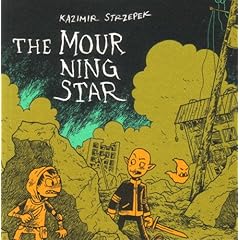
Ben's Indy Odyssey: The Mourning Star

Firstly, I was not aware that this was only part one of whatever, and thus was expecting shit to be resolved by the time I got to the end and was greatly disappointed when it was not. As Rickey was drunk when he gave me this, I lay the blame 100% on the shoulders of David Paggi for misling me.

Secondly, I read about two thirds of this in one sitting and then finished a few days later; this was a mistake as I see now it would have read better all at once.

Those points aside, I did have fun with this, though I wouldn't place it in the pantheon of the best indy stuff I've read. At times, I felt like I was on a really cool roadtrip where there was a lot of neat stuff to see, but I didn't have a map and thus was a bit too preoccupied with getting lost to fully enjoy what I was taking in. I guess that's a metaphoricaly way for me to say that the splintered narrative through me a bit, especially in the beginning. Once I got a hang of things, I actually appreciated the shifting focus between the two main stories, but at first, it was too rickety as I still couldn't keep track of the first set of characters and then had a second dumped on me.

The stuff I really enjoyed was the world-building parts. I like all the thought and backstory that Strzepek put into the landscape and the mythology of it all. I liked learning bits of culture like how the different races regarded each other and also dug the half-explained stuff like the Mr. Hanky thing eating people's dreams by going in their mouths when they were asleep. Bits like that were just fun. I also got an inexplicable amount of glee about there being some caste of feared warrior called a "Snipper Sniper" and it's some guy who fights with a pair of scissors as his weapons. I enjoyed this stuff, the fights and the banter far more than the love story, which, for whatever reason; I get that it's kinda a must for this genre of storytelling to have a quest revolving around a lost lover, but it was my least favorite part.

The art was perfectly servicable in some places and really cool in others. The battle scenes and just the designs of the different species were pretty dope.

Overall, didn't rock my world, but made me fer sure want to read the next part and find out what happens (particularly to that father and son in the beginning who I was waiting for them to circle back around to the entire time).

Tuesday, November 4, 2008

Ben's Indy Odyssey: Super Spy

Earlier this year, lifelong super hero comic enthusiast Ben Morse asked some of his more indy comic-savvy friends to begin recommending him stuff he should read outside of his typical comfort zone. These are the chronicles of his adventures.


Man, there sure is a lot to like about this one, and I can see why it's so fondly regarded.

First and foremost, Matt Kindt's interest in and love for the genre he's working in shines through in the material without question. The guy clearly digs espionage and it's pretty clear putting together a project like this one is a dream come true for him. His passion is evident in how finely he details every story with if not realism then at least the sense that, "Yeah, if somebody were to hypothetically do that, it could certainly work." He seems to have really thought through every one of his stories, and I find his dedication to be admirable and his enjoyment of the work to be infectious.

I'm also impressed by the diversity of material. There are a lot of stories that share common elements, but no two are exactly alike and there are more than a few that are utterly unique. The reinvention of what you're reading every few pages definitely keeps things fresh and allows Kindt to really stretch both his writing and his art.

At the same time, I'll confess that I found what I just listed as a strength to also be a weakness in some ways. This could be a personal thing for me, but whenever you've got a collection of shorter stories, you risk losing my interest as a reader simply because it's easier for me to put the book down and not get back to it for a few days because I'm not so invested in what happens next. This really shouldn't be too much of a concern for any writer, Kindt here in particular, both because I'm a target audience of one and also because even if I didn't feel the need to read Super Spy every night, I knew I was gonna come back to it because even without cliffhangers the material was strong enough to keep me hooked.

Another thing somewhat linked to the previous point that also went both ways for me as far as enjoyment was the way that many (all?) of the stories were linked in some way, but not arranged in order. This is pretty cool, because it's definitely neat to see characters popping up who you vaguely remember from several chapters earlier and then figuring out how the larger narrative fits together. It also pulls off the trick of creating memorable characters in the context of an anthology without breaking your structure ("The Shark," Super Spy, etc.). On the other hand, it did frustrate me a bit to have to keep flipping back to figure out where I remembered certain things from without any real roadmap to help me. Again, this is a personal to me thing, and it's in no way a knock on the book, more on me for being a a lazy reader.

Honestly, the "negatives" I listed here really came out of me analyzing Super Spy from a critical perspective and wanting to write something aside from "this book rocked." They're there to be certain, but they didn't impact me as much as I'm maybe making it seem like they did, and I don't think they'd hinder really anybody from enjoying this book. It's a good read.