Showing posts with label the essentials. Show all posts

Wednesday, July 14, 2010

The Essentials: Supertboy by Kesel & Grummett

In talks with my comic book-reading chums, they’ve pointed out—mostly Kiel pointed out—that whereas many young fans tend to gravitate towards characters whom they could relate to or empathize with such as Spider-Man or the Tim Drake incarnation of Robin, I seemed to go the opposite way as a kid and adopt alpha male types who were definitely cooler than me and whom through I liked to somewhat live vicariously through like New Warriors era Nova or Guy Gardner.

In no case do I think this was truer than with the Superboy of the 90’s in his original iteration.

From the minute “The Kid” showed up courtesy of writer Karl Kesel and artist Tom Grummett in the closing pages of Adventures of Superman #500, I was hooked on the character. The leather jacket, the shades, the fade cut, the earring and every one of his two dozen unnecessary belts—loved it all. But more than that, I dug his brash attitude, his insistence that nobody call him Superboy his uncontrollable flirting with every woman he saw and underneath it all the naiveté of a young man literally bred to be a hero but who had no idea of sacrifice. That was the dude I wanted to be.

Following Reign of the Supermen, Kesel and Grummett took The Kid out of Adventures and into his own series, titled Superboy as he finally consented to that name. Over the next two or so years, they would create some of the more enjoyable comics of my youth and stories I still remember fondly and hold dear to this day.

Kesel has always been pretty open about his devoted fandom to Jack Kirby, and I believe it shines through in very positive ways through those first 30 issues of Superboy. With the rich Superman mythos to mine and cherry pick villains and supporting cast from, Kesel and Grummett instead elected to relocate Superboy to the uncharted-in-the-DC Universe waters of Hawaii, giving them the chance to create from scratch their own world in which their character could play, much as “The King” had done so many times during his decades forging his legend.

And make no mistake, the surrogate family Kesel and Grummett would build around Superboy was a major component in what made the series stand out from the pack. The Kid’s primary love interest Tana Moon seemed to start out as merely a multicultural Lois Lane for a new generation, but her Hawaiian roots and moreover her complex feelings towards dating somebody a few years younger than her physically but who was quite honestly a newborn in terms of emotional experiences provided her significant depth. Hawaiian police chief Sam Makoa was a young Jim Gordon with far more orientation towards action, but his duality of annoyance that Superboy brought so many super-powered threats to an area that had gone years without any balanced with a subtle enjoyment over his now-interesting job was gold. Slimeball manager with a heart of gold Rex Leech and his bombshell daughter Roxy—the third point of the Superboy-Tana love triangle who was always lagging way behind—were tremendous fun. And the DNAlien Dubbilex, a telepathic demon-looking fellow with a demeanor more befitting Mr. Miyagi and a Kirby creation himself, provided both guidance and additional comic relief, particularly when he started wearing Hawaiian shirts and board shorts on the regular.

The villains Kesel and Grummett created for Superboy were a mixed bag, but the point again is the effort they put forth in dreaming up new threats for their hero to face, only peppering in familiar foes like Parasite, Killer Frost or Black Manta and making those appearances seem all the more like events as a result.

Of the new baddies, King Shark has probably gone onto the most longevity—though not much—as a general DC Universe villain, appearing regularly in Aquaman: Sword of Atlantis and more recently Secret Six. However, whereas he’s become chattier and a bit of a Killer Croc knock-off of late, King Shark originated as a silent savage who only Makoa had taken down in the past and who presented a genuinely creepy threat in his original appearances guest-illustrated by Humberto Ramos; he also had a pretty cool and grisly origin as the son of a shark god and regular woman who allowed him to feed off her own freaking arm!

Scavenger was an intriguing recurring foe if only because a cranky old man seemed a natural opponent for Superboy and his crazy paranoia and never-revealed motivations provided a bit of mystery. Silversword had some promise as the native Hawaiian who resented Superboy becoming the hero of the islands and ended up a villain despite his best intentions, but his design was cooler than any of his actual appearances. And good ol’ Sidearm, Superboy’s first villain from back when he was still going by Superman, was fun for the occasional comic relief appearance before his untimely demise during the too-serious-for-him “Watery Grave” arc.

None of them, however, had anything on Knockout.

While fans of a more recent vintage probably best remember Knockout as Scandal of the Secret Six’s recently-deceased lover, she got her start as the super-strong serial sexpot who drove Superboy nuts during his early years. A stripper named Kay with a mysterious past teased out over the better part of two years, Knockout was the only woman who truly flustered The Kid, alternating between ultra-aggressive sexual advances that put his boyish flirting to shame and brutal physical attacks in which she proved more than his equal.

Knockout would prove to be a huge part of Superboy’s development in the larger arc Kesel and Grummett were building over the course of her tenure. She’d show up often and baffle our hero with both her skewed morality as well as her not-at-all overtures towards the libidinous Boy of Steel. Whereas Tana represented Superboy’s innocent first love, he thought Knockout stood for the wild and unrestrained type of romance he saw as being truly “grown up” and had to learn that sometimes a bad girl is just that in the hardest lesson of his young life.

Because the heart of what Kesel and Grummett were doing with their first run on Superboy was telling a story of growing up and how it can be both the most you’ve ever had the most terrifying thing you have to do. The colorfully carefree standalone stories of Superboy’s early issues would give way and give weight to more serious sagas like the aforementioned “Watery Grave” and the creative team’s swan song, “Losin’ It,” in which The Kid finally succumbs to Knockout’s charms and ends up alienating the people he cares about in the process, destroying the life he’s built for himself, and then having to earn it all back.

When Superboy first came to prominence during Reign of the Supermen, he was the idealized teenager living all his dreams with incredible powers and no parental guidance to speak of. Shipping off to a tropical paradise only served to amplify this as suddenly The Kid lived in a world where hot girls in bikinis were lining up to meet him and the only threats he ever faced were easy enough to dispatch because no real bad guys ever come to Hawaii. He had friends, he had a great girl and he had awesome adventures with nary a consequence to fear—being Superboy was the coolest gig in the world.

But that was only the first part of the story Kesel and Grummett were telling.

It was masterful the way things slowly got tougher for Superboy bit-by-bit as opposed to all at once. A kid wearing his costume for a personal appearance he couldn’t make ends up getting killed by a villain aiming for him. He goes on a mission with the Suicide Squad as a favor to Makoa and learns about shades of gray. He’s unable to save Valor’s life and has to ship him off to the future. The pressure continues to build because he was really only built to handle success and is expected to shoulder the responsibility of a seasoned hero despite only having lived for a couple of years. And all the while Knockout is in his ear telling him to ditch the shackles of a life filled with duty and go off with her to just have a good time.

People scan the covers of those early Superboy issues and they see the earring and the shades and a lot of goofy fun—and the book had all that, but it was also telling a pretty damn powerful story about growing into adulthood whether you’re ready or not.

Up to this point, I’ve mentioned Grummett’s story contributions, as while Kesel was certainly the driving force behind the narrative from all I’ve heard it was a true collaboration, but I’d be remiss in not emphasizing how much his skill as an artist brought to the series. I’ve always loved Tom Grummett’s work as he is very much the ideal for a super hero artist, able to draw ladies who run the gamut from cute to gorgeous as well as dudes who look ready to do damage, but it’s his design sense and knack for having fun that really shined in the Superboy series. No villain’s costume ever looked bland, no supporting cast member ever faded visually into the background, and no battle lacked a tangible energy with Tom Grummett guiding the art chores on Superboy.

And speaking of energy, I think that’s the best topic to close this little essay on.

A buddy of mine and I were speaking just today about how the 90’s get derided a lot—and often with good reason—but it was also a period of incredible creative energy. So much of that period was throwing wild new ideas at the wall and seeing what stuck; not everything or even a lot did, but the stuff that succeeded was really something special. Nowadays that energy is still present in a lot of comic book work, but there’s also an increased emphasis on mining what worked in the past with reverence and trying to find a way to retool it for a modern time; I’m not saying that’s a bad approach or trying to praise one over the other, but there’s certainly something about that unbridled race to break away from what came before that I miss.

Karl Kesel and Tom Grummett’s Superboy was all about that wild energy and forging forward with new ideas, tossing them out rapid-fire in the spirit of Kirby and seeing what worked. From the main character to the unique setting to the quirky supporting cast to the bizarre array of villains, Superboy was all about taking a name that was familiar and building something completely new around it. The love those two guys and their collaborators put into the book really showed through the page and gave me a sense of consistent enjoyment I still cherish.

Sunday, March 7, 2010

Essentials Extra: New Warriors Must Reads Pt. 2

Last time, I covered some of the most essential reading from Fabian Nicieza’s first 25 issues on New Warriors. This go-around, let’s take a look at the latter half of that run, the bulk of which was illustrated by Darick Robertson, who remembers those days so fondly that he did not think me a psycho fan when I was working at Wizard and practically assaulted him at a bar in L.A. expressing my fandom and later did a very nice Nova sketch for me.

(Again, in a perfect world I really do recommend reading all of New Warriors from start to finish, but these are just a few of the stories that stand out for me)

“The Next Step” (New Warriors #26)
In Robertson’s very first issue, he’s clearly still in his growing stages as an artist, but Nicieza gives him a doozy to start with, as it’s the epilogue to “Nothing But the Truth” as well as a bon voyage for Marvel Boy, who has been convicted of manslaughter and is headed to prison. It’s a real tug at the heartstrings, as Firestar, Namorita and Nova attempt to spring their teammate en route to The Vault, and he ends up surprising them with his response. My favorite part of the issue is the emotional farewell between Marvel Boy and Firestar, as well as his incredibly mature and beautifully-expressed reassurance of her in regards to taking a major step in their relationship for the wrong reasons. While I was more of a Nova-Namorita fanboy when it came to Warriors couples (for obvious reasons if you know me), I always have and still and a soft spot for the “aw shucks” feel good nature of the Vance-Angel romance, and this issue reminds me why.

“Forces of Darkness, Forces of Light” (New Warriors #32-34, New Warriors Annual #3)
There’s definitely a different feel to this arc than most of the others on this list as it’s probably the only time Nicieza really deviated from putting the Warriors and their personal conflicts front and center, instead placing them at the center of a big ol’ action epic guest-starring half the Marvel Universe. Because of that feeling of separation for the overarching New Warriors saga, I’d never place “Forces of Darkness, Forces of Light” at the very top of my must-reads, but at the same time it certainly warrants some place as it’s cool to see Spider-Man, the Avengers, etc. taking their cue from the Warriors, because the idea of a villain who can turn the heroes into bad guys by flooding them with darkness with the visual expression being that they turn charcoal is one of those great high concepts that appeals to your inner kid ala evil twins, and because Robertson starts to come into his own on this one.

“Poison Memories” (New Warriors #37-38, Night Thrasher #1)
Despite having an interesting twist on the Shazam concept being an inner city kid in an adult hero’s body, Rage was mostly a blank slate during his tenures with the Avengers as well as the New Warriors, but in this story, Nicieza really cracked him open and found the unique character within the shell. It was a different kind of conflict for the Warriors from the start and yet very fitting with the world they existed in, as they’re targeted not by a true super villain, but by a street gang whose leader actually did his homework, seducing Namorita—the only Warrior with a publicly known identity—in a nightclub and then stealing her address book to learn her teammates’ IDs and target their loved ones. While most of the team surrenders to Kimeiko Ashu and his Poison Memories lest Nova’s brother or Speedball’s father be harmed, Rage lashes out following the murder of his grandmother, living up to his name. Night Thrasher’s return to the team to save them from Ashu, who began as his enemy, is dramatic, but nowhere near as tense as when Rage has the villain in a chokehold and callously snaps his neck over his allies’ pleas not to. Also, once again, Robertson takes his work to the next level, aided by a seemingly renewed energy as well from Larry Mahlstedt on inks and Joe Rosas on colors.

“Family Viewing” (New Warriors #39)
The epilogue to the Poison Memories saga deserves its own entry as it’s a “downtime” issue where Nicieza really opens things up and gives readers their money’s worth. You’ve got Nova’s brother, who just lost his pinky finger two issues back, giving an awesome pep talk to his moping super hero sibling about how he’ll lose all four limbs if it means his bro saves the planet again. You’ve got a nice moment where Firestar refuses to leave the bedside of her comatose father and leaves Marvel Boy dangling on the other line of the payphone when he wakes up. You’ve got Rage trying to take responsibility for his actions by turning himself in to the authorities and Night Thrasher making it clear he answers to a harsher jury: him. And of course, you have the Nova-Namorita hook-up that took 39 issues, but was well worth it.

“Time and Time Again” (New Warriors #47-50, Night Thrasher #11-12, Nova #6-7)
The first (and last) real crossover between the suddenly burgeoning New Warriors family of titles that emerged at the height of 90’s excess was somewhat hit or miss by its very nature. The Sphinx scattered the team throughout time, meaning you got eight different stories by eight different artists (all written by Nicieza) as well as a ninth set in the present where Warriors mascot Hindsight Lad, the former female Sphinx and Night Thrasher’s half-brother Bandit attempt to organize a new team to rescue the originals; some of the stories were good, some not so much, some totally forgettable (I don’t even remember what happened with Rage and know that Namorita was in ancient Atlantis while Firestar was in the Salem Witch Trials, but couldn’t tell you much more than that). Personally, I liked Nova’s trip to a parallel world where his brother got his powers, Justice traveling to his abusive father’s childhood and learning that he was a repressed homosexual, and Silhouette being put in the “would you kill baby Hitler?” position with her evil grandmother, Tai. Regardless, it’s Robertson’s final issue as well as Nicieza’s last sweeping epic, and both go all out in the landmark, over-sized fiftieth issue which features some of the most vibrant art I’ve seen to this day, incredible wall-to-wall Warriors vs Sphinx action, and appropriately touching resolution to the whole thing.

“Another Think Coming” (New Warriors #51)
Though he’d hand on a couple issues longer, to me the coda to “Time and Time Again” was really Fabian Nicieza’s well-earned farewell to New Warriors, and a perfect note to end on. He brings back one of the Warriors’ very first villains, The Mad Thinker, not to battle our heroes, but to remind them of the purpose they seemed to have misplaced and galvanize them to remain as a team. For Nicieza, it’s a chance to sum up for us what those first 50 issues were all about as well as demonstrate how much these characters have grown since they got together. It’s got some neat art by Richard Pace (who only stuck around about four issues and I have not really seen since, which is a shame) and puts a nice cherry on top of Fabian Nicieza’s New Warriors sundae.

Sunday, February 28, 2010

The Essentials: New Warriors by Fabian Nicieza

Growing up, I always liked to root for the underdogs; maybe it was the burgeoning Red Sox fan in me, who knows. I pulled for the Buffalo Bills to upset whoever they would inevitably lose to in the Super Bowl, rooted for guys like Kerry Von Erich to win the Royal Rumble, and always made sure my favorite character on any TV show was the third most popular at best (i.e. Laser from American Gladiators as opposed to Nitro, Gemini or Turbo).

In comics, I was no different. The more well-known a character or property was, the less interest I had. Of course the secondary reason for this was that the more undiscovered a comic was the more fun I had learning all about it, but I didn’t really get that consciously until later.

I knew who Superman and Batman were, so I eschewed DC for Marvel. I was at least somewhat familiar with Captain America and Iron Man, so I passed over the Avengers for the X-Men (who of course were anything but obscure to comic book fans, but they didn’t have a TV show or anything yet). Even within the X-Men titles, I always preferred X-Force to the main books because Cannonball was more interesting to me than Wolverine.

And then there was New Warriors.

One day early on in my comic book journey as I was rooting through the back issue bins of my local baseball card store, I happened across three or four issues of New Warriors from the original run by Fabian Nicieza and Mark Bagley. I was mesmerized by these characters who all had great designs thanks to Bagley and the artists he was borrowing from, but who I had no familiarity with whatsoever, yet there was the Marvel logo up in the corners, so they did somehow share a universe with Spider-Man and the rest. That it was a book about teenagers closer to my age than the X-Men or most other prominent characters of the day was a welcome discovery I would make upon returning home and reading the book, but I bought every issue I could find just on the strength of those first few covers and my curiosity about the unknown.

New Warriors ended up becoming the book that served as the spine of my first Golden Age as a comic book collector and remains not only one of my favorite series ever, but one I feel more than comfortable pointing to and saying “This totally holds up as proof the 90’s weren’t all bad.”

I know that looking back at my favorite childhood comic inevitably means many of my observations are going to be tinted through a haze of nostalgia, but I still think I can speak pretty conclusively to some of the things that really made New Warriors work.

In my mind, Nicieza’s commitment to the book and the characters was the most important factor in its success (and for my purposes, we’re talking about “success” more in terms of being a critically well-received and much-beloved by me personally comic if not necessarily a commercial blockbuster), but no doubt the environment of Marvel at the time, at least in terms of their treatment of Warriors, played a huge role in making that possible.

During the 90’s age of super-continuity and titles often being sucked up into bigger events beyond their control, New Warriors was for the most part left to its own devices. Yeah, Nicieza brought in plenty of guest stars from The Punisher to Namor to Darkhawk to an entire alternate Egyptian-themed Marvel Universe in those first couple years, but they added to rather than distracting the larger stories being told over lengthy periods of time in Warriors, stories that felt very self-contained and that as a reader of the book you felt a great deal of ownership over and satisfaction in.

Out of the aforementioned sense of standing alone, I always dug that the New Warriors felt like a far more intimate and welcoming group in opposition to their counterparts at both Marvel and DC. While the X-Men were fighting for Xavier’s dream, the Avengers were Earth’s Mightiest Heroes, the Justice League were (at the time) working for the government and so on, the Warriors had no great modus operandi and were really just a group of misfits who ended up becoming friends because they enjoyed hanging out together; it was far closer to my (and I’d think most people’s) junior high/high school experience than any other comic.

To wit, the Warriors were founded thusly: Night Thrasher wanted to create a team of young super heroes to fight crime and avenge the death of his parents (yes, I know it sounds familiar); Marvel Boy (later Justice) wanted to join the Avengers but was deemed too young; Nova got his powers back thanks to Thrash and was looking to kick ass; Firestar was at loose ends; Namorita wanted a place on the surface world; Speedball was just looking for a good time. Six completely different agendas, but through more coincidence than design, they ended up banding together to beat Terrax and decided it made more sense to be a team than not to be one. From there they got a cool warehouse to hang out in, brought in some other directionless recruits, and of course started pairing off romantically like bunnies in heat.

In other words, it’s one of the most unique and yet most realistic depictions of teens as super heroes ever; because honestly, at age 17 were you and your buddies more likely to hold formal meetings with roll calls and such or meet up every so often in your clubhouse, order pizza, and go fight aliens because you saw them attacking New York on the news?

In interviews, Nicieza always said his run on New Warriors was about two things: making hard choices and seeking the truth. Again, as a kid, these were things I grasped really easily and found far more compelling than simply “We’re out to save the world” or even “We’re out to foster peace between our race and those who hate and fear us” (no offense meant to my other childhood comic book loves of course).

With those two guiding principles, New Warriors often tackled issues that you wouldn’t see in your average comic on a semi-monthly basis. Marvel Boy was a victim of child abuse and ended up killing his father accidentally while using his powers for self-defense, which formed the crux of one of the title’s most monumental storylines when he went on trial (defended by Foggy Nelson no less). Namorita led the team into a hostile Middle Eastern country where they were unable to determine whether the dictator in charge or the leader of the rebellion was a bigger scumbag. Foes like eco-terrorists the Force of Nature and the vigilante Bengal had the Warriors constantly having to make those aforementioned hard choices as to what side was the right one.
On the seeking truth side of the equation, the mystery behind what exactly happened to Night Thrasher’s parents ended up becoming far more complex than a simple Batman knock-off and the revelations would for an epic that dominated much of the book’s second year and concluded explosively alongside Marvel Boy’s trial in Bagley’s final issue. Nicieza being able to meticulously plot and unfurl these intricate tales gave New Warriors much of its strength.

And yet while New Warriors did hard-hitting “torn from the headlines” stuff better than most mainstream capes and tights titles, it could flip on a dime to stuff that made the universe shudder as well. That Egyptian alternate universe story, for instance, was the Warriors’ first encounter with Nova’s near-omnipotent old foe, The Sphinx, albeit a female version, and that “Forever Yesterday” trilogy not only stands out as a perennial favorite to anybody who has read it, but also heralded more mammoth tales pitting our young heroes against the immortal lovers in a Shakespearean drama gone cosmic.

The Warriors also took on world beaters like their old buddy Terrax as well as the Inhumans and Star Thief, not to mention having to help Nova save an entire dead world in “The Starlost.” They tussled with The White Queen and her Hellions as well as out-of-control mutant Darkling who brought half of New York City’s good guys under his control, including several Warriors. They had memorable moments from Nova and Namorita’s first hook-up to Rage snapping the neck of the man who killed his grandmother.

Like New Teen Titans, New Warriors was a comic that could adapt to any genre, be it topical issues, fantasy, science-fiction, etc. The heart of the book was the family that Fabian Nicieza and his artistic collaborators created in these characters and that you felt a part of.

Speaking of those collaborators, Nicieza and fans like myself were damn lucky as we not only got Mark Bagley for 25 issues, but then no less than Darick Robertson as an encore through issue 50. New Warriors was always a great-looking book and a lot of the fun in following it monthly was seeing both men grow from the rookies they came on the title as into the superstars they’ve become today.

I think I’ll wrap on that point of the New Warriors feeling like a family, which is an overused cliché in singing the praises of good comics to be sure, but that doesn’t make it any less apt. However, the Warriors never felt like a family in the traditional sense, they felt like the way you call your best friends “family” and know you can count on them to be there for you when maybe you don’t want to go to your parents or siblings. Coming full circle to why I picked up New Warriors in the first place, since they weren’t an established property with years of history when I started reading, I felt like I got in on the ground floor of basically the first week of school and got to become friends with Dwayne, Vance, Angel, Rich, Nita, Robbie and the rest at the same time they were becoming friends with one another; as their fictional bond grew, so did my attachment to following their adventures, hardships and triumphs.

Interestingly enough, I can still draw parallels to that original run of New Warriors to my experience as teenager into the present. In the same way I haven’t really remained close to many of my friends from high school but can still talk to them for hours when we do run in to one another, I don’t feel any great void in my comic book-reading life for lack of a New Warriors ongoing, but I still get excited whenever any two or more members of the team appear together.
Dan Abnett and Andy Lanning illustrated pretty well in an issue of Nova last year where Rich got together with Justice and Firestar to have some pizza and beers that you can never really go home again as far as those glory days. Today, Night Thrasher and Namorita are dead. Nova is off in space. Speedball is a haunted basket case. Justice and Firestar didn’t end up getting married, they went their separate ways. When the survivors hang out, they talk about the good times they had way back when, but their lives are elsewhere now, for better or for worse.

Sound familiar?

Like high school, New Warriors is something I got a lot out of and would never want to trade in, but it’s also something I’m happy leaving on the shelf, revisiting once in awhile before moving onto something else. Those 50+ issues were really something special, but also a neat instance of a comics saga with a good beginning, middle and end that you can always remain satisfied with even as the characters move on to other things.

Sunday, September 13, 2009

The Essentials: Suicide Squad volume one

I have a general stance on books in which villains are the protagonists, and that is that if they run too long, they tend to be no good and do more harm than good to the characters they are meant to spotlight. I think a good limited series, one-shot or original graphic novel giving the stage to a bad guy can be rad, as can something like Dark Avengers where the plot is very driven by the current state of the larger universe, but a solo ongoing series in which a popular ne'erdowell stars generally doesn't end well.

My two clarion examples of my above statement have always been the Deathstroke ongoing and Venom series of minis from my youth. Both showed that if you're going to have a badass mercenary or slobbering sociopath as your point guy, eventually they've got to soften to the point where readers can sympathize with them. In the 90's, it was this trajectory that caused both Deathstroke and Venom to lose their teeth and go from awesome villains to shades of grey wussies. It took tremendous effort to rehabilitate both guys in the past decade (Eddie Brock is still a complex work in progress).

Thusly it was with great trepidation that I took Geoff Johns up on his recommendation at San Diego Comic Con in 2004 that the original Suicide Squad series from the 80's was one I needed to check out. As Geoff had not led me wrong to that point, I went ahead and grabbed the first few issues of what he claimed was one of the definitive books in shaping his career from the back issue bins for cheap and figured if nothing else I had some decent plane reading for the trip home.

Wouldn't you know it, Geoff Johns was right again.

Spinning out of the 1986-87 Legends events, writer John Ostrander brought back the classic DC (and frankly evergreen fiction) concept of the Suicide Squad, a group of government operatives who headed into each mission with full knowledge that it could very well be their last. The twist Ostrander added was that whereas the Slver Age Task Force X (as the Squad was also known) filled its ranks with military men and women, this new group would be primarily comprised of super villains given the option to serve in exchange for having their prison sentences reduced with a few quasi-heroic types like Rick Flag and the Bronze Tiger along for the ride to keep them in line.

Through 66 issues and several Annuals plus a one-shot special or two, Ostrander was the driving creative force behind Suicide Squad, aided by a rotating group of artists and more significantly by his wife and co-plotter, Kim Yale (who passed away from breast cancer in 1997). Ostrander, Yale and company not only produced a stunning work that stands out from so much of what was being produced in late 80's ongoing super hero comics (it is far more in line with stuff like Frank Miller's Daredevil or Alan Moore's Watchmen than the Superman and Spider-Man comics of the time), they created perhaps the exception that proves the rule about books starring villains being a bad idea. They also opened up a darker, more mature corner of the DC Universe that I'd wager contributed in some ways to the birth of Vertigo and still resonates today in recent books like Checkmate and just about anything featuring Amanda Waller.

Perhaps the greatestest strength of Suicide Squad, what set it apart from other titles and allowed it to succeed regardless of the cast's moral leanings, was the ability of Ostrander and Yale to create or refine characters who felt like real people, warts and all. The DC Universe of 1987, both on its own and in contrast to Marvel, had always been a place comprised of infallible heroes who smiled and saved the day, their flaws only coming to the surface in the most intense of stories. Ostrander and Yale gave the members of the Squad as well as their support staff and supervisors personalities ranging from mundane to sadistic, but at the end of the day you definitely got the feel the guy living down the street from you could more likely be Nemesis than Green Lantern (and not just because Nemesis was a master of disguise). The world of the Squad was a dark, twisted and often terrifying place--though not without a healthy dose of black comedy--but also somewhere you could quite easily see yourself living, and that made the series all the more powerful.

As for the cast itself, Ostrander and Yale made the most of their rotating band of misfits, plugging all sorts of different characters into the Squad with varying degrees of success, but always making sure the book never hurt for variety. Aside from series pivot Amanda Waller and regulars Deadshot, Captain Boomerang and Bronze Tiger plus key players Flag, Nightshade and Nemesis (more on all of them later), you really never knew what you were going to get with Suicide Squad. You had your cannon fodder villains like Mindboggler or Slipknot, but you'd also get the occasional high profile baddie like the Penguin or Captain Cold being forced out of their colorful exploits battling Batman and the Flash into the murky waters of infiltrating Communist Russia or exposing corrupt U.S. politicians. Sometimes, particularly in the cases of Poison Ivy and Count Vertigo, these "A-listers" ended up sticking around and enjoying some of their best stories serving with the Squad.

You also had what can best be termed as "reclamation projects," where Ostrander and Yale took characters who had never quite reached their full potential elsewhere, such as Vixen or Roy Harper, and saw if they could be made to work with less of a super hero bent, an approach which sometimes panned out beautifully and other times flopped, but credit for bravery. Perhaps the best example of this approach would be Barbara Gordon, as the broken Batgirl was picked up by Suicide Squad and transformed into the wonderful Oracle character who has endured to this day. The Atom also got a much-needed pick-me-up from serving on the Squad in a story that brought Superman and Aquaman briefly into the title alongside frequent guest star Batman in a trippy tale that really stretched the scope of the DCU.

Ostrander and Yale also cast their net far and wide for recruits, going to Kirby's Fourth World to nab Lashina or to the misty lands that would soon become Vertigo to grab hold of Black Orchid and Shade, the Changing Man; heck, Grant Morrison himself even served one ill-fated mission with the Squad.

This ever-shifting and eclectic roster served to hammer home the core impetus of Suicide Squad and the "gimmick" the title brought to the table: Anything can happen, nobody is safe. Indeed, a character dies in the very first issue and the random bloodshed continues throughout the entire series. It's not just the folks wearing costumes who fall either, as supporting characters who Ostrander and Yale will make you fall in love with or want to punch in the face often get caught in the crossfire. Hell, characters you would have tabbed only issues earlier as indispensable are written out in grisly fashion and the book just reinvents itself and moves on.

Nobody is safe--and it's awesome.

However, beyond the bells and the whistles of guest stars, quirky also-rans getting a shot and creeping death, Ostrander and Yale assembled an incredibly strong core of characters who would serve as Suicide Squad's touchstone through the title's existence.

Always at the eye of the storm was Amanda Waller, perhaps John Ostrander's most enduring contribution to the DC Universe and truly a one of a kind character (which I'm sure those around her says their thanks for every day). Indeed "The Wall" is generally less a simple character and more a force of nature, a physically imposing (in her own way) shitkicker who doesn't suffer fools, who has tunnel vision when it comes to her goals, and who has no problem crossing any and every moral and ethical line if it serves the greater good. Oh, and did I mention that this strong, prominent, uncompromising character also happens to be an African-American woman?

Throughout the course of Suicide Squad you were never really quite sure whether to classifiy Amanda as a hero or a villain, and that certainly seemed to be in accordance with what Ostrander and Yale were shooting for. What drove Waller on a personal level was always a mystery that the writers would only peel back and reveal very small pieces of on the rare occasions they tantalized you with glimpses into her personal life. You'd get so caught up in the fact that this lady who was drawn as wide as she was tall could get all up in Batman's face that you didn't realize how much you were salivating to learn her motivations until they were dangled in front of you. It was always tough to get a handle on whether or not the Squad really was a force for ultimate good or just a tool Amanda was using to further her own shadowy agenda, and that ambiguity served the series well.

Aside from the Wall, the three characters who somehow survived with the Squad beginning to end were Deadshot, Captain Boomerang and Bronze Tiger, with Nightshade not far behind, Nemesis clocking in behind her, and Rick Flag getting an incomplete for reasons I'd rather not fully spoil despite the story being two decades old and since retconned because it was that good.

Before the Squad, Deadshot was a dime-a-dozen Batman bad guy, Captain Boomerange was one of the less interesting Flash Rogues, Bronze Tiger was Richard Dragon's sidekick and Nightshade was a Charlton acquisition headed for inevitable limbo. Ostrander and Yale made Deadshot an unquestionable badass with the cool of Clint Eastwood and that ever-present "does he have a deathwise or not?" question hovering over him to the point where fans were rabid for his background-expanding mini once it came out a couple years in (prior to his Squad days, that would have been like people clamoring for a Cavalier origin story). Boomerbutt became the DCU's uncrowned king of gallows humor and the scummiest of the scummy; the boomerang-tossing creep fans absolutely loved to hate. Bronze Tiger emerged as a man torn between a violent past and questionable present fighting for future happiness that seemed unattainable. Nightshade was the moral compass of a team that had no need for one and became a truly tragic figure on many levels.

Like few other writers in comic book history, Ostrander and Yale were masters of getting the best out of every character they touched, regardless of where they came from or what baggage the brought with them.

You may have noticed I've focused primarily on characters up to this point, and that's because I saw Suicide Squad as a very character-driven series--an impressive feat given the rapid entrances and exits of so many--but I don't want to give short shrift to some of the amazing plots Ostrander and Yale tangled said characters up in. Suicide Squad came at a time when it was becoming somewhat in vogue to infuse comics with real world politics and tackle the corresponding issues, but they really pushed the envelope in that regard and did it with maturity as opposed to preachiness or too on-the-nose. In addition to the aforementioned trip to Russia to free an oppressed revolutionary writer and Flag's ongoing quest to weed out dirty politics in the U.S. senate, the Squad also took on fundamentalist terrorists, rival intelligence agencies, the drug trade, and war-torn third world countries being run by dictators.

On the flipside, Waller and company journied to Apokolips and battled Granny Goodness, battled an army of zombies and took part in DC crossovers like Millenium, Invasion!, and War of the Gods. Suicide Squad often felt like a book on the fringe of the DC Universe, but it never had any trouble slipping back in when necessary.

Suicide Squad was also a book that rewarded long-time readers in a very satisfying way. Some plot threads introduced in the first 10 issues weren't paid off until a few years down the line, but when they were, it was worth it. Seemingly incidental characters were never what they seemed and almost always came back to play a bigger role. Past grudges were never forgotten. Slow-simmering revenge plots came to a boil nicely. I'm sure it may have gotten knocked for not being entirely new-reader-friendly, but Suicide Squad was a book with a plan.

Why do I feel like Suicide Squad ultimately succeeded where most "villain books" fail? Because really it wasn't a book about the heroic ideal or about bad guys twirling their mustaches, it was a series about life. Yes, in this case "life" centered around a group of super villains based out of a prison going on crazy missions they weren't expected to return from, but there was something very earnest about that. There was something you could connect with in Rick Flag's survivor's guilt, Nightshade's search for that elusive silver lining and even Captain Boomerang's self-serving schemes. This were people not trying to save or doom the world, they were just doing a job and bringing a psychology textbook worth of problems along with them. They became real to you and you mourned both their losses and their loss.

It was never pretty, but maybe that's why Suicide Squad was a book that felt like home, albeit one you hoped never to live in for long. John Ostrander, Kim Yale and company created a world that was the ultimate in escapism because it didn't feel that far off; while part of you was relieved to close each issue, a larger part was anxious to revisit the most unreliable group of friends you'd ever find.

Friday, April 3, 2009

Essentials Extra: Deadpool by Joe Kelly Must Reads

Honestly, there's not one of Joe Kelly's 33 issues of Deadpool--plus the various annuals and specials--I wouldn't heartily recommend, but if you're looking for the creme de la creme and don't have hundreds of dollars to shell out to some dude over eBay like my buddy Jordan, here are the ones you really need to check out...

DEADPOOL #3 - "Stumped! Or...This Little Piggy Went...Hey! Where's The Piggy?!" I'm a sucker for any time 'Pool pines after Siryn, the fiery redhead then of X-Force (currently of X-Factor) whom he considered his one true love. Mark Waid first hooked them up in the second Deadpool mini, "The Circle Chase," then Kelly took the ball and ran with it. Deadpool spends so much time posturing and putting on his facade of ego and wisecracks, that it's always nice to see a different side of him, i.e. the one that turns into a nervous schoolboy whenever Siryn shows up. The nice thing is, while she doesn't totally reciprocate his feelings, Siryn does believe in Wade in a way nobody else does and there is something there. She wants him to be a better man, and at the end of the day, she's probably the only person he truly wants to be better for. Kelly understood how to play their interactions for laughs, but also how to really tug at the heartstrings, and this was his first shot to do so. The next two issues are also required reading, I guess, since they continue the story (and Deadpool fights the Hulk!).

DEADPOOL #11 - "With Great Power Comes Great Coincidence"
Not only my favorite issue of Deadpool, but probably the funniest single comic I have ever read. Kelly (with much assistance from editor Matt Idelson I have been told) came up with the brilliant idea to take an old Amazing Spider-Man comic and "Forrest Gump" Deadpool into the role of Peter Parker and Blind Al into Aunt May. Kelly doesn't just make up some generic Spidey story either, he uses an actual issue and changes nothing except the dialogue of "Peter" and "May" and their reactions to the ridiculously 70's shit going on around them. Al thinking Mary Jane is having a seizure when she starts go go dancing in the middle of a living room and Wade being terrified by the Osborns' brillo hair are just two of the great gags that make up this issue. Kraven is the villain du jour and is a perfect pick because there's plenty about Kraven in the abstract that is ridiculous. But really it's Deadpool's bizarre interactions with the likes of Gwen Stacy and Flash Thompson that steal the show. Before anybody with a scanner and Photoshop could "remix" comics, we had this: 64 pages of sheer hilarity that I'll hold up against anything even remotely similar that has come since. And I didn't even mention the secret origin of Weasel!

DEADPOOL #14 - "In Absentia"
In the aftermath of some truly heinous events, Deadpool snaps and takes it out on Al and Weasel, throwing the blind old lady into a room filled with broken glass, needles and worse--and not for the first time. This issue is all about Al and why living with Deadpool is not funny in the least. It's a total break in style from the comedy of previous issues and truth be told it's issues like this that give the series its depth. We laugh with Deadpool and forget that he is a very disturbed man with an incredibly twisted sense of ethics. Every hero's journey has some sort of "rock bottom" chapter before the climb back to the top begins, but this is different, and it sets Deadpool apart from most characters in comics. Like Al, you can believe in Wade and you can root for Wade, but you can never truly trust Wade. After this story, you will never look at Deadpool the same way again. And poor Weasel...

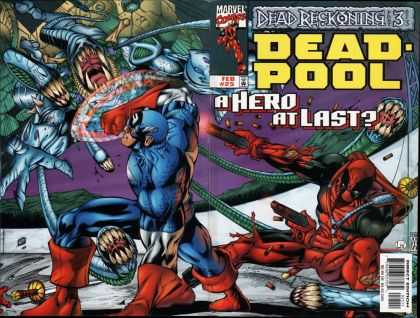
DEADPOOL #25 - "What The World Needs Now"
On the other end of the spectrum, here is Deadpool in his finest hour. It's the culmination of everything Kelly spent over two years building, and it does not disappoint. Wade gets his chance to prove he's a hero, but it turns out the choices he needs to make aren't easy ones and he ain't getting a tickertape parade at the end of this one: they needed him because they need something killed. He needs to go through no less than Captain America, in a great fight because it swings from the inherent humor of two such polar opposite characters interacting to the very serious burden Deadpool feels when doing the right thing means going against the guy the Marvel Universe considers its patron saint. If "In Absentia" shows why the things that make Deadpool not your traditional knight in shining armor also make him kinda terrifying, "What The World Needs Now" demonstrates why sometimes you need a monster to do the things that the bright shiny heroes can't. Lots of resolution for lots of characters here and plenty of payoff for various Easter eggs, but nothing bigger than Deadpool's big moment and his realization that destiny doesn't intend for him to have a happy ending.

DEADPOOL #27 - "Look! It's Wolverine!"
As the cover says, "...in his most gratuitous guest appearance ever!" Gotta love that this book put stuff like that on the cover. This wasn't the deepest issue, as Kelly was really kinda winding things down at this point, but hey, it's an awesome fight between Deadpool and Wolverine that 'Pool instigates after Logan initially refuses by knocking Kitty Pryde into the air with a move from Street Fighter II. Oh, and Howard the Duck's archenemy Doctor Bong is acting as Deadpool's therapist. Do you really need more sell than that? Well then I can't help you, because you obviously hate joy.

DEADPOOL #33 - "The End of the End or Happy Entrails To You"
Joe Kelly's final issue of Deadpool has Wade in mortal combat with his bitter rival, T-Ray, as they try and untangle their convoluted shared origin in one of the most confusing comics ever. The glorious thing is that I'm pretty sure Kelly meant for it to be that confusing, because about three quarters of the way through, Deadpool just basically says, "Fuck it--I don't understand any of this, but I'm Deadpool, a snarky dude with guns and knives who likes to make wiseass comments and kick people and you really don't need to know much more than that to enjoy what I do!" It's a perfect conclusion to Kelly's run and a brilliant bit of meta commentary in a series that had more of that than you'd expect.

SUPERMAN/BATMAN ANNUAL #1 - "Stop Me If You've Heard This"
Y'know what, I'm not gonna give this one away other than to say that seven years later, Joe Kelly still had one great Deadpool story left to tell, and he told it in the most unlikely of places. Enjoy.

Sunday, March 22, 2009

The Essentials: Deadpool by Joe Kelly

Not too long ago, some friends and I were talking about the truly iconic characters in comic books. The characters that transcend the genre and become ingrained in the public consciousness, that people who are both fans and laymen are inherently drawn to because there's something that makes them stand out among the pack. Superman, Spider-Man, Batman, the Hulk, Wonder Woman, Iron Man, Aquaman, Captain America, the Flash, Daredevil, etc. etc. These are characters who have gone through changes over time, but who have always maintained or reverted to a certain default state because they have too important a place in the hierarchy of comics not.

The talk turned to who was the last character to join this pantheon. Who was the most recently-created charcter who could reasonably be called iconic? Convention holds that a character like that hasn't come along since the 70's. The usual suspects include Wolverine, the Punisher and Swamp Thing, all characters who have broken away from the pack at some point and transcended the A-list. However, I threw a bit of a wild card out there:
Deadpool.

And the funny thing was, nobody really disagreed with me.

Ok, unlike the bulk of the characters we place in that rarified air, Deadpool has not starred in his own movie or been on "Superfriends" (although the former will be somewhat remedied in a couple months with "Wolverine: Origins" and I'm now struck by how amazing a "Superfriends" mash-up featuring Deadpool would be), and he has certainly not permeated mainstream consciousness to the degree of even a Green Lantern or Punisher, but he's on that cusp. He's a character that a lot of people who aren't hardcore comic geeks at least know of to some degree and gets placement in a lot of cartoons and video games and toylines because there's just something about the character that hits that casual fan sweetspot.

And as far as folks who actually read monthly comics go, there are a huge amount of Deadpool fans who are vocal and excited about the character. As a veteran of more than a few Marvel convention panels, I can say that when we make a Deadpool-related announcement, it gets more of a pop than when we announce stuff about even Spider-Man and the like. Moreover, since the late 90's, Deadpool has always had an ongoing series because I think if he didn't there would be a riot. Creators from Brian Michael Bendis to guys who come in from outside the industry are chomping at the bit to find a way to write him because he has that kind of following amongst their community as well.

It's tough to explain the zeitgeist around Deadpool, but I'll attempt to do so anyways, because I think a good deal of it can attributed to one really good writer.

Probably what stands out to me most about Deadpool is the way the character has "risen above his station," so to say. I think Rob Liefeld and Fabian Nicieza would probably have no trouble acknowledging that when they created the character in 1991 they weren't looking for much more than a cool-looking adversary for Cable who had some neat add-ons as far as the yperactive pop-culture quoting and the scarred up face. Nicieza and Mark Waid--two writer whom I hold in extremely high regard--added a bit of meat to the bones as far as giving Deadpool some dimension in his two 90's limited series, fleshing out his past and adding some supporting cast, but again, I doubt either had designs on making the character particularly enduring.

Then along came Joe Kelly and an incredible 33-issue run on a Deadpool ongoing series that I'm guessing most people wouldn't have given past 12 issues in their offices pools (in the event that anybody was having office pools centered around how long a Deadpool series would last).

You can't get 6 issues, let alone 33 (or the 69 issues that Deadpool's first ongoing ran), just out of "kewl assassin with swords and guns." What Kelly did was take a harder look at what would be going on inside the psyche of a dude like Deadpool, combined it with a great sense of humor, a unique supporting cast and more, and created a very different kind of super hero book. He set a template that successive writers such as Deadpool's original co-creator Fabian Nicieza and current DP steward Daniel Way have been able to continue tapping into over a decade later, that of the most unlikely hero in the world trying to do his best against his nature.

In his first few issues, Kelly makes sure to establish that in the mercenary world, there's nobody better than Deadpool, and that his peers either revere him for how bad ass he is or hate and are jealous of him for the very same reasons. As long as he's got the mask on and a target to stab or shoot, Wade Wilson is the coolest cat around, quipping and flipping his way to whatever he wants.

However, when the mask comes off, we see that Wade is an extremely flawed and messed up dude, both physically and otherwise. Via Weasel, DP's geeky tech bud introduced back in his first mini, we get to see 'Pool at his best, doing the merc thing. But one of Kelly's early triumphs is the introduction of Blind Al, one of the most unique supporting characters in comics, and perfect for an offbeat character and book like Deadpool. Al is a cantakerous old blind lady who Deadpool has "taken hostage," having lived in her house for years with her waiting on him when he needs it. Al is the warped Aunt May or Ma Kent of Deadpool's world, as she sees the true, beneath the mask Wade and challenges him yet is terrified of what he's capable of. She gives Wade shit and pushes him to be better than he is, making the fact that he refers to her as a hostage seem ludicrous, but whenever he gets a bit too dark, unlike Weasel or the other characters, Al backs off because she has also seen him at his worst and knows he is far from a joke.

So you've got the "public" Deadpool we'd gotten to know via his X-Force appearances and minis as represented by how he is amongst his fellow mercs and with Weasel, but the "private" Deadpool that Kelly delved into and expanded via his interactions with Al and his inner monologue (and sometimes dialogue, because, y'know, he's nuts) was where the magic happened. This guy who's great at his job and has the respect/annoyance of his peers puts up a front of bravado and humor to mask the fact that at the end of the day, he's got nothing. He's an ugly motherfucker who lives with a blind granny who he needs to keep a prisoner in order to have anybody to talk to. His life, which he portrays to the world around him as being the shit, is in fact just shit. He's miserable. And deep down, he knows he can do better.

And that's a guy you can root for.

Joe Kelly transformed Deadpool into an iconic character for a different era in that he was not a millionaire with a square jaw or even a nerdy high school kid with a heart of gold; he was a deeply deeply flawed individual who indulged in violence, heard voices in his head, had a face that looked like hamburger and killed people for profit--but he wanted to be better.

He was not the Punisher or even Batman. He did not feel content or justified in his actions. He was just kinda resigned to them. That was his routine.

Then he got offered something better.

Early in the Deadpool series, Wade is approached by representatives from the "interdimensional law firm" of Landau, Luckman and Lake, who inform he has a destiny to become a great hero and save the world. Wade rejects this as nonsense and continues along his semi-merry way, but over the next 25 issues, amidst much chaos and many good, entertaining stories, the super-structure is Deadpool struggling with the idea that he does have the capability to be more than what he has always been, and dealing with how much that terrifies him.

As Deadpool embarks down the journey to his ultimate destiny, Kelly deftly weaves in brilliant stories fleshing out Wade's complex past, explaining how he came to be who and what he is, while also tossing out fun one-two-issue romps and crazy fights with an eclectic mix of guest stars from Sasquatch to the Hulk to Bullseye to Taskmaster. He balances the heavy stuff like Deadpool's dealings with Typhoid Mary or doomed attempts at romance with Siryn with absurd comedy with the Great Lakes Avengers or the funniest issue of any comic I've ever read in which Wade becomes Silver Age Peter Parker (more on that in the next post). The first 25 issues of Deadpool are just a great potpurri of entertainment, from easy reading fun to deeper psychological contemplation, and Kelly juggles it masterfully.

A brief aside: I'm not saying much about the art because there's really no need to. Joe Kelly's run on Deadpool had some fantastic artists, including Ed McGuinness and Pete Woods, but I mean no disrespect to their work when I say they were just icing. Rob Liefeld did a great job when he designed Deadpool because it's a look that's hard to mess up; it's inherently cool-looking. The artists who handled the first 33-plus issues of Deadpool did some great action work, etc., but the character and the writing was really the main event.

Anyways, as per usual with these Essentials, I could go on, but I'll try to wrap up. The first 25 issues of Deadpool read wonderfully as an offbeat epic that keeps twisting and turning every which way. You get everything you want and stuff you'd never expect. Joe Kelly seriously connected with the character and his world and just got it in a very special and unique way. He drops seemingly inconsequential bits in the first five issues that won't pay off until the tail end of his run. He works in what has become vintage Deadpool bits like breaking the fourth wall in a way that does not seem contrived. It's an incredible run.

In many, ways, Kelly's final eight issues of Deadpool feel like a horrible tease. He's just finished a story that seems impossible to top, and indeed almost make you wish there were no more Deadpool stories after (just kidding, that's crazier than Deadpool; it really does have a great ending though), then just as he gets his wind back and seems like he's cranking into opus number two, he's gone. We get an awesome Deadpool/Wolverine fight that include 'Pool knocking Kitty Pryde around with Street Fighter moves and a few other gems, but it's really just those last few scraps on the plate after an amazing meal.

What Joe Kelly did with Deadpool is a feat. He took a character who by all rights should have gone out of style with the likes of Crule and Gunfire and made him an icon. If you have ever even been mildly entertained by Deadpool or would like to be, you owe it to yourself to check out this run. The first two issues just got collected in the volume one of Deadpool Classic (which also had his debut and the minis), so hopefully more will be coming later this year.

You can also do what my pal Jordan did and spend like $200 books getting every Deadpool appearance ever in handbound hardcovers on eBay, but you could also continue to feed yourself.

Coming soon, I'll go more in-depth on some of my favorite stories from those 33 radtastic issues.

Sunday, November 16, 2008

Essentials Extra: New Teen Titans Must Reads

A week ago, in the last installment of The Essentials, I talked up the superlative first 50 issues of the initial volume of New Teen Titans (Tales of the Teen Titans from issue #41 on) by Marv Wolfman and George Perez. In my humble opinion, that chunk of 50 issues (plus three Annuals, the original Tales of the Teen Titans mini, and a couple one-shots here and there) reads best as one complete thread. There may be a dull issue here or there, but there's so much good in between, and so many subplots running beneath the main stuff, that you won't feel cheated if you go for the full monty. However, there are parts of those magical 50+ issues that stand apart for my money, so as promised, here are the stories that make up my definitive New Teen Titans dream collection...


"Today...the Terminator" (NEW TEEN TITANS v1 #2)
While we meet the Titans in the first issue, it's not until the second issue that the larger super-story that will drive Wolfman and Perez' run really kicks into gear. It's in this issue that we first meet Deathstroke the Terminator, are introduced to the H.I.V.E., and the wheels are set in motion for both to be ongoing threats to the Titans. The first Ravager also makes his debut in this issue, and while the character himself doesn't have a particularly long-lasting role to play, his story is what motivates the Terminator's ultimate plan against the Titans and his legacy remains active in the DC Universe to this day. We also dive straight into the Titans' personal connections with one another in this issue, as they bond away from fighting aliens and demons with both relationships and animosities beginning to show.


"A Day in the Lives" (NEW TEEN TITANS v1 #8)
One of my very favorite single issue stories of all time, this is the story that really began to set NTT apart from other team books for me and probably, in my mind, blazed a trail for many titles that followed it on into the present. Following their fights against Trigon and the Fearsome Five, the Titans take a day off and go their separate ways, with us readers getting to follow each. Some of the side stories are more interesting than others (I found Raven's a bit dull and while I appreciate them taking a shot at making Kid Flash unique by showing his relationship with his folks, you could always tell he wasn't really wanted in the book by the creative team), but every character becomes at least a little bit more real to the reader (even Robin, who is there for about two pages before speeding off on his motorcycle back to the Batman books). Starfire's naivete is really endearing for the first time here in her bit with Donna Troy (which also introduces Donna's weirdo middle-aged love interest Terry Long...the less said about him the better...) and we can a nice view of Changeling's world, but Cyborg is really the breakout star here, as he becomes arguably the most interesting character of the book's second year. After Vic Stone gets dumped by his girlfriend, who is unable to deal with his new look, he mopes his way into a park and gets his day brightened by a group of handicapped kids who think a super hero whose power is essentially a bunch of artificial limbs is the coolest; it may sound corny, but Wolfman and Perez handle the Vic stuff with such genuine affection that his "civilian" subplots quickly became my favorite.


"Clash of the Titans" (NEW TEEN TITANS v1 #11-12)
NTT ends its first year with a two-parter that brings the three female Titans (Wonder Girl, Starfire and Raven) to Paradise Island where they get caught up in a literal war of gods. Wolfman has often talked about how the the three girls on the team were set up as a trinity, with WG as the moderate between Starfire's boundless displays of emotion and Raven's lack thereof (Robin was there to strike the same balance between Changeling and Cyborg on the boys' side, another reason Kid Flash always felt tacked on), and he plays with the relationship masterfully here. Wonder Girl is entranced by the Titan of Myth, Hyperion, into falling in love with him, but you can never quite tell how much is a spell and how much is real. Starfire and Raven's opposite reactions, with Kory being confused but hopeful while Rave is distrustful, again explores that spectrum that made this a great cast. These are just the little picture details though, as the big action stuff is the Titans of Myth battling the gods of Olympus, with the girls and the Amazons along for the ride, giving Perez the chance to flex his epic storytelling muscles in ways he hadn't gotten to up to that point.


"The Search for the Doom Patrol" (NEW TEEN TITANS v1 #13-15)
While the girls are doing their thing in the previous story, the boys (minus an injured Changeling) are searching for Changeling's father, former Doom Patrol member Mento, and end up finding his teammate Robotman instead. When all seven Titans reunite, alongside Robotman they have to first take on a delusional Mento, and then the DP's killers, Madame Rouge and General Zahl. In the final issue, the new Brotherhood of Evil (a revamped version of the Doom Patrol's archenemies) gets involved as well, establishing them as quintessential Titans baddies and showing off Perez' penchant for awesome costume design (Houngan's original look was da bomb). Not every second of this three-parter is gold, but it's definitely a watershed story for Changeling, with some really emotionally trying moments for the youngest Titan and the first step on his long journey towards adulthood that would just get rougher as the series went on.


"Beware the Wrath of...Brother Blood" (NEW TEEN TITANS v1 #21-22)
As I mentioned last time, I think what makes Brother Blood a unique and creepy villain (besides another timeless Perez costume design) is the way he exploits what we rely on as comfort in our times of crisis (faith) and perverts it. This very first Brother Blood story remains the best one for me, as Wolfman draws on his horror writing experience to play Blood as that eerily detached cult leader figure and also gives the Titans a personal stake by having Cyborg's old girlfriend as one of his followers and later his victim. You can really feel Vic's justified rage as he goes after the villain and the Titans' frustration at knowing even if they beat the bad guy here, he has already won in a way by gaining the trust of his flock.


"War!" (NEW TEEN TITANS v1 #23-25, NEW TEEN TITANS ANNUAL v1 #1)
Wolfman and Perez take the Titans into outer space and throw everything and the interstellar kitchen sink into the widescreen sci fi blowout they've clearly been itching to do since the first issue. This arc is very much about world-building, particularly for Wolfman, who shines the spotlight on guest stars the Omega Men, whose series he went on to launch, and fleshing out the Vega system, where that series is set (and which has become a timeless DC locale). Starfire's evil sister, Blackfire, also makes her first appearance, and immediately presents herself as a force to be reckoned with (why hasn't Blackfire been used in a Titans book lately, come to think of it? She didn't die in the Rann/Thanagar War, did she?). The highlights here are mostly the big explosions and space battle, drawn with enthusiastic aplomb by Perez, but it's also a nice (excuse the wordplay) star turn for Starfire, who for once gets to be the character most in the know, guiding her friends through a foreign environment, as opposed to being the stranger in a strange land. This story combined with Kory's Tales of the Teen Titans spotlight adds tremendous depth to her inner strength and plays nicely against and in concert with her typical more bubbly persona.


"Runaways" (NEW TEEN TITANS v1 #26-27)
And in an impressive 180 swing, Wolfman and Perez go from the no limits space opera of the previous story to this very serious, "real world" two-parter about teenage runaways, drug addiction and other very heavy stuff. We get the unusual and interesting pairing of Cyborg and Raven as the leads, with Vic exposing Rave to horrors very different from the demonic ones she's used to on the streets of New York City and the two bonding as a result. This story also brings Roy Harper, the former Speedy, back into the Titans' lives, in a relevant and suitable role as liaison between the federal and local authorities targeting the drug trade; Roy would show up several more times over the course of NTT as one of the very best guest stars. We also get our first glimpse at "vigilante" D.A. Adrian Chase, who would play a big role in Robin's maturation process before going onto his own solo series, and of course Terra. Much like with the Brother Blood story, the Titans learn tough lessons here about losing even when you "win."


"Who Killed Trident?" (NEW TEEN TITANS v1 #33)
A very neat one-off murder mystery that has both the neat hitch of the team's resident detective, Robin, being M.I.A., so the other Titans need to solve the case themselves, and a very inventine resolution that I won't spoil. We also get Terra fully integrated into the team and bonding with her teammates an issue before she breaks our hearts, and a funny scene where Starfire meets Jason Todd.


"Who is Donna Troy?" (NEW TEEN TITANS v1 #38)
Another great one-and-done that is unlike most other comics you would have seen at the time and even today. The whole issue is Dick Grayson, out of costume, piecing together the mismatched puzzle pieces of Donna Troy's past, as a wedding present to her and Terry. Wolfman shows tremendous restraint in his pacing and the ability to keep you totally tuned into the story without big action or bright costumes, while Perez really starts to experiment with his use of borders, shading, and other bedrock elements of storytelling. It's not only an enthralling story with an emotional payoff, it was also the type of continuity doctoring that Geoff Johns has since become famous for, but which was unheard of in 1984 (of course none of it makes sense anymore after a half dozen more reboots to the character, but details...). Wolfman, Perez and countless Titans fans have all pointed to this issue as a favorite.


"Crossroads" (NEW TEEN TITANS v1 #39)
This issue is probably better known for its oft-imitated iconic cover than what's inside, and it's hardly the most essential issue of the run, but it's an important checkpoint that sets the table for "The Judas Contract" and gives us a chance to observe how far the cast has come, individually and as a unit, over the course of 39+ issues. There's also some interesting meta commentary as Kid Flash muses about never having really felt a part of the team and how they're all much more broken up about Robin's departure than his. The tender moments between KF and Terra are probably Wally's greatest contribution to the series though, as his affection for his young teammate and her faux reciprocation is the final twist of the knife needed before her big betrayal.


"The Judas Contract" (TALES OF THE TEEN TITANS #42-44, TALES OF THE TEEN TITANS ANNUAL #3)
The mother of all Titans stories, this is the mega-arc that Wolfman and Perez have been building since issue #2, stirring in extra elements like Terra, Dick Grayson's identity crisis and more along the way. This four-parter crams in more cool stuff than we get in most 7-issue event minis these days, as we learn the Terminator's full origin, meet his family (including pivotal son Joey, aka Jericho), witness Robin's transformation into Nightwing, see the final fate of Terra, and the culmination of everything else we've been waiting four years for. Each chapter stands alone as a unique masterpiece in its own right as well, with the first basically being all prologue and character work, the second providing another showcase for Dick Grayson's detective skills as he figures out how Terra and the Terminator took out the Titans CSI-style, the third giving the spotlight more or less completely to Terminator, and the final part providing the all-out action finale and heartbreaking climax. "Judas Contract" is the all-you-can-eat buffet of comics goodness, providing the most bang for your buck you'll find and doing it well. There is plenty written around the 'net and elsewhere praising this bad boy, but I highly suggest you experience it for yourself (and it's one of the most readily-available trade collections of NTT, so you've got no excuse).


"We Are Gathered Here Today..." (TALES OF THE TEEN TITANS v1 #50)
Marv Wolfman and George Perez put a bow on their initial run as a creative team not with a big fight, but with a wedding, as Donna Troy and (ugh) Terry Long tie the knot in an extra-sized issue that gives Perez an excuse to draw the entire DC Universe in formalware and Wolfman cause to dig up every Titans-related Easter egg he can find, from Duela Dent to naming wedding guests after longtime Titans fans. It's a gorgeous, touching love letter to the characters these creators spent five years bringing together, without a super villain or disaster in sight. "We Are Gathered Here Today..." remains the gold standard for comic book wedding issues and is a wonderfully upbeat sendoff to the first Wolfman/Perez Titans age (until they came back together a few months later to launc a second volume of the book in ghastly dark fashion with the scariest Trigon story ever...but that's another post).

This trip down memory lane is deeply indebted to the awesome TitansTower.com, which you should do yourself a favor and check out ASAP.