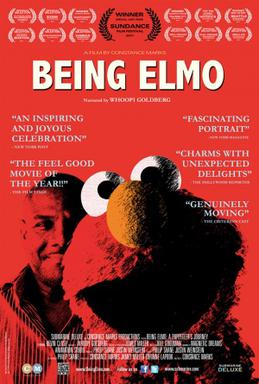
What makes a great documentary? I found this story of Kevin Clash's rise from his childhood dream of becoming a puppeteer to becoming the man who brings Elmo to life and all the steps in between to be captivating, heartwarming and inspirational. Clash is an intensely likable and interesting subject who speaks passionately and with great recall about his life and the adventures he's had throughout. The amount of archival footage that director Constance Marks was able to acquire dating back to Clash's high school days and detailing every step along the way from local Baltimore cable to Captain Kangaroo to Sesame Street is impressive and just cool (Clash either didn't believe what was happening and wanted to document everything, knew a documentary would someday be made of his life, or maybe a little of both with the amount of stuff he taped). The supplemental interviews from Clash's parents as well as figures like Frank Oz and other legendary members of Jim Henson's team were great; nothing felt tossed out. And of course the highlight (at least for me) was getting a behind the scenes look at how the Henson operation runs, be it through old test footage from a commercial Clash did with Henson and Oz to Clash helping train the staff of France's Sesame Street; it's fascinating to see what goes into these productions. I also loved watching the growth of Clash's relationships with grandfatherly Sesame Street designer Kermit Love as well as with Jim Henson himself, the stories of which I thought were supplemented in a neat way by the use of old photos and motion animation to fill in the gaps of what wasn't videotaped. Going back to the question I posed at the start of this review, though, does a documentary need some sort of tragic angle or obstacles the protagonists overcomes in order to be great? The bulk of Being Elmo tells me it does not, as most of the piece focuses solely on the positive aspects of Clash's life and career, and that worked just fine for me. There are a few spots, though, where Clash's strained relationships with his ex-wife and daughter come into play, and they just don't match up with the rest of the through line for me. There seems like there's a whole other documentary to be made about things like Clash's ex-wife telling him not to treat their daughter like a puppet or his regret over spending time making other children happy while not seeing his own; it's sad stuff and a provoking commentary on how people who never fully grow out of their childhood have difficulties with adult relationships and being parents. However, this portion of the documentary is dropped in somewhat haphazardly--his marriage is not mentioned until Clash talks about his daughter, and he already there refers to his spouse as his ex-wife--both souring your mood in the midst of this feel good tale and also raising questions that don't get fully explored. It feels like the filmmakers felt like they couldn't fully ignore this aspect of Clash, but also didn't want to give it more than minimal space; it's a 15-minute section you get the sense they felt obligated to put together rather than wanting to. However, warts and all, Being Elmo I would argue is indeed a great documentary and I'd highly recommend it.
Saturday, March 10, 2012
Paragraph Movie Reviews: Being Elmo
What makes a great documentary? I found this story of Kevin Clash's rise from his childhood dream of becoming a puppeteer to becoming the man who brings Elmo to life and all the steps in between to be captivating, heartwarming and inspirational. Clash is an intensely likable and interesting subject who speaks passionately and with great recall about his life and the adventures he's had throughout. The amount of archival footage that director Constance Marks was able to acquire dating back to Clash's high school days and detailing every step along the way from local Baltimore cable to Captain Kangaroo to Sesame Street is impressive and just cool (Clash either didn't believe what was happening and wanted to document everything, knew a documentary would someday be made of his life, or maybe a little of both with the amount of stuff he taped). The supplemental interviews from Clash's parents as well as figures like Frank Oz and other legendary members of Jim Henson's team were great; nothing felt tossed out. And of course the highlight (at least for me) was getting a behind the scenes look at how the Henson operation runs, be it through old test footage from a commercial Clash did with Henson and Oz to Clash helping train the staff of France's Sesame Street; it's fascinating to see what goes into these productions. I also loved watching the growth of Clash's relationships with grandfatherly Sesame Street designer Kermit Love as well as with Jim Henson himself, the stories of which I thought were supplemented in a neat way by the use of old photos and motion animation to fill in the gaps of what wasn't videotaped. Going back to the question I posed at the start of this review, though, does a documentary need some sort of tragic angle or obstacles the protagonists overcomes in order to be great? The bulk of Being Elmo tells me it does not, as most of the piece focuses solely on the positive aspects of Clash's life and career, and that worked just fine for me. There are a few spots, though, where Clash's strained relationships with his ex-wife and daughter come into play, and they just don't match up with the rest of the through line for me. There seems like there's a whole other documentary to be made about things like Clash's ex-wife telling him not to treat their daughter like a puppet or his regret over spending time making other children happy while not seeing his own; it's sad stuff and a provoking commentary on how people who never fully grow out of their childhood have difficulties with adult relationships and being parents. However, this portion of the documentary is dropped in somewhat haphazardly--his marriage is not mentioned until Clash talks about his daughter, and he already there refers to his spouse as his ex-wife--both souring your mood in the midst of this feel good tale and also raising questions that don't get fully explored. It feels like the filmmakers felt like they couldn't fully ignore this aspect of Clash, but also didn't want to give it more than minimal space; it's a 15-minute section you get the sense they felt obligated to put together rather than wanting to. However, warts and all, Being Elmo I would argue is indeed a great documentary and I'd highly recommend it.
Monday, March 5, 2012
Should Have Beens: Guy Gardner
This is an interesting (and debatable) one as this “should have been” is really a has been and even an is (and that’s how you do an opening sentence).Guy Gardner is headlining (or co-headlining) his own well-selling series, Green Lantern Corps, and for the past few years before that was doing the same either in its predecessor or Emerald Warriors. He was perhaps the most popular member of the late 80’s/early 90’s Keith Giffen/J.M. DeMatteis Justice League and is always at least a cult favorite when that group shuffles its line-up (he’s technically on Justice League International right now, I guess, but he hasn’t been on the main team since just after Doomsday though a vocal segment always wants to see him there; his last dalliance in being recruited by the big guns was as a bit of a running joke during Grant Morrison’s run over a decade ago).
He had a respectably long-running—and underrated—solo series in the 90’s, he crossed over to animation with Batman: Brave and the Bold, and is generally a character held in high regard. Save for a period right after his introduction—he was in a coma—and the first few years of this century—he was in a weird limbo after sort of dying during Our Worlds at War before coming back via Joe Kelly’s Action Comics and getting rebooted as a Green Lantern by Geoff Johns—Guy Gardner has always more or less been a high B-lister verging on the A-list of DC Comics heroes.
And yet it feels like he had the potential to be more.
Guy Gardner is the most interesting of the human Green Lanterns. Kyle Rayner is more relatable, but Guy has more to him. He’s got more range than golden boy Hal Jordan and more depth than the shifting tabula rasa that is John Stewart. Don’t get me wrong, all of those characters are great (except for Hal Jordan), but while Kyle is likable, John has potential and Hal is a douche bag, Guy’s got layers.He’s a genuinely heroic man trapped in the façade of a jerk by circumstance. Guy overcame a difficult childhood to become a social worker and later a teacher, working to better the community and world around him even as he kept his own aggression in check. He was judged equally worthy to be Earth’s Green Lantern by Abin Sur, with Hal Jordan only getting the nod because he was geographically closer. Guy eventually became Jordan’s back-up and friend, but suffered one tragic setback after another, getting hit by a bus saving one of his students, getting trapped in the Phantom Zone, and eventually lapsing into a coma (also, Hal Jordan romanced his girlfriend when he was out of commission one time; yes they both thought Guy was dead, but come on!).
All this piled up to create the Guy Gardner the DC Universe—and readers—are most familiar with: an arrogant, brash, hot-tempered loose cannon who also happens to be a noble and dedicated champion for justice (even if it’s not always evident). Part of this persona is written off in-universe as the result of his brain damage and whatnot, but the more interesting story to me is that of a man who had the potential to be a hero or a jerk, did his best to be the former, got knocked on his ass at every junction, naturally fell toward his darker nature, and now struggles to balance the two; that’s a character whose life and adventures I want to follow.Unfortunately, as has long been the problem with a lot of characters who came to prominence in the Giffen/DeMatteis JLI, more often than not the deeper complexities of Guy Gardner have been ignored in favor of just writing a loudmouth who is obnoxious because he’s an obnoxious loudmouth. Giffen and DeMatteis were (and are) geniuses when it comes to working in subtleties, so that their parody is strong but when they’re being serious and giving their characters deep moments, it has extra added value; a lot writers who followed them only got the surface level stuff.
One writer who understood how to make Guy Gardner more than a cliché was Beau Smith, who penned Guy Gardner: Warrior during the mid-90’s. Smith explored the character’s past, the roots of his insecurities and why he had such a desperate need to fly in the face of authority. But Warrior wasn’t just funny book psychology; it could be as funny as JLI and Guy remained the bare-knuckled bad ass Smith loves to write, but with stakes that made you care about him. Your mileage may vary on Guy’s altered look and powers during his Warrior days, but that series was a revealing glimpse at the character beneath the gimmicks and how much potential he truly had.As with so many of these Should Have Beens, unfortunate timing has been Guy Gardner’s enemy. His popularity and visibility peaked while he was on a team, so while Giffen and DeMatteis did wonders with him, they still had a half dozen other characters to juggle. His solo series was launched at the height of 90’s excess and didn’t quite find its way under Smith until the market was a more volatile place that couldn’t sustain unproven commodities. By the time Guy became viable again, much of his development had been forgotten and his chief function was gag cameos. Even now, since being reborn under Geoff Johns and shepherded along by the talented Peter Tomasi—who obviously cares about what makes the character tick beyond the obvious—Guy has to tie for third fiddle at best in the Green Lantern franchise behind the resurgent Hal Jordan and tenacious Kyle Rayner.
Guy Gardner has never had a chance to truly shine. He’s been a replacement, a team player, a joke and a co-headliner, but never gotten that top spot. Again, Tomasi does a great job with him in GLC, and I have every confidence he’ll continue to do so, but honestly, wouldn’t you love to see a movie about a wise ass who’s quick to throw the first punch because he’s fighting back against the bum circumstances life has dealt a good man who happens to have the most powerful weapon in the universe on his ring finger?I sure as hell would.
Sunday, March 4, 2012
Paragraph Movie Reviews: Wanderlust
As a longtime fan, I'm impressed and pleased to see David Wain and others from the State/Wet Hot American Summer/Stella comedy cabal deliver a movie like Wanderlust that is their most mainstream and casual viewer-friendly effort yet without losing any of the feel (or indeed the in-jokes) of their previous work (Role Models probably exceeds it in terms of broad audience appeal, but it also loses a lot of the more quirky aspects in the process). The premise has Paul Rudd and Jennifer Aniston as George and Linda, a married New York City couple who lose their jobs and home and end up settling into a sort of hippie commune called Elysium as they try to get back on their feet and find their way; the set up provides a great gallery of weirdo characters as well as fundamental questions about discovering your path in life and prioritizing work, love and happiness (no lie, man, it's all there). As always, Rudd is game to be the heart of the story, kicking ass across the board, be it with physical comedy, improv bits in front of a mirror (seriously, these are downright uncomfortably funny), anchoring the dramatic end of the movie, etc.; he gets to go versatile as well, vacillating between the carefree and uptight half of the couple. Aniston puts in the effort and doesn't deliver a bad performance, but in all honesty, there's an exhaustion in her face and demeanor that undermines Linda supposedly being the dreamer of the two; she's not awful, but I don't buy her in the role. The greatest strength of Wanderlust, not unlike Wet Hot, comes from a deep bench ensemble, where the first half hour is essentially one great introduction after another, and the remainder is a well-balanced team effort. Justin Theroux is the standout as Seth, the charismatic alpha male of Elysium, getting under your skin with his passive aggressive attempts to undermine George and Linda's relationship even as he cracks you up rattling off outdated technology as the evils of the world or dance fighting a car; he's the kind of dimwitted douchebag Theroux himself has said he loves to play. The other principal scene stealers are Kathryn Hahn (who knows how to explode in bursts without pushing her co-stars out of the action, something Kerri Kennery could learn, I'm sorry to say), Ken Marino (completely over-the-top as George's cro-magnon successful older brother), Michaela Watkins (Marino's drugged out and long-suffering wife) and Jordan Peele (casual beyond belief Rodney). That's just scratching the surface, as Lauren Ambrose and Joe Lo Truglio are great as well, Alan Alda gets what he can out of limited material, and Malin Akerman is mostly there to be pretty, but has a funny line or two. Unfortunately, the weakness of Wanderlust is that Wain and Marino (the co-writers) are fantastic at crafting comedic bits and creating an environment for their actors to play in, but I think they still have trouble generating adversity and conflict for a more traditional movie like this. In Wet Hot, the "threat" that needs to be overcome is a falling meteor; when it comes to something more grounded like saving a marriage and having two adults come to terms with needing to give and take on their values, these guys haven't quite mastered it, so that middle portion of the movie slows down considerably. From an acting standpoint, Wanderlust is absolutely fantastic; from a writing and structural perspective, it's a great step, but still a work in progress. I laughed out loud for about 85 of the 100 minutes I was there, though, so in my mind, call it a win.
Monday, February 27, 2012
Five Comics Worth Reading - February 2012
ARCHIEAt this point, having a comic book blogger tell you that you should give Archie Comics a second look because they’re doing some pretty remarkable and groundbreaking stuff is not the shocker it was a year ago (I already more or less did as much recently). However, just because it’s getting exposure is no reason not to talk about something good, and Archie is indeed something good right now. I’ve always appreciated the rock solid and consistent grasp of storytelling and characterization the folks from Riverdale have, but the material they’re producing right now is pretty bold and standout, not to mention something I can sink my teeth into as an adult while still recommending it to my sister who is a school teacher to give out in class. If you want to see issues like gay marriage or the economic crisis covered with intelligence and wit but also restraint and balance, Archie of all places is where you should be turning. Also, there are guest appearances from rock bands and parodies of movies; it’s like how Sesame Street got cool again, but more up my alley. I’ve been meaning to sample more of the line, such as the fairly acclaimed Life with Archie, but for now I’m recommending the titular flagship since that’s where my amigo Alex Segura’s recent “Archie Meets KISS” story just wrapped and where he’ll be tackling “Occupy Riverdale” in the coming months.
AVENGING SPIDER-MANSo perhaps you checked out the first three issues of Avenging Spider-Man because Joe Madureira made his return to comics, and likely you were not disappointed because Joe Mad has still got it and kicked some ass. However, while marveling (pun not intended) at Joe drawing eight zillion Moloids, you may have found yourself chuckling at Spidey’s banter even more than usual. You may also have been shocked at how much you were seeing J. Jonah Jameson as a complex character rather than just a gruff curmudgeon (but also still a gruff curmudgeon). You may further have empathized with The Mole Man, gasped when Red Hulk went down and marveled at Spider-Man’s solution to the whole conflict. All of these reactions came in large part thanks to writer Zeb Wells, who is indeed the goods. Peter Parker is fortunate enough (or as fortunate as comic characters can get given the high tragedy rate they suffer through more or less monthly) to be handled with regular love and care by the brilliant Dan Slott, but Zeb comes from another direction on this book, focusing exclusively thus far on the Spidey side of the equation, and with results I’m digging. It really clicked into place with me on issue #4, a standalone team-up with Hawkeye drawn by Greg Land, where Wells inverted the usual Spider-Man/anybody else dynamic by having Spidey as the frustratingly responsible one, and then nailing a core character trait of Clint Barton from an angle I’ve certainly never seen, and if it’s been done before surely not any better than this. Zeb Wells is a busy dude out in Hollywood who doesn’t get to write nearly enough comics, but when he does, you should rush to appreciate his twin barrels of genuinely hilarity and razor sharp grasp of what makes the characters he’s writing tick; that he’s currently on a book where he gets to play with the coolest heroes in the Marvel Universe while top notch artists draw them is the proverbial gravy sauce.
GLORYOn a recent trip to Midtown Comics, I decided to put my money where my mouth was re: a claim I made recently in an Art Attack post that the covers for the new Extreme books were enough to entice me to check out at least one or two with no idea what I was buying—and I’m glad I did. I have no familiarity with the character Glory, either in her original or Alan Moore incarnations (are they the same?) and further had no knowledge of who Joe Keatinge and Ross Campbell were outside of names my more sophisticated comic reading friends drop when discussing folks good at writing and/or drawing. The story by Keatinge in the first issue (technically #23) is all over the place both in terms of chronology and focus, but while that can take me right out of some stories, here it was done wonderfully, as I felt immersed in a huge saga within 20 or so pages, getting glimpses of tons of stuff I knew a little about and want to learn more of, but also feeling like I got a good enough sense of this character and her world that I am invested in what comes next. Campbell’s art is wild and unique, certainly outside my normal comfort zone and I ate it up, man. Glory is terrifying in her proportions and the visual violence she reaps, but she’s also quite beautiful, both in the quiet moments and glimmering in the heat of battle. This is also a comic where I really noticed the colors, given how much white and grey there is so kudos to Shatia Hamilton for really making it stand out. Discovering new comic book universes where I’m a total neophyte but want to know more is one of my favorite things, so I’m quite pumped to be reading this book!
NEW MUTANTSFor the longest time I didn’t really “get” the New Mutants. Weaned on X-Force as I was, they were only ever the younger, wimpier, less cool versions of the characters I really liked to me, and Cannonball looked like a dork. I had no desire to read about that incarnation of my beloved team and even less to see them regress to that point. When Generation X and later the New X-Men came into being while X-Force quietly dissolved back into being reserve X-Men, the mutants I grew up loving seemed to suffer the same middle child syndrome as the original Teen Titans, just kind of hanging around in the background as less competent adults or out-of-place young people. It’s only recently that I’ve really started to appreciate through trades the endearing quirkiness of the original New Mutants—it helps that I’m not 12 years old and baffled by characters under 20 without earrings or leather jackets anymore—just in time for Dan Abnett and Andy Lanning to find a niche for the characters today. Having just departed my 20’s, I dig how DnA writes the original Muties as that drifting lost generation too old to live on Utopia with Cyclops and company but still too young to know quite what they’re doing with their lives. For a team that includes techno-organic aliens and other-dimensional doppelgangers, the New Mutants seem refreshingly “normal” amidst an X-Men Universe of the extraordinary (which I also love, but there’s room for chocolate as well as peanut butter; well, not for me, I’m lactose intolerant, but you get me). Tossing this weird yet relatable group up against gonzo threats like demonic metal bands or islands of monster birds plays the contrast beautifully, and the soap opera aspects are also finely tuned, feeling more Reality Bites than 90210, as befitting the protagonist demographic. With guys like David Lopez manning the art, New Mutants is also one of the prettiest book on the stands. And did I mention they had a whole issue that was Magma on a date with Mephisto and it was phenomenal? Mephisto truly is the most lovable character of 2012…
RED LANTERNSOk, on the surface, Red Lanterns would seem to have a lot going against it for the discerning reader. There’s the pretty absurd violence level and the fact that most of the characters are literally vomiting up acid blood more often than not. There’s also the overblown sexualizing of many female figures in physically impossible poses. The book gives you plenty of reasons not to give it a shot, and nobody would blame you if you wanted to pass and try something else—I won’t—but if you do elect to sample Red Lantern, you may be surprised to find you enjoy it; I kinda was. It’s not a surprise that Peter Milligan can write a good series, but given the material of perpetually pissed off monsters whose personalities consist more of yelling than anything else, it’s pretty impressive how much depth he gives them. Without a traditional heroic lead, Milligan chooses instead to muse on the concept of rage and anger getting somewhat deep in the process, but never lapsing into boring. As the series has progressed, he’s gone a bit further and explored the gamut of emotions, how those that drive the Red Lanterns fit in the mix, and how they can be exploited. The power struggle between Atrocitus and Bleez is reminiscent of something you might see on Apokolips, and as the cast expands, the intrigue grows. Ed Benes’ art may not be for everybody, but you can’t deny it’s striking, and when it comes to designing or portraying out there beasts, his skills can shine quite nicely. So yeah, I didn’t think Red Lanterns would be a book I’d be championing six months in—and again, this is one of those “your mileage may vary” cases—but I do contend it’s worth a look if you’re even slightly curious.
Labels:
alex segura,
archie,
dna,
five comics worth reading,
new mutants,
spider-man,
zeb wells
Academy Award-Winning Paragraph Movie Review: The Artist
From just about every technical standpoint, The Artist is a masterpiece; really it has to be, as it needs to hold the attention of a 21st century audience with the film making techniques of nearly a century ago and absent of any spoken dialogue or color. A great, consistently moving score help to keep you engaged with a plot that could easily lose you otherwise. Meticulous cinematography and art direction contribute as well. Michel Hazanavicius and his crew deserve tremendous credit for putting every aspect of a movie that might get glossed over because they're covered by strong acting under the microscope and making sure to get as close to perfection with them as they can. Even stuff I wouldn't normally notice like the snappy costumes stood out. And the performances are there to boot, as Jean Dujardin brims with the charm of a born leading man whose expressive physical work, comedic chops and ability to pour his heart into his face is remarkable. Berenice Bejo is a notch or two below Dujardin, but that doesn't mean she's not fantastic (she is). The supporting cast is wisely packed with actors not out of place in the setting who do so much storytelling with the way they move, particularly John Goodman, but also Missi Pyle and even James Cromwell; Penelope Ann Miller is a bit of a weak link, but she's not a particularly important cog. Finally the story being conveyed--the fall of a lovable but vain silent film star railing against talking pictures and his love story with the woman symbolizing his replacement--is strong with much to say. My big knock against The Artist would be its lack of staying power, meaning now that I've seen all the tricks (and there were some great ones, from everything I outlined to the gradual introduction of sound and so on), I really have no desire to watch it again. I'm also not sure how much my attention would have been held had I seen it in the theater as opposed to with my friends at their apartment, with us able to commentate over the whole thing (which we did). But hey, there are far worse things that being a darn near flawless piece of cinema that you only want to see once, and that dog was adorable.
Wednesday, February 22, 2012
Art Attack: May 2012's Coolest Covers
-On Animal Man Annual #1 and Avengers Academy #30, Travel Foreman and Giuseppe Camuncoli both do something that makes their covers stand out in a perfectly logical and yet unexpected way, that being taking characters whose chief physical characteristics are physical deformities and actually making them visually a bit gross. Swamp Thing is a shambling swamp monster and Mettle is basically an accident victim with no skin, but the tendency for artists will often just be to make them look super heroic and bad ass; Foreman's Swamp Thing is a creeping mass of gelatin while Camuncoli's Mettle appears horribly uncomfortable in his own proportions. It solidifies what makes these characters unique when artists go for it like this, and it makes their work stand out in the process.
-On his variant to Avengers Vs. X-Men #4, Jerome Opena demonstrates how to make a simple concept very powerful. And dig those Dean White colors.
-Captain America dinosaur! Captain America dinosaur!
-There is seemingly not only nothing Paolo Rivera can't do, but nothing he can't do with his own spin. This month, he does sexy like you've never seen before on the cover of Daredevil.
-Dave Johnson is a genius with composition. I'm loving seeing the techniques he's been using to make his Deadpool covers break from the pack and am anxious to see how that black space is ultimately utilized. His Fury MAX stuff is pretty damn hot too.
-Breaking: Adam Hughes draws gorgeous ladies.
-It's always fun to see Ethan Van Sciver apply his detailed style to new designs, in this case Batwing and OMAC at the least.
-Hey, remember how I said a couple months back I was intrigued to pick up Glory based just on the cover? I did and I liked it!
-That Grim Leaper cover unsettles me and I can't put my finger on exactly why.
-Incredible Hulk #7.1's cover is currently the background on my work computer.
-What in the blue hell is happening on that Wolverine cover by Chris Samnee? I must know.
-Young Justice #16 feels a bit like an homage to the original Young Justice #22, itself a bit of an homage to New Teen Titans #8. Cool stuff.
Tuesday, February 21, 2012
Paragraph Movie Reviews: Like Crazy
I'm a sucker for romantic movies that tug at the heartstrings, and this was quite a good one (in fact it may have tugged a bit too hard, which is a commentary on my teenage girl-like emotional over-sensitivity and if anything another compliment to the film). Anton Yelchin and Felicity Jones could not be more perfect as Jacob and Anna, an American man and British woman who meet in their final year of college and embark on a relationship that is almost immediately sidetracked by issues of distance. They hit the nice moments so well, and you become emotionally invested in their happiness almost instantly, but they're also disturbingly skilled at making their fights remarkably believable for two real people in love; their relationship never feels scripted or rehearsed, which makes the highs higher and the lows heartbreaking (I was agonizing the whole time about how one seemingly simple transgression they make with loving intentions in the first 20 minutes becomes the dragon they must battle for the remaining hour plus). They're backed up by a solid supporting cast where Oliver Muirhead and Alex Kingston shine as Anna's parents while Jennifer Lawrence doesn't do much but look pretty and Finola Hughes seems a bit wasted as well in a cameo. The film is beautifully shot, with director Drake Doremus (whose relationship with his ex-wife the story is apparently based on) specializing in wonderful close-ups and jump cuts. The time lines jumps around quite a bit, which is nice as it helps advance the plot and the characters' relationship, but can also be slightly confusing and make it seem as though you're missing key bits; fortunately Yelchin and Jones ensure that while some tipping points in their journey take place between scenes, the emotional resonance is never lost. I doubt this will go down as an all-time classic and certainly it's the type of movie I'm appreciating a lot while still in the moment of having experienced it, but even stepping back I'm really impressed by the nice little piece these folks have created.
Subscribe to:
Posts (Atom)