Tuesday, August 17, 2010

Random Reviews: Murderland #1

[Editor's Note: As always, the nowhere near semi-regular feature known as "Random Reviews" should NOT be considered any of the following things: The opinion of anyone who works at DC or Marvel. Brief. Smart. Entertaining. Insightful. Spoiler-free. Or vaguely resembling something resembling actual comics criticism. We cool? - KP]


Murderland #1
Image Comics
Written by Stephen Scott
Drawn by David Hahn
Colored by Guillem Mari
Preview Here
Website Here


I knew next to nothing about this Image Comics mini-series up until the week it came out. Amazing as it sounds, even with my job there are books from the biggest publishers in the direct market that slip my notice, and the first time I had a real idea that I'd want to buy Murderland came when my buddy Andy Khouri noted on Twitter that it was drawn by David Hahn. And hey...I LOVE me some David Hahn art.

From his late-lamented Private Beach series to his occasional Vertigo work on titles ranging from Bite Club to Fables to his brief run on Marvel all-ages books like Spider-Man Loves Mary Jane and Marvel Adventures Fantastic Four, it's been a rare thing for me to find a book by Hahn that doesn't immediately please the eye in some way. The artist has a very refined line and cartooning sense that on its surface falls between Jaime Hernandez on one end and Paul Grist on the other. And while Hahn's most recent work has done well to add some weary layers to what could easily be seen as a more cutesy, "light" style on the basic design level, what really brings me back to his stuff is how his characters betray so much personality in the simplest of actions, inflections and ticks. The eyes say a lot in a David Hahn comic book, which is a rare thing even when it's not coupled with some very clear, very unflashy storytelling.

And while all of that is on display in this first issue, the rest of Murderland comes off as something of a mess by comparison. Actually, scratch that. This would read like a mess no matter who was drawing it.

To jam out the plot-basics as best I can, the series focuses on "Method" – an Alias-like femme fatale who can change her appearance to get close to any target – and "Arabber" – some kind of criminal of some sort who's maybe in love with Method or whatever. It's hard to tell. The pair go out on what seems to be a standard "whack a wealthy ass hole" assassination when we learn that they're in fact there to turn the tables on an actual one-eyed assassin who's in said ass hole's mansion. Oh, and everyone has superpowers where they can grown extra bones for kung fu or some crazy shit, and none of them can be killed even by the most drastic of wounds to their bodies so there's tons of disaffected blood and guts and gore. Or something like that. Not much in newcomer Scott's script seems to make a lot of sense or warrant a tremendous amount of in-story explanation.

Let me give you the perfect example. The knick name of our narrator/hitman type is "Arabber" which comes from the (mostly) Black street merchants of (usually) Baltimore, who sell fresh produce from the back of a horse-drawn wagon. Of course, I didn't learn any of that from the comic. I learned it from Wikipedia. Within the pages of the comic, the Arabber term is given significance by our lead, and his identity as such a vendor (or perhaps the son of a vendor or perhaps one who's laid claim to the name of such a vendor, it's never very clear) is thrown out at the last page hook as some kind of essential hook to follow the story to the next issue. But none of it adds up to anything beyond vague hints at semi-important language wrapped in underdeveloped crime saga ciphers.

It's odd, because the script in general reads very confident in the ideas it's putting forth. Scott has no problem shifting between scenes, years, points of view and story threads at the drop of a hat. In the midst of a particularly strange "let me see how easily my crazy powers can rip your throat out" fight sequence between Method and the one-eyed hitman, the focus cascades between the fight, a winking parallel action sequence of a female Rambo type playing on a nearby TV, the oblivious face of the wealthy target and a bit of Arabber's own plot manipulations. None of these threads get enough development on their own, but Scott drops them all into the pot as if to say, "This is crazy. This is cool. This is what you haven't seen before, so it has to be good enough to like."

It isn't. Even with Hahn's self-assured work which can make the gore feel somewhat in place alongside some street-level cops and robbers tough guy talk, Murderland just zips around with no focus assuming your curiosity will be piqued enough to come along for the rest of this mini and maybe even "more tales from the Murderland universe" as the solicitation promises.

I'm not sure if the talent involved sees the entire four-issue series and its eventual graphic novel as the true introduction/explanation of whatever "Baltimore crime story meets mutant super killers" high concept they're hanging this thing on, but I still come to issue #1 of a new comic looking for any semblance of an idea on what that comics about. This one didn't do it, and I'm unsure Hahn's work will be strong enough a pull to bring me back for a second chance next month.

Sunday, August 15, 2010

My Five Favorite NES Games

Due to personal circumstances, I may be the only dude in the geek universe who didn’t get to see Scott Pilgrim vs. The World this weekend, but I’m super-psyched to get to the theater hopefully next weekend. So as not to feel completely left out, however, I thought I’d bust out a list of my five all-time favorite video games for the original Nintendo Entertainment System, many of which influenced big chunks of both the Scott Pilgrim series and film.

I was the kid who was always about a generation behind when it came to video games. When everybody else had an NES, I had an Atari; when I got my NES, other folks had moved onto Genesis or Super Nintendo; I finally got an N64 in like 2003 when my buddy Matt got bored with his and let me take it to college. None of this ever really bothered me, though, as I had plenty of friends who had the latest goods and it was fun to head over to their houses and check out the latest (even though it always sucked when their moms would yell at us to get some fresh air).

By the early-90’s when I did pick up my first NES, I already had a bunch of titles I wanted to grab myself or borrow from pals. Later on, in college, my main man Jordan brought his system to school our sophomore year when we were (practically) neighbors and he had about a zillion games, so that was a whole new renaissance. From both those eras of Ben’s gaming, here are the five elite jams (and my memory is crap, so as soon as I publish this I’ll remember a dozen others I loved; I’m already wondering if I should have included Nintendo Golf, Double Dragon, Mike Tyson’s Punch-Out, Spider-Man: Return of the Sinister Six…).

5. BUBBLE BOBBLE
This was a crazy little game I used to play with my little sister in one of our major sibling bonding experiences of our early years.

You and whoever you played with (it was definitely way better as a two-player game) were two little dinosaurs who could blow bubbles (hence the name) and then use your noggins to move said bubbles around or pop them, solving puzzles and defeating bad guys. There were hundreds of levels to wade through and tons of neat variations that made for a fun lengthy gaming experience and a swell way to kill an afternoon.

4. SUPER MARIO BROTHERS 3
There’s no way you can chalk up the weirdness of the Mario Brothers franchise to just Japanese culture or whatever. Super-powered plumbers in a land of evil turtles who get special powers from mushrooms and flowers? I’m sorry, but there’s definitely more than meets the eye to all that, and some day I hope there’s a tell-all on where the heck it came from.

But regardless, pretty much every game in the series from the 80’s to today is a winner and great fun to play. Especially in the early games—the even-weirder-than-usual second one aside—there was a pretty consistent formula of straight ahead challenges and kinetic fun that carries through to the most recent installments.

Super Mario Brothers 3 is the one I most fondly remember with crazy stuff like the raccoon suit and the sprawling level maps; definitely a prototype of many great games to come.

3. ZELDA II: THE ADVENTURE OF LINK
Years later, I’d whittle away countless hours of my life playing A Link to the Past in my friend Matt’s basement for Super Nintendo, but Adventure of Link was the first Zelda game I really dug and one I’d rediscover years later as a college student.

Most Zelda games appeal to my love of mythology and appreciation for puzzles and other challenges that made you think beyond just jumping on mushrooms or punching bad guys. I never really appreciated the first Zelda because the bird’s eye view was a bigger knock for me than it probably should have been, but this one was mostly side-scroller, so I was all good. I also really liked being able to upgrade my different attributes as Link by beating different levels, something that wasn’t commonplace in games back then.

The other cool thing about Adventure of Link was that I turned out to be insanely good at it when Jordan and I popped it in, so I earned my amigo’s respect.

2. TECMO SUPER BOWL
Football has always been one sport I really enjoy watching and part of me would have loved to have played, but I was both too scrawny and pretty terrible at it, so instead I ended up a wrestler since there you’re always up against guys your own size no matter how tiny you are.

However, football video games have always been the refuge of “love-but-can’t-play” types such as myself, and Tecmo Super Bowl (not just Tecmo Bowl, there’s a difference) remains for me the bar by which all others are judged.

Even back in 1991, most football games were already starting to adopt the QB’s eye view look, but as an avid side-scroller man, I appreciated Tecmo stacking the linebackers on top of one another and keeping it looking like Mario playing football. It certainly made it easier for me to perfect my “run all the way back out of the Shotgun and throw a Hail Mary” strategy as Jim Kelly that I still use to this day playing Madden. TSB allowed crazy junk like that as well as 50-yard field goals and more.

TSB was also one of the very first game to actually work with the NFL to license team and player names, so you didn’t have to ID your guys by just numbers and suffer through generic colors to label your squad. It also made it much more satisfying when you could knock Phil Simms out of action on a nasty blitz. The regular season mode was ahead of its time and you could also pull lopsided trades to create dream teams and enjoy awesome cut scenes whenever you notched a touchdown.

1. MEGA MAN 3
I had the sort of bizarre relationship with Mega Man 3 only a 9-year-old with the beginnings of future anxiety disorders can have with a video game.

It was prominently displayed for months at Wellesley Video (my local video store pre-Blockbuster Invasion) and I wanted to play it in the worst way, but I didn’t have a Nintendo at the time. When we finally got an NES, my parents got me Mega Man 3 as a Christmas present (I think) and for some reason I got really scared and didn’t want to take it out of the package. So it sat in my attic or something for weeks and we ended up giving it away to one of my cousins or something—to this day I have no idea when 9-year-old me was thinking or why this went down the way it did, but oh well.

Down the line, I ended up renting the game, as despite the weird trauma, it remained my holy grail of gaming (clearly my parents were very patient people). I spent hours navigating its extremely tricky challenges and somewhat sluggish controls (man jumping was hard), but it was super-rewarding when I finally got the hand and started taking out Robot Masters.

Years later, Jordan and I would go nuts trying to blast our way through the entire Mega Man series anew, and again I remember the third game, with the debut of Rush and Proto-Man, plus some truly great bosses like Spark Man, Gemini Man and of course Hard Man, standing out.

Even though it could be frustrating as hell, I definitely dug on the fact that Mega Man was more difficult to win than a lot of other NES games of the time. I was also grateful that it was among the first to have a password function—basically the first iteration of a save feature—so you didn’t need to beat it all in one sitting (which would have been nigh impossible, but most early video games did indeed demand just that). I also loved the cartoonish yet cool look of the characters—very comic book-y and indeed very Scott Pilgrim these days—as well as there being a back story I could latch onto with Dr. Light, Dr. Wily, the mysterious relationship between Mega and Proto, et al.

So it took a bit of a lengthy and strange path to find its way to me, but I would say Mega Man 3 is probably my favorite NES game of all-time.

Friday, August 13, 2010

Linko! LV


* Some somber links to start the day on: If anyone out there hadn't heard, yesterday was "G Day" – an informal online comics holiday meant to remember both writer Mark Gruenwald and artist Mike Wieringo who both passed away on August 12th. If you can, I always feel reading some of their comics work is the most fitting tribute that anyone can do, but if you've got none available, let me make two suggestions for web browsing that might help keep both men in your thoughts. For Gruenwald, you could do a lot worse than to read I, Zombie writer Chris Roberson's essay on how the man's work impacted modern comics (thanks to Mark Waid for the link). And as with last year, my best suggestion for remember 'Ringo involves browsing through his blog, which his brother lovingly keeps active in remembrance. Lots of great sketches there including the above Superman.

* Some awesome links to continue the day with: In case you've been under some kind of "find my center" self-imposed media ban for the past two weeks, you probably know by now that today is opening day for the hotly anticipated by nerds/possibly overlooked by general audiences film adaptation of Bryan Lee O'Malley's Scott Pilgrim comics by director Edgar Wright. Being one of said nerds, I went and saw the movie at a midnight showing last night even though I'm on vacation in our nation's capital, and I enjoyed it thoroughly.

Anyway, if you're looking for some web media to pump you up for the big night, you could do a lot worse than CBR's own Scott Pilgrim Hub where every article we've written on the movie and comics is gathered in one place or Robot 6's Scott Pilgrim tag which holds a lot of links and news on related media/events/products/news. And to be extra selfish (even for someone who just linked to his own work site twice) for a minute, I'd love it if you checked out my video interview - with O'Malley from Comic-Con where I hope I'm not too awkward (video here if the embedding is too awkward):


* Moving along with my new "let's look at comics journalism/criticism I read this week" format, I know one thing my eye was drawn to was Vaneta Rogers' interview with WildCats writer Adam Beechen at Newsarama. Yeah, I know that this sort of thing (posted on CBR as well as the 'Rama) doesn't qualify as hard-hitting journalism by a long stretch, so haters please move on. But I wanted to call attention to Rogers' story for two reasons: 1) She has got to be one of the nicest people in comics, and I'm saying this as someone who has never met or interacted with the lady. I just know from reading her interviews how much she seems to enjoy the job and how much people seem to enjoy talking to her about their stuff. That's on display here, and coming from someone who feels his own interviews could be a lot more informative and readable, her conversational style in enviable. 2) I actually talked to Beechen about that very book for a story that should go up on CBR next week, so I took extra notice to see the kinds of things Rogers asked that I hadn't. There's no better way to learn how to do my job better than to compare notes with those doing the EXACT SAME THING. Hope you dig mine when it goes up.

* Tom Spurgeon's Ten Thoughts on the end of "Cathy" is great in that way that makes you look at a piece of the comics marketplace and a specific work of comics that almost never crosses your mind. Although it is crazy, even years before I followed anything that could at all be considered writing or media about the comics, I had a very clear conception of "Cathy" as a strip loved by many women and equally despised by many men (and not exclusively in either case, I might add). It's end leaves a big legacy and even a bigger gap in papers with or without strong comics sections.

* Speaking of that gap, I found it rather convenient (for my purposes at least) that Spurgeon picked Rina Piccolo's "Tina's Groove" as a potential replacement for many papers since Alex Duben just taught me a lot more about Piccolo's work via his CBR interview with the artist. Alex is someone who doesn't get nearly enough attention for his work, I think sometimes because what he does for us is cover such a wide range of topics. Seriously, his comics knowledge is DEEP, and it pays off big with interesting profiles.


* I'm really not familiar with up-and-coming writer Nick Spencer's work, but I think I'm going to pick up Morning Glories #1 when I make it to a shop this week. Preview of the issue is here.

* I love it when my non comics-reading friends post random web comics on Facebook (thanks, Slayer).

* I'm still not sure how I feel about Mike Illitch's proposed buying of the Detroit Pistons. Illitch is a proud and admirable Detroiter, but having three or four of the city's major franchises owned by one guy will have to have some downsides eventually, particularly if Little Caesar's ever takes a dive. Is the metro Detroit area really that bad of a media market that he's the only one who won't want to move the team out of state?

* Finally, apparently iPhone users have more sex.

Thursday, August 12, 2010

Cruel Summer: Poison Ivy

The femme fatale is a character archetype as old as fiction itself. So long as there have been virtuous male heroes (and that’s stretching all the way back to the days of myth), there have been sultry women of questionable repute there to tempt them. For every Samson, there was a Delilah; of a slightly more recent but still formative vintage in the medium we’re dealing with, for every Spirit, there were a dozen vixens trying to steal his heart and his wallet, and pretty much every other pulp or comic author followed Will Eisner’s lead with their own creations.

Batman received his token bad girl in 1940 in the form of Catwoman. Though she would be squarely on the wrong side of the law during her first five decades or so of existence, Selina Kyle always carried a torch for the Caped Crusader that made her reform at least a possibility, and our hero seemed close to reciprocating on each occasion they met.

26 years later, the Batman Rogues Gallery gained its second-most prominent female member in the form of Dr. Pamela Isley, aka Poison Ivy. In her early, pre-Crisis appearances Ivy didn’t differentiate all that much from Catwoman in terms of being a hot lady who made out with Batman nearly as often as she fought him. However, as the grim 80’s dawned, comics became a bit more serious, feminism rose in stature and Catwoman edged closer to being a hero, Poison Ivy began to take on a harsher tone and represent a new breed of femme fatale for her genre.

In her modern incarnation, Poison Ivy stands out from the crowd of sexy seductress types because while she will flaunt her sexuality to achieve her goals, said goals never have anything to do with attracting the attention of a man, either on the surface or subconsciously. Catwoman and most of her ilk talk a good game about using boys as playthings, but there’s always that one unattainable dude—generally the hero of the piece—who can turn the tables on her.

There is no man for whom Poison Ivy would give up her mission.

That mission is one of ecological extremism, as Pamela Isley values plant-life more than humanity, and would gladly eradicate the latter to protect the former. The origin of Poison Ivy came about when appropriately a man—in this case Jason Woodrue, aka Atom and Swamp Thing villain The Floronic Man—seduced a young Pam and transformed her into a walking toxin capable of—and partial to—killing with a kiss.

When I first got into Batman, I always found Poison Ivy to be more interesting than Catwoman—and yes, more attractive, since I was after all a pre-teen boy—precisely because she was so unattainable and aloof. With Catwoman, you got the sense that if Batman really wanted, he could turn her to the side of good, which made her no real kind of threat. On the other hand, Poison Ivy was fully aware that with her green one-piece and overflowing sensuality every hot-blooded male she came into contact with including Batman felt like they were climbing the ropes in gym class when she showed up, but while this amused her, it didn’t interest her outside of how she could exploit her physical attributes to gain pawns and achieve her goals.

It’s one of the oldest romantic clichés in the book: the girl you can have you don’t want, but the girl who you’ve got no shot with is the one you think you need.

My all-time favorite portrayal of Poison Ivy came from the same place many of my favorite Batman-related things come from: Batman: The Animated Series. Series co-creator Paul Dini has never made a secret that Ivy’s one of his favorite characters—he’s utilized her several times in his comics work, most recently as one of the stars of Gotham City Sirens—and he clearly understands what makes the character work and keeps her unique from similarly motivated or powered villainesses.

Dini and the rest of the B: TAS brain trust demonstrate perfectly their grasp over Ivy in the episode “House and Garden,” where she seemingly reforms, gets married, and endeavors to live a normal life, fooling everybody including possibly Batman (he always seems at least a bit suspicious). It’s all a lie, of course, but via Ivy, the writers really lure you into rooting for and wanting to believe this character can be good only to harsh that buzz decisively in the end. Indeed episodes—and comics—where Ivy displays a false humanity only to pull that “Gotcha” moment in the end only underline how truly monstrous and detached from being a feeling person she really is, and make her that much more intriguing along the way.

Ivy pulls a similar trick in her first B: TAS appearance, “Pretty Poison,” where she seems to be Harvey Dent’s perfect fiancée, only to reveal her uncaring interior with an assassination rooted in revenge for his financing a construction project that unwittingly killed off a rare breed of flowers. In another episode—the name of which escapes me—Ivy tricks Alfred and Leslie Tompkins into attending a sort of spa weekend for the wealthy, then turns them and several others into trees as vengeance for their neglect of ecological issues, a visual which stuck with me a long time.

The people who worked on B: TAS got the essentials that make Poison Ivy work so well as a villain in my mind: first that she has a more complex reason for committing her acts of crime or terrorism than lust for power and one that she can justify in a way that readers must recognize as at least rational on some level (she’s trying to save the world, albeit in a complete insane way), and second that is a beautiful woman who recognizes her own assets and derives a sadistic glee from using them but not one that comes from being validated by men or a single man.

I actually don’t think Uma Thurman was too far off from creating a decent Poison Ivy in the reprehensible-to-the-masses Batman & Robin, in that she got the first part of that equation right and seemed to at least try to portray a certain lack of interest in her male pawns, but the makers of the film seemed to push her—or maybe she pushed herself—too far in the willing sexpot role, and never pulled back to the cold-blooded predator the way the cartoon did.

Of course as with any comic book character who has a significant backlog of appearances, Poison Ivy’s portrayals over the years have hemmed and hawed as far as quality, but as mentioned, there’s a pretty basic formula for getting her right that many writers latch onto nicely. Dini writes a great Ivy in his books and adding the element of her bizarre but passionate friendship with Harley Quinn certainly freshened up her dynamic. Of course I dug her role in John Ostrander’s Suicide Squad, particularly in regard to her giving the arrogant Count Vertigo his comeuppance by making her his slave and in turn being metaphorically spanked by maybe the one character in the DC Universe who can pull such a thing off, Amanda Waller.

However, even in her most banal of appearances, it seems creators have enough of an understanding—respect?—for Poison Ivy that she never falls head over heels for Batman or decides Nightwing is hunky enough to trump keeping the world’s plants alive. That’s a good thing, as we always need at least one femme fatale who’s a bit more fatale than the rest.

Monday, August 9, 2010

Iron Man & Magneto in Restoration

So I've been doing a bit of research, and apparently at some point Tony Stark and the Master of Magnetism took a trip back to the 17th century where they engaged in some court intrigue, got some British ladies pregnant, and maybe helped cure the Plague (I'm not entirely sure). Also, they grew their hair long and wore robes.

I've got to apologize in advance, guys, because honestly I think I'm gonna keep doing these until they cease to be amusing (a moment I sense may have come and gone) or every film in history is actually incorporated into Marvel movie continuity. Enjoy the ride!

Sunday, August 8, 2010

Underrated/Overlooked: Spider-Man: The Lost Years

Recently I’ve started digging into the newly-collected Spider-Man: The Complete Clone Saga Epic. Obviously it’s remembered as one of the more “controversial” comics stories of the 90’s and maybe all-time (I put that word in quotes since it just seems to be the polite catch-all folks use when describing something people didn’t receive that well, ala how WWE announcers frequently call John Cena “The most controversial WWE champion of all-time”).

I’m not here to praise or bury the story as a whole, as some talented folks were involved both creatively and editorially and odds are no matter how many “tell-all” interviews see print, we’ll never know the full story behind where certain elements that were supposed to zig were meant to zag and so on. I wasn’t invested enough in Spider-Man at the time to really be super-offended by any of it; I didn’t love how long it dragged on (and from what I understand, neither did most of the people involved), but at the same time it did get me to check out the books a few times.

Revisiting the storyline thus far in its early stages, I’ve yet to form a larger opinion of it (it’s going to take quite some time before I get to read the “Complete Epic”), but one volume in, I do know one thing: J.M. DeMatteis, John Romita Jr. and Klaus Janson dropped one gem of a limited series in the midst of the madness.

Spider-Man: The Lost Years is a three-issue snapshot from 1995 of the time Spidey clone Ben Reilly spent in exile in the decades between his debut and return. Following his presumed death in his first appearance, Ben took to the road and travelled across America and the world taking odd jobs teaching science or working in labs to stay close to the passion that still resided within him, but mostly just biding time on a long journey to nowhere. Lost Years tells of one particular stop-over where Ben finds love and reluctantly dons a mask once more to combat small-town corruption and the specter of his fellow clone and “evil twin,” Kaine.

J.M. DeMatteis stands out as one of comics’ best when it comes to writing introspective stories that delve heavily into the psyche and questions both base and complex about the nature of things like humanity and morality. In Lost Years, identity is the subject of DeMatteis’ exploration, as its centerpiece is Ben Reilly struggling with his inner turmoil over whether or not he has the right to a “real life” when he’s just a copy of somebody else as well as whether or not to claim ownership over things like his love of science or the values he—or rather Peter Parkers—acquired from Aunt May and Uncle Ben, including that pesky “With great power comics great responsibility” chestnut.

Where Ben stands on that last point fuels much of the conflict in Lost Years, as he observed bad things happening to good people, but tears himself apart over whether or not doing something about it is laying claim to that life and those privileges he feels he doesn’t deserve. Indeed inaction and observing Uncle Ben’s sage wisdom seems to form something of a bedrock of Reilly’s code: he’s being more of a hero by not using those great powers as to do so would be an affront, and he’s not beholden to that great responsibility because it’s Peter’s burden to bear as a counterweight to all the good things he has that Ben has been denied.

To be sure, Ben Reilly in Lost Years is about as angsty as “heroes” come, even for 1995, but in this case you can’t help but feel like he has a right to his pathos. This is a man who was forced into the world with memories, loved ones and even tiny things like interests or hobbies he’s keenly aware of at all times, but can never touch; DeMatteis succeeds in stripping Ben down psychologically to show why he is a fascinating protagonist and give reason to root for him to get his shit together and (literally) get a life.

On the other side of the coin, you’ve got Kaine, the scarred and diseased first attempt to clone Peter Parker (it’s a whole long thing) who now spends his life drowning in self-pity, causing trouble for the sake of amusement, and tailing Ben Reilly, the person he hates and envies more than anybody else in the world. Besides being bulked up and thus a physically-exaggerated version of Ben, Kaine is also the psychologically-heightened take on Reilly: whereas Ben may be eternally dejected at his lot in life, Kaine is flat out pissed off about it; where Ben’s negative feelings about his status as “not a man” manifest in moping and detachment, Kaine’s are expressed via rage and violence.

While Lost Years complains no shortage of action, it’s of an almost refreshingly mundane variety, as the spandex and super powers are left mostly at home with Ben and Kaine getting caught up in organized crime and corrupt police business around the Salt Lake City area of Utah. It’s nice contrast to the rest of the Clone Saga collection I read it in, where Spider-Man seems to be going up against Omni-powerful bad guys way above his pay grade, but also just feels like the right setting for two lost souls whose lives are anything but colorful. Indeed the lack of panache and energy blasts being thrown around is a pretty good summation for the lack of being special or even unique Ben and Kaine feel.

Both the clones seem to find love over the course of Lost Years, and each faces trials along the way to a possible happy ending (I won’t reveal the specifics, because obviously I think you should read this story). Again, DeMatteis shows his grasp over human nature here, as love is really played up as the potentially redemptive element that could give Ben and Kaine each something unique to call their own and reclaim them for their respective (or perhaps shared) purgatories. It’s also worth noting that Kaine of course dives headfirst into his romance without even really realizing at first it might be his “out,” while Ben is characteristically with trepidations not only about dragging another soul into his complex existence, but again whether or not this is even something he deserves.

This book came out right around the period I was starting to come around on John Romita Jr.’s art after a childhood of hating the way I thought he made the X-Men look ugly. It took a series like this (as well as an introduction to his Daredevil work) to really appreciate how much care he puts into drawing people without costumes, not to mention scene-after-scene of torrential rain. It’s the attention to detail that makes JRJr. great, and I’ve certainly changed my tune on him over the years, thanks in large parts to work like this (I still don’t really like how he draws the X-Men, but hey, pretty good batting average still). Klaus Janson is the perfect inking complement (as he often is) and they really capture DeMatteis’ somber, moody and powerfully raw work in a way I’m not sure any other art team could have.

I think the tragedy to a solid piece of work like Spider-Man: The Lost Years for me is that I read it and see how the Clone Saga maybe could have gone “right,” or at the least yielded a pretty cool long-term character in Ben Reilly. This type of story, with Ben as a wandering and reluctant hero struggling with his own issues and musing for writers like DeMatteis on the meaning of identity while stopping the occasional bad guy could have been a cool and different avenue to explore alongside the traditional Spider-Man fare rather than in its place. Indeed if the clone had returned to the Spidey mythos briefly to remind the true Peter Parker (who was kind of a downer at the time) of the great life he has, restoring that status quo somewhat and then hit the road again, perhaps a bit more fulfilled and a bit more at peace with his existence, the Spider-Clone (or Scarlet Spider or whatever) could have been a great every-other-year guest star/once-in-a-while limited series star.

Well no use mourning over what could have been for too long, but I do suggest you get a taste with Spider-Man: The Lost Years.

Saturday, August 7, 2010

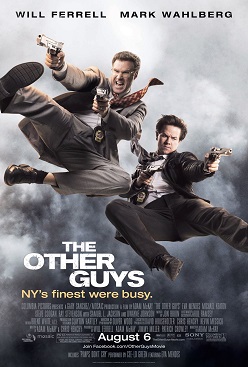
Paragraph Movie Reviews: The Other Guys

If you don't have plans to see this movie, you can check the spoilers here and then come back.

This buddy cop flick send-up had probably some of the flat out funniest dialogue I've heard in a comedy in years, I'm pretty sure in large part because Will Ferrell and Mark Wahlberg seemed to be ad-libbing most of the time. These dudes have more than just good chemistry together and a clear sense of comfort with one another, they provide excellent balance as they're not just two guys doing the same act with one doing it better as seems to be the case too often with Ferrell movies. I enjoyed Ferrell more than I have in awhile here as he seemed to settle into the character and fight the urge to go too over the top. As far as I'm concerned, Wahlberg should do more and more comedic roles because he's so funny without even seeing to try that hard; just that he's self-aware enough to poke fun at his own tough guy image makes me chuckle. Ferrell is actually more of the straight man despite being so quirky here, while Wahlberg just throws wild temper tantrums, and it works. Can I watch Mark Wahlberg make jokes without picturing Andy Samberg? Honestly, no, but that's ok (and his character's understated delusional view of his world is just great). However, great as Ferrell and Wahlberg are together and though I could just watch them play off one another for hours, that's pretty much all The Other Guys is, and aside from two funny guys telling jokes, there's not a lot to hang on as far as emotional heart. That's fine, and if you adjust your expectations I think you'll certainly dig this, but be forewarned. As far as supporting cast, they could really be anybody given how huge the two stars loom, but Eve Mendes and Steve Coogan are still pretty inspired; Michael Keaton is fine, but given how rare a performance by him is these days, I guess I was expecting more. Samuel L. Jackson and Dwayne Johnson are both clearly having a blast sending up their usual action personas and it shines through, but pretty much what you see from them in the trailer is all they're in the move for. One final thought: For a guy who just does Will Ferrell comedies, Adam McKay directs some pretty great action sequences.